By Greg Nowak. Updated 12 October 2026.
If dispatch starts with someone repairing yesterday’s spreadsheet, logistics optimization has a clear starting point. Before buying another platform, find out why orders, stock information, and delivery promises need so much manual attention.
A routing engine can improve a workable plan. It cannot decide what an ambiguous delivery window means or recover a warehouse update that never reached dispatch. For business owners, operations leads, and agencies supporting logistics clients, the first investment should make one recurring decision more reliable. Then you can judge which technology earns its place.
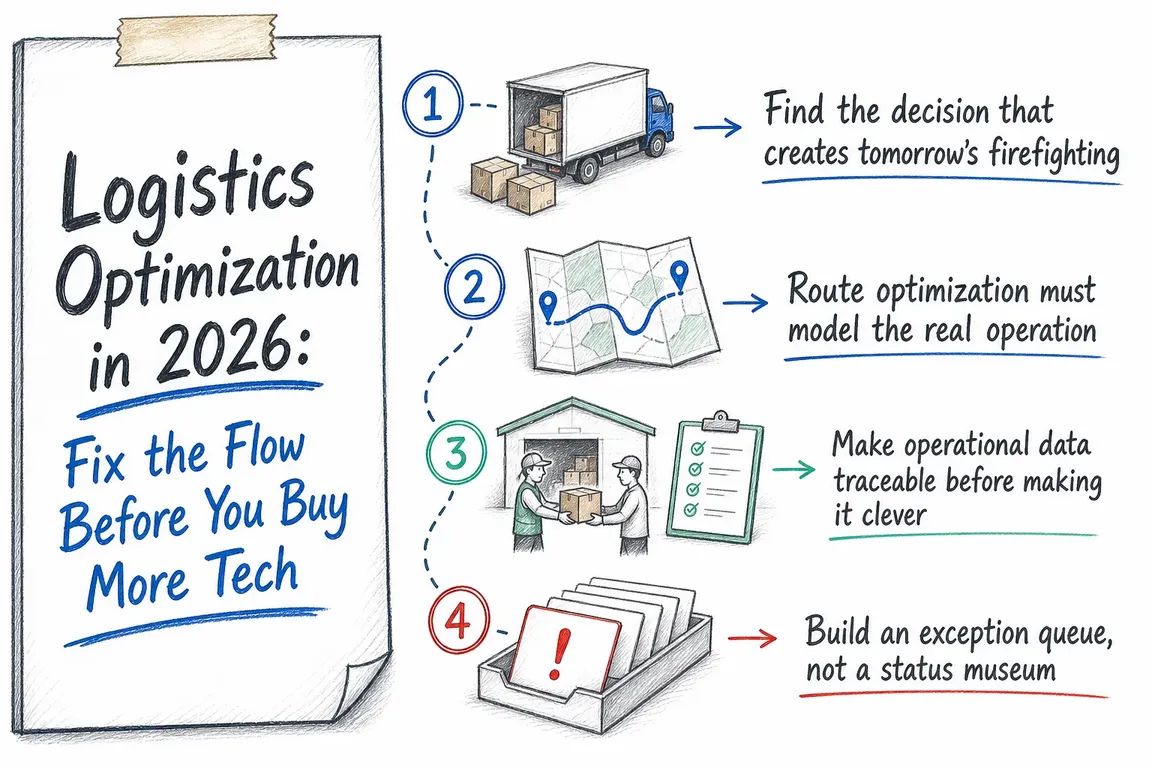
Start with the decision that causes tomorrow’s firefighting
Choose one problem: releasing routes, confirming delivery dates, replenishing stock, or clearing orders for dispatch. Follow several real orders through the process, including a cancellation, a partial shipment, and a failed delivery.
Sit with the people doing the work. Ask what they retype, which export they wait for, and what they check before trusting the system. Include warehouse staff, planners, customer service, finance, and drivers. A spreadsheet may contain a useful business rule that the official workflow overlooks.
Write a short pilot brief: the decision, its owner, the inputs needed before cut-off, the current workaround, and the result you want to improve. “Reduce planning time without increasing late deliveries” gives a project direction. “Optimize the supply chain” leaves too much unresolved.
| Recurring problem | Useful first change | Pilot measure |
|---|---|---|
| Routes need rebuilding after release | Validate delivery windows, service times, and vehicle capacities | Changes after release; late stops |
| Blocked orders reach dispatch too late | Assign exceptions to an owner before cut-off | Orders cleared on time; manual touches |
| Stock figures disagree across systems | Reconcile identifiers and delayed or duplicate updates | Unexplained discrepancies; update delay |
| Forecasts are routinely ignored | Compare forecasts with a simple baseline and record overrides | Forecast error; stockouts; excess stock |
Route optimization needs the rules planners actually use
Shortest distance is only one objective. A usable route also needs realistic service times, weight and volume limits, customer opening hours, driver breaks, loading sequence, vehicle access restrictions, and return collections.
Separate hard constraints from preferences. An access restriction cannot be traded for a shorter journey; a preferred delivery time might allow flexibility. Decide who can approve an exception and how the customer will be informed.
Google’s OR-Tools routing documentation covers capacity, time windows, depot resources, and penalties for dropped visits. It also explains that larger problems may return good solutions without proving mathematical optimality. In procurement, ask vendors to demonstrate feasible plans using your constraints and awkward orders.
Review planner overrides with reason codes. Repeated changes may expose missing rules or poor travel-time estimates. Check service performance alongside distance: fewer kilometres are little comfort if deliveries miss their agreed windows.
Make data traceable across the existing stack
Agree which system owns each field: order status, stock availability, address, delivery promise, and proof of delivery. Preserve links between order, shipment, item, and carrier identifiers so staff can investigate a discrepancy without matching records by hand.
GS1’s EPCIS standard provides a shared model for supply-chain visibility events. You may not need a full implementation, but its approach is useful: record what happened, when, where, and at which business step.
For each integration, check failed messages, delayed updates, retries, and duplicates. Make repeated processing safe so a retry cannot create a second shipment. Keep event time separate from the time an update arrives, and document time zones. These details matter when reconciling warehouse activity with carrier scans.
Validate addresses and required delivery fields at order entry. Give rejected records an owner and a correction path; otherwise validation simply moves the backlog.
Give exceptions a next action
A useful operational dashboard tells someone what to do before a deadline. Each exception should show the affected order, reason, owner, next action, and cut-off, with a link to the record where it can be resolved.
Show when data last refreshed. Distinguish missing information from a confirmed delay. Agree escalation rules for unowned or overdue issues, and check that “resolved” means the underlying record changed. Keep historical management charts available without burying today’s dispatch decisions.
Use AI where you can check the outcome
Start with a reversible task, such as suggesting delay categories or flagging unusual orders. For forecasting, compare against a simple baseline using data available at the prediction date. Record inputs, model version, suggestions, reviewer changes, and eventual outcomes. Acceptance rate alone does not prove better decisions.
The voluntary NIST AI Risk Management Framework is a useful reference for evaluating and managing risk. Assign an owner, define acceptable errors, and keep a fallback process.
For EU operators, classify the specific use. The Commission’s current AI Act guidance lists phased deadlines: AI literacy obligations have applied since February 2025, while certain high-risk rules apply in December 2027 or August 2028. Worker management and transport safety uses warrant particular attention; “logistics AI” alone does not determine the obligations.
Make the pilot earn its next phase
Use representative orders and compare similar workloads. Include busy days and exceptions. Measure one primary outcome, such as planning time or cost per completed delivery, with service and workload checks so improvement in one area does not hide extra work elsewhere.
Run proposed plans alongside the existing process before handing over live decisions. Agree what would justify expansion, revision, or stopping. Include integration maintenance, data correction, licences, and staff training in the investment decision.
Bring one workflow to a practical review
A focused review should leave you with a workflow map, documented rules, identified data gaps, and a pilot brief your team can act on. For agencies, that also creates a clearer implementation scope and acceptance criteria.
If you want help connecting operational knowledge with the systems expected to support it, talk to Greg about a logistics IT review. Bring the workaround your team relies on, a few representative orders, and the decision you want to improve.
Related on GrN.dk
- AI automations need a spend dashboard before the first runaway bill
- AI Search Is Eating the Click: Measure Before You Rewrite
- Before your AI agent starts clicking, write a browser policy
Need help with this kind of work?
Talk to Greg about a logistics IT review Get in touch with Greg.