GrN.dk

Main navigation

  • Articles
  • Contact
  • Your Digital Project Manager
  • About Greg Nowak
  • Services
  • Portfolio
  • Container
    • Excel Freelancer
    • Kubuntu - tips and tricks
    • Linux Apache MySQL and PHP
    • News
    • Image Gallery
User account menu
  • Log in

Breadcrumb

  1. Home

Articles

Unsupported Theme Contracts Made WordPress 6.9.3 a Paid Troubleshooting Story

On March 10, 2026, WordPress shipped 6.9.3 as a fast follow to the 6.9.2 security release after some sites suddenly showed a blank front end. By March 11, 2026, 6.9.4 was already out as another security release. That two-day sequence is a practical business lesson. A routine core update can still turn into urgent, billable troubleshooting when a custom theme has been leaning on behavior WordPress never promised to support.

WordPress Playground Made Faster Reproduction Easier, but Plugin and Hosting Bugs Are Still Paid Troubleshooting

WordPress has taken a noticeable amount of friction out of setup in a very short time. On March 11, 2026, WordPress launched my.WordPress.net as a persistent WordPress environment that runs entirely in the browser. No sign-up, no hosting choice, no domain decision first. The official Playground page now presents WordPress Playground as a place to build, experiment, test, and grow without a host, and the January 15, 2026 update makes it clear the product is no longer being framed as a novelty.

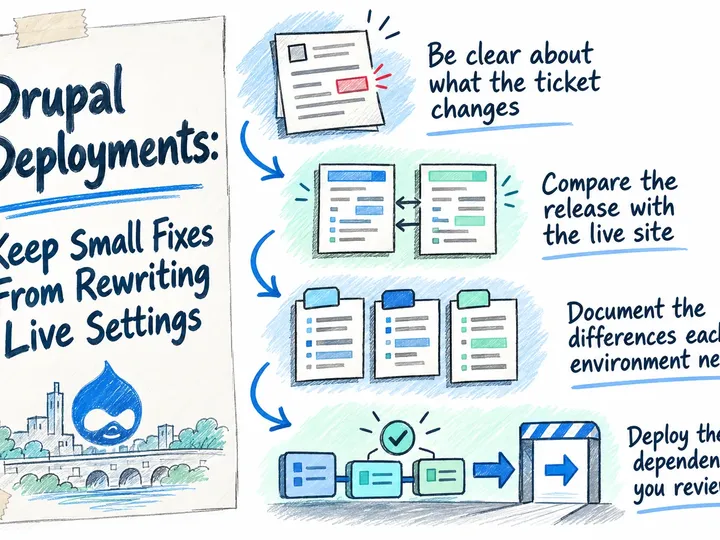
Drupal CMS 2.0 Makes Marketing-Site Rebuilds Faster, but Canvas, Recipes, and Governance Are Still Paid Work

Drupal CMS 2.0, launched on January 28, 2026, is one of the more consequential packaging changes Drupal has made in years for teams rebuilding marketing sites. With Drupal Canvas now the default editor, a Mercury component library, site templates, recipes, and optional AI, the jump from a blank install to a presentable first build is much shorter than it used to be. If the practical test is how quickly editors can see a branded landing page and start working in it, Drupal CMS 2.0 improves that part of the process in a very real way.

Public Staging URLs and Admin Panels Are Still an Ops Leak, and Cloudflare Access Is a Paid Cleanup Job

If a staging site, /wp-admin path, partner portal, or internal dashboard is reachable from the public Internet, the issue usually is not that the URL is obscure. The issue is that temporary access became permanent enough to survive. Review links stay open. Admin panels remain routable. Vendor tools get shared credentials because nobody wants to slow delivery down for a cleanup task. Over time, that turns into an operations leak: a collection of public entry points sitting outside normal onboarding, offboarding, and change control.

WordPress 6.8 Password Hashing Makes Legacy Login Bridges a Paid Troubleshooting Problem

WordPress 6.8 changed a part of the stack most sites never think about until it causes trouble: password hashing and related verification logic. From a security standpoint, this is a sensible upgrade. Core user passwords move from portable phpass hashing to bcrypt, and several other security-sensitive values now use WordPress’s fast-hash path with BLAKE2b via Sodium. The problem is not the change itself. The problem is older custom code that assumed WordPress hash formats were stable enough to inspect, pattern-match, or verify outside the supported APIs.

WooCommerce HPOS Migration Is Now an Ops Project for Stores With Plugin and Reporting Debt

HPOS is easy to underestimate because WooCommerce surfaces it inside settings. For a new store, that is mostly fine: HPOS has been enabled by default for new installations since WooCommerce 8.2, released in October 2023. For an older store, especially one with years of plugin decisions, one-off reporting fixes, and custom operational scripts, that framing breaks down fast.

Bulk Delete Cloudflare DNS Records: Better Than Chrome Browser Console JavaScript

If you searched for a Chrome Browser Console JavaScript trick to bulk delete Cloudflare DNS, you are probably cleaning up a bad import, a rushed migration, or a zone that has drifted for years. The old approach of clicking dashboard buttons from DevTools depended on Cloudflare's front-end markup staying the same. That is not a safe operating model for a live DNS zone in 2026.

Search Console's Hourly Data Made Post-Launch SEO Monitoring an Ops Task

Search Console used to be something teams checked after a launch, once the dust had settled. That approach is harder to justify now. On April 9, 2025, Google added hourly data to the Search Analytics API. Search Console’s 24-hour Performance view already made the last available 24 hours visible with only a short delay. Then, on November 17, 2025, Google added custom annotations to performance charts. Taken together, those changes shift post-launch SEO monitoring much closer to an operational task than a reporting routine.

CodeIgniter Tips and Tricks for Secure Login and Password Resets

CodeIgniter still earns its place in client portals, internal ops tools, and lean SaaS projects because it is fast to ship and straightforward to maintain. The part that usually creates real cost is not controllers or models. It is account management: login, password resets, session handling, rate limits, and the small security details that later become support tickets. If you run a live CodeIgniter application, one of the best upgrades you can make is to make authentication boring, predictable, and easy to own.

Drupal Commerce: Practical Setup and Scoping Guide

Drupal Commerce is still one of the better choices when ecommerce has to live inside a serious content platform. If your team needs rich editorial control, custom catalog structures, B2B rules, multilingual content, or tight integrations with ERP, PIM, CRM, or fulfillment systems, Drupal Commerce deserves a close look. If you just need a very standard storefront with minimal customization, there are faster paths.

WP-CLI Tips and Tricks for Faster WordPress Operations

WP-CLI is one of the few WordPress tools that genuinely saves operations time. If you manage launches, staging copies, handovers, or emergency fixes, it lets you make repeatable changes without clicking through wp-admin. That matters to business owners because repeatable work is cheaper, faster to review, and much less dependent on one person remembering the right screen.

WordPress Autoloaded Options Are Still a Paid Performance Fix, Not Just a Site Health Warning

WordPress has made autoloaded options easier to notice. It has not made them self-fixing. Core still loads autoloaded options into the normal request path, and wp_load_alloptions() caches that set so it can be reused. When the autoload set is bloated, that overhead becomes part of everyday page handling. The Site Health warning matters because it surfaces that cost. It does not tell you whether the real problem is a stale plugin row, an oversized settings array, a poor save routine, a legacy autoload flag, or a cache setup that is hiding part of the symptom.

PHP Test If Front Page: Safer Homepage Detection

When a PHP site needs a different hero, template partial, tracking tag, or call to action on the homepage, developers often reach for a one-line check. The original version of this article did exactly that. The problem is that production sites are rarely that tidy. Campaign URLs add parameters, some sites live in a subfolder, and many teams inherit routing decisions they did not make. A small condition can turn into a source of layout bugs if it is too literal.

Scraping Tools and Browser Automation for Modern Teams

Most scraping projects do not fail because the parser is wrong. They fail because the team chose a full browser when a simple request would do, or because the automation has no plan for login state, downloads, consent banners, and UI changes. That is the main reason old PhantomJS-era notes feel thin today: modern sites are more dynamic, and the maintenance cost matters as much as the first successful run.

PHP Only on the Front Page

Sometimes you really do want a piece of PHP to run only on the homepage. That might be a launch banner, a homepage-only lead capture block, a pricing teaser, or a temporary campaign message that should not appear on service pages. The original one-line snippet captures the idea, but it is too brittle for a live site that may have tracking parameters, URL rewriting, a CMS, or multiple environments.

WordPress Security Releases Still Need an Ops Runbook

When WordPress 6.9.2 was released on March 10, 2026, WordPress classified it as a security release and advised site owners to update immediately. For sites with automatic background updates enabled, WordPress also noted that the rollout would start automatically. That sounds straightforward until you look at it from an operations perspective. Security updates are urgent, but the way they land on a live business site still needs control.

MySQL 8 Support for Drupal 7: Fixing the NO_AUTO_CREATE_USER Error

If your Drupal 7 site throws SQLSTATE[42000] errors about NO_AUTO_CREATE_USER after a MySQL upgrade, you are dealing with a known compatibility problem, not a mysterious one-off. The original patch thread that circulated in 2020 was useful at the time, but it is no longer the best default advice. Drupal 7 gained official MySQL 8 support in core in 7.76, followed by a hotfix in 7.77.

Sending Mail From a Linux Server with Postfix

Linux can send mail easily. Getting that mail accepted and trusted is the harder part. If you only need password resets, form notifications, cron alerts, or system messages, the goal is usually not to build a full mail platform. The goal is to send small volumes reliably, with clear DNS, sane Postfix settings, and a delivery path that modern providers will accept. The examples below assume Ubuntu or Debian, Postfix, and GNU Mailutils.

Check Defined Constants in PHP: Practical Code Snippet

If you are troubleshooting a WordPress or PHP application, checking whether a constant is defined is often faster than digging through plugin settings, deploy notes, or a control panel. This matters when a site behaves differently between staging and production, when a security plugin toggles a flag such as DISALLOW_FILE_EDIT, or when an agency team inherits a server with unclear configuration.

WordPress 7.0 Collaboration Readiness: Why Legacy Meta Boxes and Hosting Assumptions Can Stall Your Upgrade

WordPress 7.0 was originally due on April 9, 2026. It is now scheduled for May 20, 2026. The useful part is not the date change itself. It is why the schedule moved. Core contributors paused the release because the Real-Time Collaboration architecture still needed work, then added an April 24 host-testing checkpoint and a May 8 release candidate that should be treated more like a fresh beta. For agencies and site owners, that is not routine release noise.

Pagination

  • Page 1
  • Page 2
  • Page 3
  • Page 4
  • Page 5
  • Page 6
  • Page 7
  • Page 8
  • Page 9
  • …
  • Next page
  • Last page

Review Greg on Google

Greg Nowak Google Reviews


  • Unsupported Theme Contracts Made WordPress 6.9.3 a Paid Troubleshooting Story
  • WordPress Playground Made Faster Reproduction Easier, but Plugin and Hosting Bugs Are Still Paid Troubleshooting
  • Drupal CMS 2.0 Makes Marketing-Site Rebuilds Faster, but Canvas, Recipes, and Governance Are Still Paid Work
  • Public Staging URLs and Admin Panels Are Still an Ops Leak, and Cloudflare Access Is a Paid Cleanup Job
  • WordPress 6.8 Password Hashing Makes Legacy Login Bridges a Paid Troubleshooting Problem
RSS feed

GrN.dk web platforms, web optimization, data analysis, data handling and logistics.