By Greg Nowak. Updated 2 September 2026.
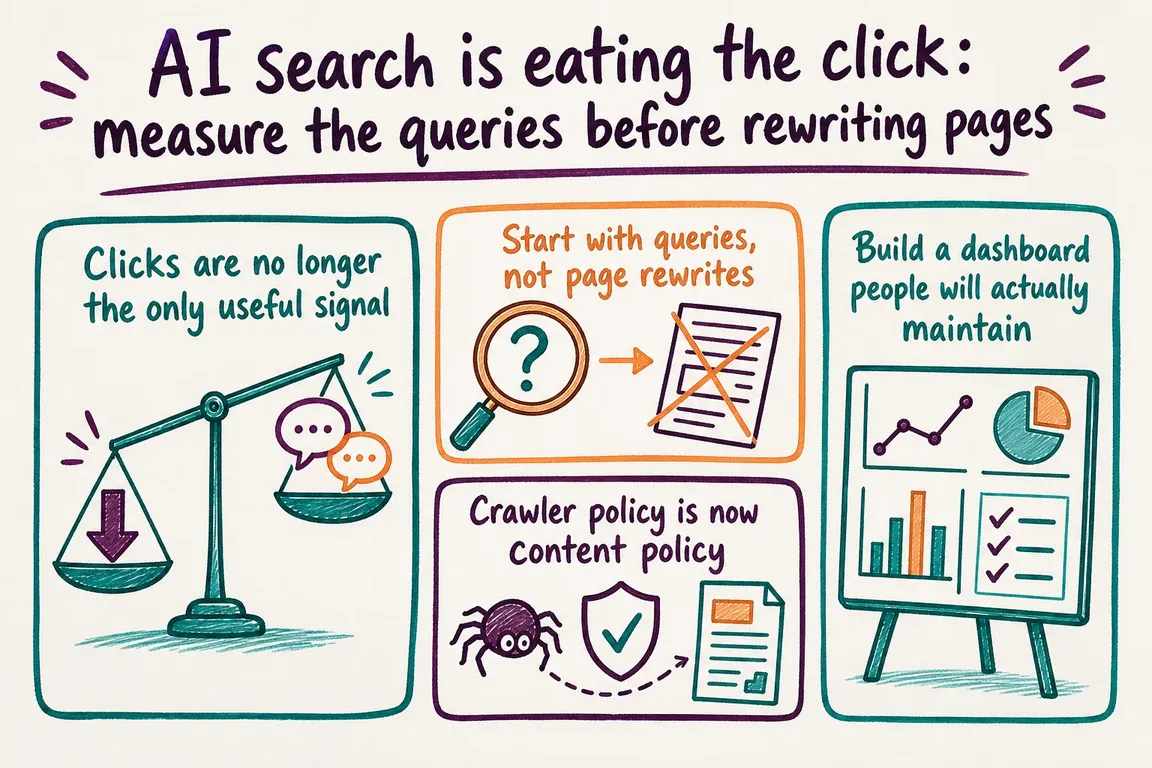
AI search has weakened a familiar bargain: publish useful pages, earn visibility, and receive visits in return. An answer engine can now use the page while satisfying the searcher before the click happens.
The effect is real, but “rewrite everything for AI” is not a sensible business response. Some pages need stronger original material. Others need a better conversion path, more accurate product information, or different crawler rules. A support article may create value even when nobody visits it; a comparison page funded by leads probably does not.
Start by measuring which queries and pages matter. Then decide what deserves editorial, technical, or policy work.
The click risk is real—but it is not uniform
Pew Research Center studied 68,879 Google searches made by 900 US adults in March 2025. When an AI summary appeared, users clicked a traditional result in 8% of visits, compared with 15% when no summary appeared. Links inside the summary received a click in only 1% of visits.
Exposure also varied by query. AI summaries appeared for 53% of searches containing ten or more words and 60% of searches beginning with question words. That makes detailed research, comparison, and problem-solving queries an obvious place to investigate.
Those figures are a useful warning, not a forecast for every website. Your commercial pages, geography, audience, and search mix may behave differently. The job is to locate your own exposure rather than apply an industry average to every URL.
What Google now shows—and what it still does not
Google rolled its Generative AI performance report out worldwide on 31 August 2026. It reports impressions from AI Overviews and AI Mode and breaks them down by page, country, device, and date. This is a substantial improvement: teams can finally identify the URLs receiving AI-search visibility directly in Search Console.
There is an important limitation. The report currently provides impressions, but no query dimension or dedicated click metric. You therefore cannot directly read “this query produced this AI impression and this visit” from the report.
Build a working approximation by combining three evidence sets:
- Standard Search Console data: queries, landing pages, clicks, impressions, position, and click-through rate.
- The Generative AI report: AI impressions by canonical page, date, country, and device.
- Business and infrastructure data: conversions or assisted outcomes by landing page, plus crawler activity from CDN or server logs.
Join the datasets at page and time-period level. It will not manufacture query-level AI attribution, but it will show which query clusters lead to AI-visible pages and whether clicks or business outcomes changed as that visibility moved.
A practical measurement workflow
- Choose the pages where a click matters. Begin with service, category, comparison, pricing, research, and high-volume support pages. Do not start with the whole site.
- Export a stable baseline. Use at least several weeks of standard Search Console data and retain the raw export. Group close variants instead of treating every phrase as a separate editorial request.
- Tag query intent. Useful groups include brand, commercial comparison, problem-solving, product detail, support, and navigational intent. Also flag question-led and longer searches as investigation candidates—not as proof that an AI result appeared.
- Add AI visibility by page. Export the Generative AI report on a regular schedule. Compare page cohorts rather than isolated daily movements.
- Add the business outcome. Record leads, sales, sign-ups, assisted conversions, support deflection, or another outcome appropriate to each page group.
- Review actual results. Manually sample important queries in the relevant markets and devices. Record whether an AI response appears, which sources it cites, and whether your information is represented accurately.
| Evidence | Likely interpretation | First action |
|---|---|---|
| AI impressions rise; conversions remain healthy | The page may be earning useful visibility | Maintain accuracy and monitor; avoid a reflex rewrite |
| Clicks and qualified conversions fall on a commercial cohort | The lost visit has business cost | Improve distinctive evidence, offer clarity, and the next step |
| AI visibility is high but the page is cited inaccurately | Important facts may be unclear, stale, or hard to retrieve | Correct visible content, headings, canonical signals, and structured data |
| Bot requests are high but human or business value is low | Access may not match the content policy | Review crawler purpose, permissions, and enforcement |
| A support cohort loses clicks while tickets also fall | The answer may still be doing useful work | Validate the relationship before trying to recover traffic |
Rewrite for substance, not an “AEO” template
Google’s current guidance says its established SEO practices remain relevant to generative search. It does not require special AI markup or an llms.txt file, and it explicitly discourages mechanical tactics such as unnecessary content chunking.
That does not mean pages should remain untouched. Rewrite when the evidence exposes a real weakness. Put the direct answer where a person can find it. Add first-hand expertise, transparent comparisons, clear definitions, current specifications, limitations, and a credible next step. Make structured data agree with the visible page. These changes help readers and reduce ambiguity; they are not magic instructions for an answer engine.
For commercial pages, ask a harder question: what can the visitor do here that an AI summary cannot do? That may be requesting a scoped assessment, checking availability, using a calculator, examining original research, or discussing a case with someone who understands the constraints.
Keep crawler policy separate from search optimisation
A crawler request, an AI-search impression, and a human visit are different events. Do not combine them into one “AI traffic” number.
For Google Search, Googlebot access and preview controls such as nosnippet, data-nosnippet, max-snippet, and noindex affect eligibility or presentation. Blocking Google-Extended is not a switch for removing a page from Google’s AI search features.
Cloudflare’s AI Crawl Control can show crawler activity, apply crawler-specific allow or block rules, and monitor robots.txt compliance. Its documentation also makes the boundary clear: robots.txt expresses a preference; it does not technically enforce one. If blocking matters, pair the declared policy with an enforcement control and test that legitimate search access still works.
Make this a monthly operating decision
A useful dashboard does not need dozens of charts. Track AI impressions by page cohort, normal-search clicks and click-through rate by query group, valuable outcomes by landing page, crawler requests by declared purpose, and policy violations. Give each cohort an owner and record the decision: monitor, rewrite, improve conversion, correct facts, or change access.
If your team has Search Console exports, analytics, Cloudflare data, server logs, and CMS owners but no shared view, Greg can turn them into a manageable audit and review rhythm. Talk to Greg about where AI search is creating value—and where it is quietly removing it.
Related on GrN.dk
- Google’s AI Search Toggle Is a Publishing Decision, Not an SEO Setting
- ChatGPT Visibility Without Opening Every Door: robots.txt Is Only the Start
- Cloudflare’s September Bot Defaults Could Quietly Cut AI Visibility
Need help with this kind of work?
Discuss an AI-search audit with Greg Get in touch with Greg.