AI Research Assistants Need a Source Trail, Not Just Citations
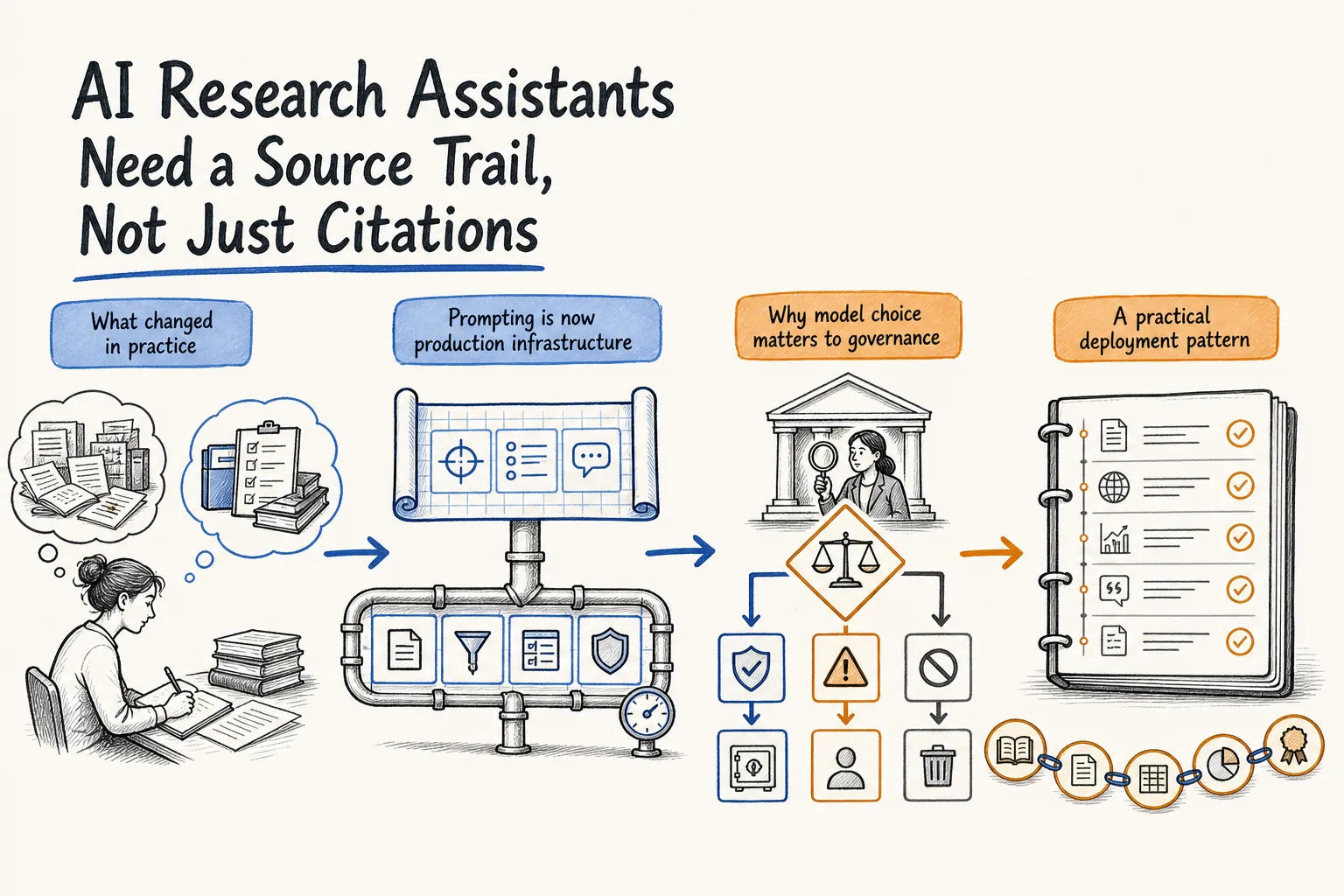
AI research assistants were easy to pitch when the story was speed. Ask for a competitor scan, a content outline, or a market brief, and get something usable back in minutes. The problem showed up just as quickly. If the model handed you a polished answer without an inspectable evidence trail, your team still had the same decision to make: trust it, re-check it, or avoid using it for anything important.
OpenAI’s current documentation changes that calculation. When web-grounded answers can include inline citations and a full list of consulted URLs, the conversation stops being only about prompt quality. It becomes an operational question about source governance.
That matters in practice. The model is still retrieving, synthesizing, and drafting, but the business risk moves somewhere more concrete: which sources was it allowed to use, which ones did it actually use, how visible should those citations be, and what review happens before an answer becomes published content or a client-facing recommendation?
What changed in practice
The web search guide introduces two controls that are more useful than they first sound. Responses that use web search can include inline citations, and the sources field can return the full list of URLs consulted during the search. OpenAI draws a clear distinction between the two. Inline citations show the most relevant references. web_search_call.action.sources can expose the broader evidence trail behind the answer.
For teams doing real commercial work, that distinction matters. A few visible citations may be enough for a reader. They are usually not enough for an editor, strategist, or account lead who needs to understand what the model actually relied on before a brief gets used.
The same guide also documents domain-level filtering through allowed_domains and blocked_domains. That turns source policy into configuration instead of wishful prompting. If a workflow should stay within official documentation, approved publishers, client-provided domains, or a vetted research list, that can be enforced directly. If there are domains your team does not want appearing in a commercial deliverable, those can be excluded at the tool layer too.
That is the real shift. Sourced AI research is no longer just a matter of asking the model to be careful. It is becoming an implementation problem with rules, boundaries, and review points.
The citation formatting guide pushes the same idea further. Its recommended workflow starts by defining what the model is allowed to cite, representing source material clearly, specifying the citation format, telling the model when citations are required, and parsing those citations downstream. It also recommends block-level citations as a strong default in many cases because they strike a practical balance between precision and simplicity.
That is a useful way to think about it. Citation quality is not something you add at the end to make an answer look more trustworthy. It is part of the system design. You decide how evidence enters the workflow and how reviewers will inspect it later.
The same guide also separates two operating modes. If you use OpenAI-hosted tools such as web search, automatic inline citations are available. If you provide your own source material, you need to define the citable units and the citation syntax yourself. For agencies and operations teams, that distinction is important. Public web research and internal source material should not be handled identically, but they still need to fit within one coherent governance model.
Prompting is now production infrastructure
The prompt engineering guide makes a point many teams still treat too casually: production prompts should live in application code, close to the feature they support, with typed inputs, tests, and evaluation checks. That is not just an implementation preference. It is how a prompt stops being a fragile instruction block and starts acting like a controlled business process.
If your research assistant is producing SEO briefs, sales prep, or market summaries, the source-handling rules should be versioned, reviewed, and deployed the same way other important application logic is. Otherwise, the workflow may look stable while its evidence standards drift quietly over time.
The guide is also clear about the role of the developer message. That is where the application’s rules and business logic should sit ahead of the user message. In this case, that means source restrictions, citation requirements, output structure, escalation rules, and review flags belong there. The guide’s structure of identity, instructions, examples, and context is useful because it gives teams a clean way to define what the assistant is for, what it must not do, and which material it may rely on.
Just as important, OpenAI notes that added context can be used to constrain the model to a specific set of resources. That is the heart of governed research. You are not only asking for a better answer. You are shaping the evidence base the answer is allowed to come from.
The recommendation to use representative fixtures, tests, and evaluation checks before changing production prompts matters here too. It gives teams a practical way to verify that sourcing policy still holds after revisions instead of assuming nothing broke.
For longer-running agentic workflows, the same guidance becomes even more relevant. OpenAI recommends planning tasks thoroughly, using preambles for major tool decisions, and tracking workflow progress with a TODO mechanism. That fits research pipelines well. If an assistant needs to search, filter, summarize, draft, and hand off, a traceable sequence is far more useful than a single polished paragraph with no visible working.
Why model choice matters to governance
The reasoning best practices guide adds another layer: workflow design. OpenAI describes reasoning models as planners and GPT models as workhorses, and says many AI systems will use both. For research assistants, that is a practical pattern. A reasoning model can break down the question, decide what evidence is needed, and handle ambiguity. A GPT model can then execute the drafting steps quickly and consistently.
That matters because source governance is rarely a one-step task. Someone, or something, has to decide whether a query is broad or narrow, whether the domain list should be strict or open, whether conflicting evidence needs to be surfaced, and whether the result is ready for publication or should go to review first.
The same guide also recommends keeping prompts simple and direct, using delimiters for clarity, and applying explicit constraints when you need tighter control. That is a useful reminder. Governance instructions should be deliberate, but they do not need to become bloated or theatrical to work.
A practical deployment pattern
If you are implementing this seriously, the deployment pattern is fairly straightforward:
- Define approved source boundaries for each workflow, including allowlists and blocklists where needed.
- Use web search when live research is required, and capture both the answer and the full
sourcesoutput. - Require inline citations or custom citation markers depending on whether the assistant is using hosted tools or injected material.
- Version prompt rules in code, with fixtures and evaluation checks before rollout.
- Route outputs into draft or review queues instead of treating a cited answer as automatically publishable.
What this pattern does not assume is just as important. Citations on their own do not make an answer safe. A fast summary is not the same thing as a reviewed brief. And not every workflow needs the same source policy. A sales-research assistant, an SEO content assistant, and an internal strategy assistant may all use similar models, but they should not share source boundaries, citation granularity, or approval thresholds by default.
That is why the term source governance is useful. The documentation now supports a credible implementation path: source restrictions at the tool layer, citation behavior at the output layer, prompt rules in code, and model orchestration for multi-step work. From there, an agency or operations team can add the business controls the docs do not define for them, such as human review, queueing, approval states, or CMS handoff rules.
That is where GrN fits. Greg can help build research assistants that restrict sources, format citations, preserve usable audit trails, and route outputs into drafting or review workflows. The result is not just faster research. It is a process sales, SEO, and content teams can inspect before they use it commercially.
Need help with this kind of work?
Plan a governed AI research workflow Get in touch with Greg.