By Greg Nowak. Last updated 2026-08-19.
Google’s new generative AI control sits in Search Console, but it is not a routine technical SEO setting. The choice affects whether a site’s links and content can appear in, and help ground, AI Overviews, AI Mode and generative AI features in Discover.
Opting out has a clear cost. According to Google’s operational documentation, an excluded site cannot be linked from these features or contribute content used to generate responses and previews. It will also receive no traffic or impressions from them.
That makes this a publishing decision about distribution, attribution, audience development and permitted content use. The useful question is not simply whether to switch the setting on or off. It is what role generative search should play in the organisation’s publishing model, and what evidence would justify changing that position later.
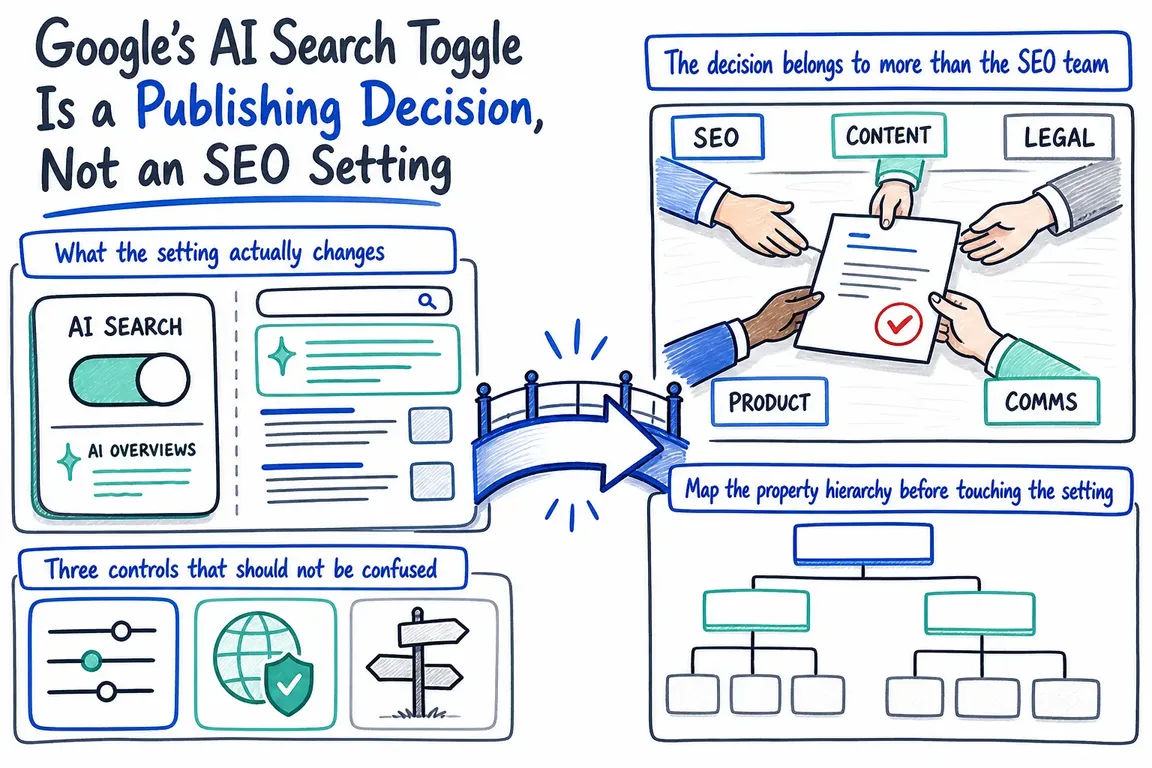
What the setting actually changes
Inclusion is the default. An included site remains eligible to appear as links and help ground generative responses, opening the possibility of impressions and visits. Exclusion removes those opportunities from the affected Google surfaces.
Google says the setting is not a ranking or inclusion signal elsewhere in Search. A site can therefore decline participation in these generative features while remaining eligible for conventional search results. The setting also leaves separate choices involving services such as Google Ads and Merchant Center untouched.
Those distinctions are easy to lose in an internal discussion about “opting out of AI.” Exclusion is not a softer version of blocking Google Search altogether. Nor does inclusion guarantee a citation, prominent placement or a visit. It provides eligibility, nothing more.
The control is currently being tested with a subset of website owners. Google’s announcement says the initial rollout is taking place in the UK before wider availability. Search Console is also beginning to report generative AI impressions, appearing pages and countries, with more metrics expected over time.
The decision belongs to more than the SEO team
Different businesses make different trades between content and reach. A manufacturer may welcome qualified product discovery. A specialist publisher may care more about how its reporting contributes to a generated answer. A subscription business needs to know whether citations bring in potential customers or let readers get what they need without visiting.
The UK Competition and Markets Authority approaches the issue through publisher choice, bargaining power, attribution and transparency. Its conduct requirement for Google Search calls for effective ways for publishers to prevent their content from powering AI search features, together with clear links attributing publisher content in generated results. The regulator says it will monitor both implementation and the effects on businesses.
So the decision should not fall to whoever happens to administer Search Console. Editorial, marketing, commercial, legal and technical teams may each hold a relevant piece of the answer. Someone needs to turn those views into one recorded policy, rather than leaving a property owner to make the call in isolation.
| Business question | Reasons to include | Reasons to exclude or set tighter boundaries |
|---|---|---|
| Does it help audience acquisition? | AI visibility produces relevant impressions, citations or visits. | Participation produces little measurable audience value. |
| Do those visitors matter commercially? | Visitors complete valuable journeys after discovery. | Visibility leads to little meaningful downstream action. |
| How does the content create value? | Broad distribution supports its commercial purpose. | Scarcity, licensing or direct consumption is central to its value. |
| Can one rule cover the whole site? | The same policy makes sense across the domain. | Editorial, support, product or premium areas need different treatment. |
| Can the result be measured? | A baseline and review process are already available. | The organisation cannot yet assess the consequences reliably. |
Three controls that should not be confused
The Search generative AI setting covers appearance and grounding in specified generative features within Google Search. Google-Extended covers something else: whether content may help train future Gemini models and be used for grounding in Gemini Apps and Vertex AI services.
Google’s information-ecosystem policy statement describes the two mechanisms as complementary. The Search-specific control does not act as a ranking signal in non-generative parts of Search, while Google-Extended applies to uses outside the Search toggle’s scope.
A noindex directive has a third purpose. Google’s Search Console documentation identifies it as the mechanism for keeping content out of Google Search completely.
Lumping all three mechanisms together under a label such as “AI opt-out” is asking for configuration mistakes and false internal assurances. The policy should name the system, the affected surface and the intended result for every directive.
Map the property hierarchy before touching the setting
Search Console’s property structure makes implementation more involved than a single domain-wide choice. A property can inherit the setting from its closest manually configured parent, while a child property can override the inherited choice.
That makes different policies possible for different parts of a content estate, provided the right domain, subdomain or URL-prefix properties have been created and verified. Start by mapping the estate to the Search Console hierarchy. Identify the properties covering the corporate site, editorial publishing, documentation, product support and any other area with a materially different role.
For each property, record whether it inherits the parent setting or overrides it. Otherwise, a change at the top-level domain may affect more content than the decision-makers intended. An old child-property override can create the opposite problem, leaving part of the estate on a policy nobody realised was still active.
Allow for propagation time as well. Google says exclusion generally takes a few days. Once the control is live, content is expected to be removed within one or two days, although caching and propagation may make some removals take longer. The change plan should account for that delay so the first verification check does not produce a premature conclusion.
Measure the starting point
Before choosing a position, record what is happening now: current generative visibility, the pages involved, the countries where they appear, resulting visits where those can be measured and the quality of the journeys that follow. Impressions alone are not a business outcome.
It is also worth looking beyond one search provider. Bing’s AI Performance reporting includes total citations, average cited pages, sampled grounding queries, page-level citation activity and trends over time across supported Microsoft AI experiences. Bing cautions that citation counts do not show ranking, authority, placement or a page’s role in an individual answer.
The same restraint should be applied to Google’s reporting. Visibility data proves exposure, not commercial impact.
A useful baseline answers four questions: which content is appearing, which subjects trigger it, how that visibility changes and whether the audience contributes value. If the data cannot answer the last question, record the limitation plainly. Do not fill it with an assumption.
Make it an operating policy, not a screenshot
The finished deliverable should outlast the person who changed the toggle. For each relevant property, document the chosen state, the commercial rationale, the approving owner, inherited-setting dependencies, the baseline date and the next review date. Maintain a change log so later performance movements can be read against known configuration changes.
Monitoring should cover visibility, cited or appearing pages, available traffic data, conversion quality and unexpected shifts in property inheritance. Scheduled reviews matter because Google says the list of covered generative features may change and additional reporting metrics are coming. A decision made during an early rollout, with limited data, should not become permanent by neglect.
This is practical work for a freelance digital project manager. Greg can coordinate the property audit, keep the different controls straight, bring commercial and publishing priorities into the same discussion, and leave the organisation with a documented decision and review process. Changing the toggle takes seconds. Reaching a position the business can explain and revisit takes rather more care.
Related on GrN.dk
- OpenAI File Search: Internal Docs Need Governance Before Trust
- SEO Trends for 2026: What Actually Changed Since 2024
- AI crawler policy now has verbs: separate search, RAG, and training
Need help with this kind of work?
Plan your AI search policy Get in touch with Greg.