GrN.dk

Main navigation

  • Articles
  • Cases
  • Contact
  • Your Digital Project Manager
  • About Greg Nowak
  • Services
  • Portfolio
  • Container
    • Excel Freelancer
    • Kubuntu - tips and tricks
    • Linux Apache MySQL and PHP
    • News
    • Image Gallery
User account menu
  • Log in

Breadcrumb

  1. Home

AI shopping visibility now depends on boring product-data plumbing

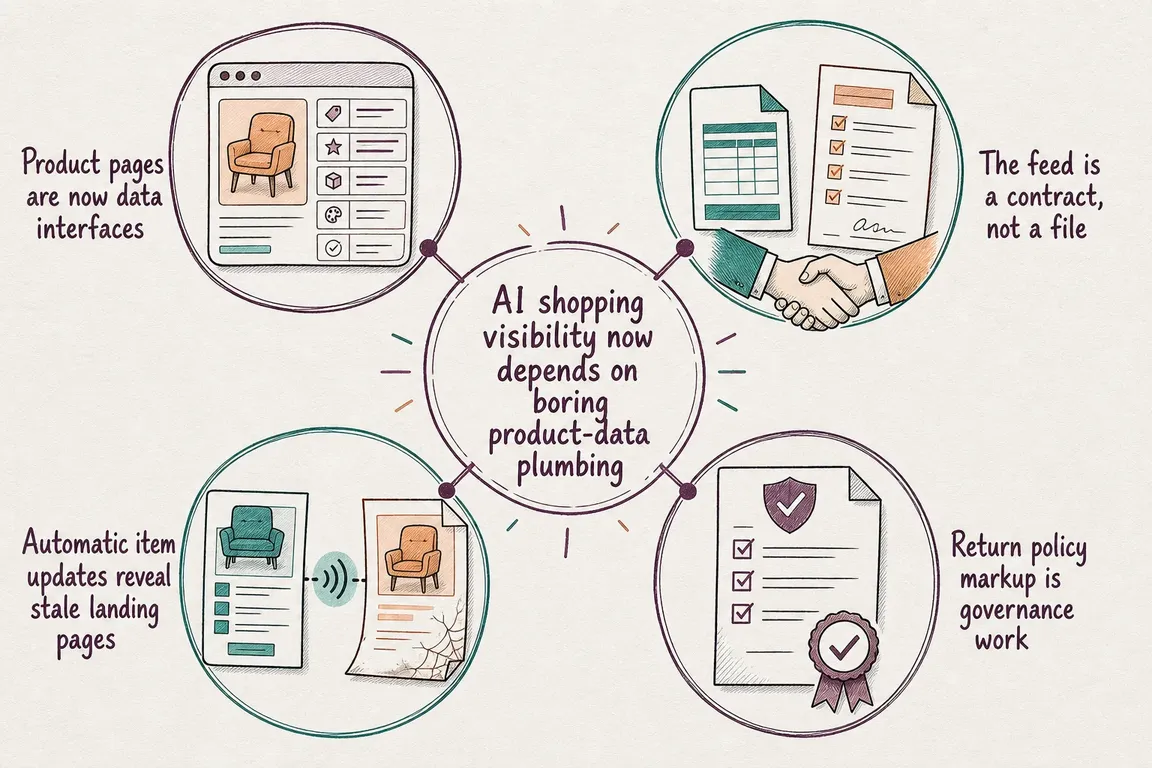
Illustrated infographic summarizing: AI shopping visibility now depends on boring product-data plumbing

By Greg Nowak. Last updated 2026-07-07.

Product visibility used to look like a mostly front-end job. Improve the copy. Tighten the category pages. Add reviews. Tune the ads. Make the search result more appealing.

That work still matters, but it is no longer enough. For ecommerce teams, a lot of the commercial risk now sits underneath the page: identifiers, feed attributes, structured data, crawlable product content, return policies, prices, availability, and the checks that keep those things saying the same thing.

This is not glamorous work. It is plumbing. But Google’s product structured-data guidance, Merchant Center product data specification, automatic item update behavior, and return-policy markup guidance all point in the same direction. Shopping visibility depends on whether machines can understand what is being sold, whether it can be bought, what it costs, and what happens after purchase.

AI-assisted discovery raises the stakes. OpenAI’s ChatGPT search announcement describes search that combines conversational answers with web results and source links. In that kind of experience, ecommerce data quality becomes part of commercial discoverability. Bad product data is not just a rich-result issue or a Merchant Center warning. It can become a source-quality problem for any system trying to interpret the store.

Product pages are now data interfaces

A product detail page still has to persuade a human buyer. It also has to act as a data interface for crawlers, merchant systems, search features, and answer engines.

Google’s product structured-data documentation describes markup for details such as product name, images, description, offers, price, availability, reviews, ratings, shipping, and related merchant information. Schema.org’s Product vocabulary provides the broader shared language behind many of those properties.

The practical point is straightforward: the visible product page, the structured markup, and the merchant feed cannot be treated as separate versions of reality. If the page says one thing, the schema says another, and the feed says a third, the business has created a trust problem for systems that need to decide what to display.

Those mismatches are easy to create. A CMS template outputs stale schema. A feed exporter maps a sale price incorrectly. A PIM holds one version of availability while the ecommerce platform renders another. A CDN keeps an old landing page alive after the feed has changed. A developer updates the product component but not the JSON-LD template. Each issue can look small on its own. Together, they weaken the machine-readable truth of the catalog.

The feed is a contract, not a file

Google Merchant Center’s product data specification is best read as an operational contract. It sets out the attributes merchants need to provide for shopping listings, including identifiers, titles, descriptions, links, image links, price, availability, condition, brand, GTIN or MPN where applicable, shipping-related data, tax information where relevant, and other category-specific attributes.

That contract does not belong to one team. Marketing cares about titles and descriptions. Ecommerce operations owns inventory and availability. Finance or trading teams often own pricing and promotions. Developers own templates, feed exports, validation logic, and deployments. Legal or customer service may own returns information. SEO may be the team that notices the warnings, but SEO cannot sustainably govern the whole system alone.

This is where many ecommerce setups stay too fragile. A feed gets created, connected to Merchant Center, and revisited only when something breaks. A stronger setup treats the feed like a production integration. It has owners, validation, monitoring, release checks, and a clear process for product model changes.

Area Typical failure Business risk Practical control
Product identifiers Missing or inconsistent GTIN, MPN, brand, or internal IDs Products become harder to classify, match, or compare Set required identifier rules by category before products go live
Price Feed price, schema price, and landing-page price disagree Merchant disapprovals, weaker trust signals, or corrected listings Use one source of truth and test page, markup, and feed together
Availability Inventory changes faster than cached pages or feed exports Shoppers see products that are not actually purchasable Match cache rules and feed cadence to stock volatility
Return policy Policy appears in page copy but not in structured data Search systems cannot reliably extract merchant policy details Add return-policy structured data and assign policy ownership
Template changes Frontend updates remove or damage product markup Rich product eligibility and data consistency degrade quietly Add structured-data validation to release checks
A compact governance matrix for ecommerce teams preparing product data for AI-assisted discovery.

Automatic item updates reveal stale landing pages

Google’s automatic item updates guidance is a useful reminder that landing-page data and feed data are connected. In supported cases, Google can use information found on product landing pages to update certain item attributes when there is a mismatch, including price and availability.

That safety net is useful, but it is not a data strategy. If Google has to reconcile mismatches, the store has already lost some control over its commercial truth.

The cause might be a delayed feed export, cached product pages, JavaScript-rendered content that does not align with markup, or a promotion engine that changes visible prices without updating structured data. The right operational question is not whether Google can correct the listing. It is why the store is publishing conflicting data in the first place.

This is where technical SEO overlaps with engineering discipline. Product data should be tested across the rendered landing page, the structured-data output, and the feed payload. The same checks should cover normal prices, sale prices, out-of-stock states, variant pages, canonical product URLs, and discontinued products. Without those checks, teams often find the issue only after visibility or listing performance has already been affected.

Return policy markup is governance work

Return information is often treated as a static customer-service page. Google’s return-policy structured-data documentation makes it more concrete: merchants can provide structured information about return policies so search systems can understand the merchant’s return terms.

For an ecommerce team, that creates an ownership question. Someone needs to own the policy language. Someone needs to own where it appears on the site. Someone needs to own the structured implementation. If the policy changes for a seasonal campaign or for a particular country, the templates and markup need to change with it.

This is not schema for schema’s sake. It is ambiguity reduction. Clear, consistent policy data helps systems interpret the buying context around a product. In a shopping experience where answers may summarize options before the user clicks, ambiguity is expensive.

Schema only works when it matches the business system

Schema.org’s Product vocabulary is broad by design. It can describe products, offers, aggregate ratings, brands, images, identifiers, and related commercial details. Google’s product structured-data guidance then narrows that vocabulary into requirements and recommendations for search features.

The common mistake is treating schema as a template snippet. A resilient implementation starts further upstream.

Which database field is the product name? Where does the public description come from? Which service calculates price? How are variants represented? Which field controls availability? Which image is the canonical product image? Which system owns reviews? Which country-specific rules affect shipping or returns?

Those questions need answers before the markup can honestly be called finished. Otherwise, structured data becomes decorative: present in the HTML, but disconnected from the system that runs the store.

AI discovery makes ambiguity more expensive

OpenAI’s ChatGPT search announcement is not a product-data specification, and it should not be treated as one. Its relevance is broader. Search experiences are moving toward answers that combine natural-language interaction with web information and links.

For ecommerce, that means product pages may be interpreted in more contexts than classic search results or shopping ad placements. It does not mean every store needs a speculative AI SEO playbook. It means the existing foundations matter more.

If answer-style systems depend on accessible, understandable source information, then clean catalog data, consistent markup, and crawlable landing pages become commercial infrastructure. Machines should not have to guess the basics: what the product is, who makes it, what it costs, whether it is in stock, which variant is being shown, which image represents it, what the return terms are, where the canonical page lives, and whether the data is current.

What a serious audit should inspect

A useful audit traces the full route from product data creation to public discovery. It starts with the ecommerce platform, CMS, PIM, ERP, or feed management tool that stores the catalog. From there, it checks feed exports, Merchant Center requirements, rendered product pages, structured data, CDN and cache behavior, JavaScript rendering, validation tooling, and monitoring.

The best findings are usually concrete systems issues, not vague SEO advice. The sale price is calculated in one system but marked up from another. Availability updates every few minutes, while the page cache lasts for hours. Return-policy copy is maintained by customer support, but schema is hard-coded by developers. New product categories launch without identifier rules. Schema validation is manual, so it gets skipped before releases.

Those problems are fixable. They need clear field mapping, better release checks, automated validation where practical, and named owners for the data that affects commercial visibility.

The commercial case for boring plumbing

Product-data cleanup rarely looks exciting on a roadmap. It competes with campaigns, redesigns, personalization, and new features. Still, the business case is strong: it narrows the gap between what the company believes it is selling and what discovery systems can confidently understand.

That gap matters in Google Search, Merchant Center, and AI-assisted discovery experiences. The teams that handle it well will not be the ones with the biggest AI narrative. They will be the ones whose catalog, feed, markup, landing pages, and policies tell the same story every time they are crawled, parsed, rendered, or exported.

For ecommerce leaders, the sensible next step is a product-data plumbing review. Map the data path. Find the mismatches. Assign ownership. Validate the outputs. Make the release process harder to break. Boring work, yes. Also the kind of work that makes modern shopping visibility more dependable.

Related on GrN.dk

  • When Google can call the business, your local data stops being cosmetic
  • Background AI Tasks Need Queues, Not Just Longer API Calls
  • OpenAI's Guardrails and Run State Make Internal Agent Rollouts a Paid Approval-and-Audit Job

Need help with this kind of work?

Audit your ecommerce data plumbing Get in touch with Greg.

Sources

  • Google Search Central: Product structured data
  • Google Merchant Center: Product data specification
  • Google Merchant Center: Automatic item updates
  • Google Search Central: Return policy structured data
  • Schema.org: Product
  • OpenAI: Introducing ChatGPT search
Last modified
2026-07-15

Tags

  • ai search
  • Ecommerce
  • structured data
  • Technical SEO
  • Data cleanup

Review Greg on Google

Greg Nowak Google Reviews


Illustrated infographic summarizing: Shorter TLS certificates expose every renewal you never automated
Shorter TLS certificates expose every renewal you never automated
2026-07-26

Shorter TLS lifetimes leave less room for manual handoffs and faulty deploy hooks. Build a renewal path that protects service availability.

Illustrated infographic summarizing: One Timeout, Two Orders: Make AI Actions Safe to Retry
One Timeout, Two Orders: Make AI Actions Safe to Retry
2026-07-25

A timed-out AI action may already have succeeded. Stable keys, durable ledgers, queues and stored results prevent a routine retry from duplicating real work.

Illustrated infographic summarizing: Your AI Visibility Dashboard Needs a Methodology, Not More Charts
Your AI Visibility Dashboard Needs a Methodology, Not More Charts
2026-07-24

A practical framework for measuring AI-search visibility with fixed prompts, repeated tests, separate metrics, retained evidence, and honest reporting.

Illustrated infographic summarizing: AI Admin APIs Are Here—But Your Directory Is Still the Source of Truth
AI Admin APIs Are Here—But Your Directory Is Still the Source of Truth
2026-07-23

New AI admin APIs can automate access and spend controls, but reliable governance still starts with authoritative directory data and clear ownership.

Illustrated infographic summarizing: OpenAI Presence Arrived—But Is Your Workflow Ready for an Agent?
OpenAI Presence Arrived—But Is Your Workflow Ready for an Agent?
2026-07-22

Before an AI agent can take on real work, its workflow needs clear scope, permissions, handoffs, evaluation cases, and production monitoring.

Illustrated infographic summarizing: Chatbot Transcripts Quietly Became a Retention and Redaction Problem
Chatbot Transcripts Quietly Became a Retention and Redaction Problem
2026-07-21

Chatbot transcripts spread across providers, logs and support tools. Here is how to map each copy, redact sensitive data and test deletion properly.

Illustrated infographic summarizing: Cloudflare Service Keys Stop in September: Find Every Caller
Cloudflare Service Keys Stop in September: Find Every Caller
2026-07-20

Cloudflare Service Keys stop working on September 30, 2026. Here is how to find every caller, move to scoped API tokens and avoid a late outage.

Illustrated infographic summarizing: Your AI Workflow Needs an Acceptance Test Before It Meets Customers
Your AI Workflow Needs an Acceptance Test Before It Meets Customers
2026-07-19

A practical way to test AI workflows using realistic scenarios, tool checks, human rubrics, regression suites, and clear release gates.

Three cover candidates for The Goats Were Load-Bearing fanned on a dark background: an ember-lit door, three slow knocks, and a founders' ledger
The Goats Were Load-Bearing: a fantasy where the bill always comes due
2026-07-19

A teaser for the upcoming darkly comic fantasy novel The Goats Were Load-Bearing — a village, a door that must stay poor, and the worst possible time to sell the herd. Readers pick the cover.

Vegan Power game: the yellow player catches falling fruit while a chicken and a cow look on
Vegan Power: The Little Game About Eating Fruit, Not Friends
2026-07-19

Vegan Power is a free browser game where you catch fruit, dodge the animals, protect seven hearts, and chase a better high score.

More articles
RSS feed

GrN.dk web platforms, web optimization, data analysis, data handling and logistics.