By Greg Nowak. Last updated 2026-07-07.
AI shopping is changing a very practical part of ecommerce: the quality of the product data that customers, search systems, and shopping agents rely on. This is not just an SEO concern. It is an operations problem that touches merchandising, templates, feeds, analytics, support policies, and release management.
Google's 2025 AI Mode shopping announcement said the experience combines Gemini capabilities with the Shopping Graph, and described that graph as holding more than 50 billion product listings with more than 2 billion refreshed every hour. The important takeaway for business owners is simple: AI shopping systems are not reading your store like a casual blog post. They are trying to reason over product facts: price, stock, color, size, reviews, shipping, returns, and whether the offer is fresh enough to trust.
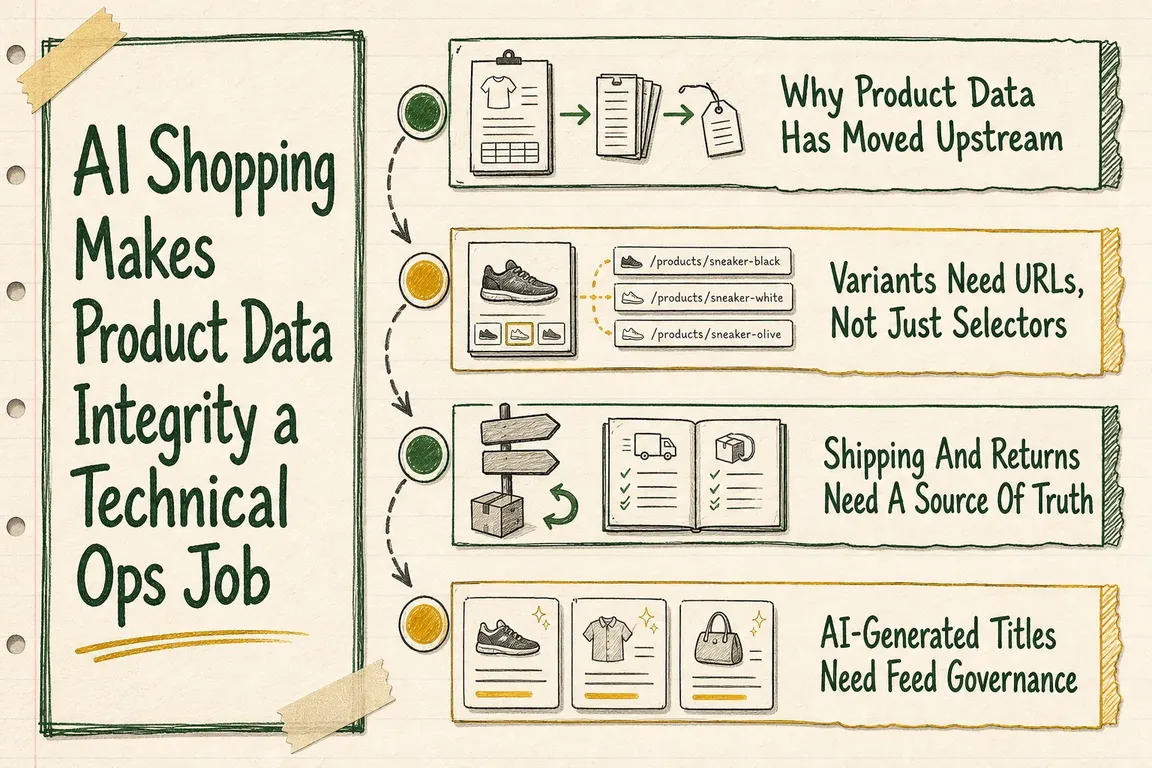
Why Product Data Has Moved Upstream
Most ecommerce teams still treat catalog cleanup as a periodic task. That is risky now. A customer may see your product inside a comparison, an AI-assisted shopping flow, an image-led product panel, or a free listing before they ever land on your site. If the page says one price, the structured data says another, the feed is stale, and the return policy is different in Search Console, the issue is no longer cosmetic. It becomes a trust and eligibility problem.
Google's merchant listing documentation is explicit about the operational nature of this work. Product markup can help products appear in merchant listing experiences, and those listings may include price, availability, shipping, and return information. Google also recommends putting Product structured data in the initial HTML for merchants optimizing for shopping results. JavaScript-generated product markup can make Shopping crawls less frequent and less reliable, especially for fast-changing fields like price and availability.
| Data layer | What often drifts | Operational check |
|---|---|---|
| Product page | Visible price, stock, variant state, image | Test key products as a customer, including variant URLs. |
| Structured data | Product, Offer, price, currency, availability |
Confirm markup is present in initial HTML and matches the page. |
| Feed and Merchant Center | Title, identifiers, sale price, shipping overrides | Compare exports with live pages and Merchant Center diagnostics. |
| Search Console settings | Shipping and return policy details | Make sure policy values match what shoppers see at checkout. |
| Generated title workflow | AI title disclosure and old title fields | Check whether title is overriding structured_title. |
Variants Need URLs, Not Just Selectors
Variant handling is where many stores quietly lose precision. Google documents ProductGroup for parent products and Product for individual variants. Each variant needs its own unique identifier, such as sku or gtin, and each product group needs a matching group ID through productGroupID or inProductGroupWithID.
The practical requirement is stronger than markup alone. Google says the site must be able to preselect each variant directly with a distinct URL. That URL should show the right image, price, availability, and still let the customer add that exact variant to the cart. If a green medium jacket only exists as a client-side dropdown state, your team should treat that as a routing and catalog integrity issue, not just a frontend detail.
Shipping And Returns Need A Source Of Truth
Shipping and return data now belongs in the same governance conversation as price and stock. Search Console lets online merchants manage simplified shipping and return policies under Settings > Shopping > Shipping and returns, including delivery time, shipping cost, return window, and return cost. Shipping details are automatically approved, while return policies are manually verified and can take about 10 to 13 days.
The exact match requirement matters. Google warns that shipping costs submitted to Google should match the shipping costs displayed on the website. If shoppers click from a listing and find a higher shipping cost on the site, the listing may be rejected. That is not a copywriting issue. It is a data ownership issue.
For larger stores, document which layer wins. Google's merchant listing documentation gives a precedence order for shipping and return configurations, with product-level Merchant Center feeds strongest, then Content API settings, then Merchant Center or Search Console settings, then product-level markup, and finally organization-level markup. Do not duplicate policy data in five places and hope it stays aligned. Pick the authoritative layer and make the others support it.
AI-Generated Titles Need Feed Governance
Product titles are also becoming a governance problem. Google Merchant Center requires each product to have a title or structured title. For titles created using generative AI, Google says merchants must use structured_title, set digital_source_type to trained_algorithmic_media, and place the title text in the content sub-attribute.
There is an easy trap here: if both structured_title and title are submitted, Google says it will use title. That means an old feed export can silently override the field your team created for AI disclosure. Also, structured_title is not supported by Schema.org at this time, so this cannot be solved only with on-page structured data. It needs feed-level checks.
A Practical Operating Model
A useful product data integrity workflow does not need to be heavy. Start with your highest-value categories and sample products every week. Compare the visible page, initial HTML structured data, feed output, Merchant Center diagnostics, and Search Console policy settings. Include at least one product with variants, one sale item, one out-of-stock item, and one product with a non-standard shipping or return rule.
Then make these checks part of releases. When a theme, product template, pricing rule, feed exporter, or merchandising automation changes, validate a few live URLs before treating the work as done. For agencies, this is also a good handover discipline: leave the client with a clear source-of-truth map, not just a fixed schema snippet.
Greg can help with this kind of hands-on audit: tracing product facts across WordPress, Drupal, feeds, structured data, Search Console, and Merchant Center, then turning the findings into a practical fix list. If your catalog data is starting to feel like nobody fully owns it, talk to Greg about a product data integrity audit.
Related on GrN.dk
- Search Console's Hourly Data Makes Post-Launch SEO Monitoring an Ops Task
- AI shopping visibility now depends on boring product-data plumbing
- Google’s August 18, 2026 Content API Cutoff: Feed Cleanup Before Merchant API Migration
Need help with this kind of work?
Get Greg to audit your product data stack Get in touch with Greg.