By Greg Nowak. Updated 22 September 2026.
Creating an llms.txt file is easy. Deciding what belongs in it, keeping those links accurate, and proving that it helps anyone are the real jobs.
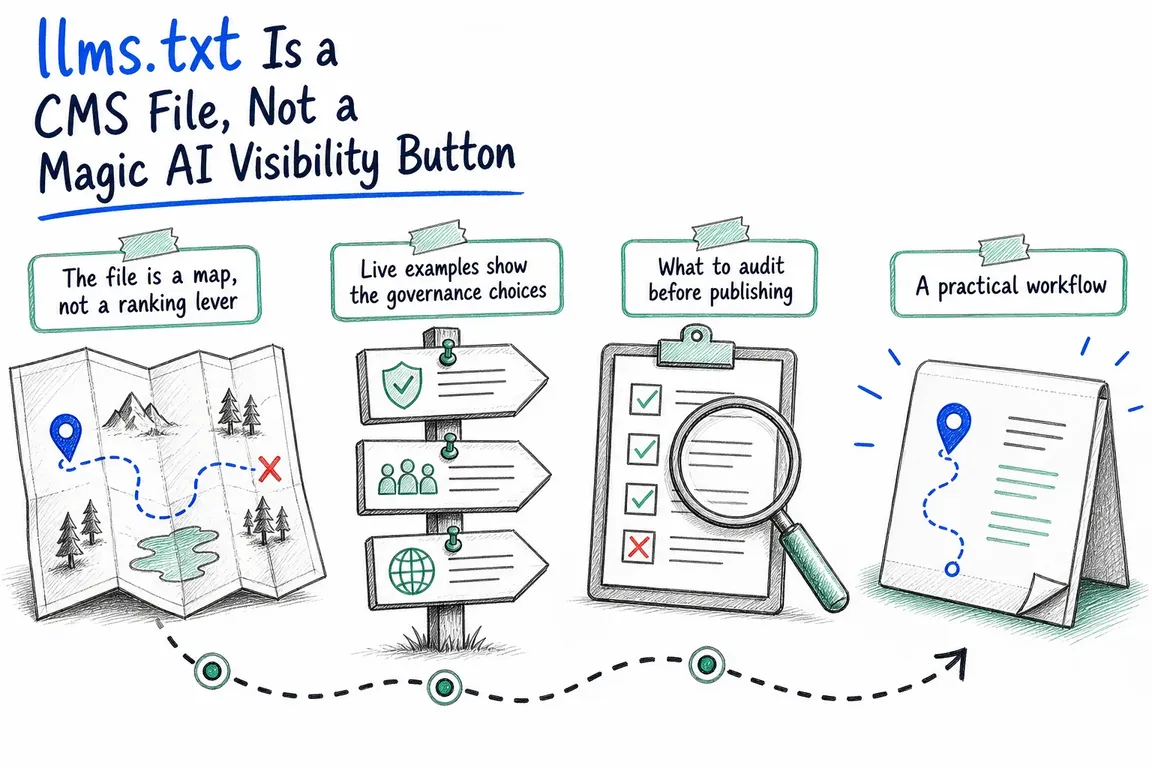
That distinction matters because the file is often sold as an AI visibility tactic. Google states that it does not use llms.txt for Search, including its generative AI features. The file will neither improve nor damage your Google visibility or rankings.
llms.txt can still be useful as a curated route into a complex website for compatible agents. Documentation publishers, software companies, universities and organisations with detailed services or policies have a plausible use case. A small brochure site probably has more valuable work waiting elsewhere.
What llms.txt does
llms.txt is an emerging proposal rather than a mature web standard. Version 2 describes a concise Markdown file placed at /llms.txt or within a section such as /docs/llms.txt. It contains a project name, optional context and grouped links to useful resources.
The proposal also recommends clean Markdown versions of important pages. Clients can discover those versions through rel="alternate" type="text/markdown", while rel="describedby" can point back to the applicable llms.txt file. That combination is more useful than a list of links leading to cluttered or heavily scripted pages.
The file has a separate role from established web controls. A sitemap lists URLs for search engines. robots.txt communicates crawler access rules. Canonical links help consolidate duplicate URLs. An llms.txt file is an optional editorial guide and replaces none of them.
| Situation | Decision | Next action |
|---|---|---|
| Large documentation or support estate | Pilot it | Curate current references, tutorials and support routes. |
| Complex products, services or eligibility rules | Consider it | Test whether agents can reach approved answers with less ambiguity. |
| Small site with clear navigation | Usually defer it | Invest in stronger pages, internal links and technical SEO first. |
| Duplicated or outdated content | Fix the site first | Identify owners and canonical pages before exposing an index. |
| Goal is better Google rankings | Do not prioritise it | Google says the file has no positive or negative ranking effect. |
Start with real user and agent tasks
Before installing a plugin, list the questions the file should help answer. A prospective client may need to compare services, understand geographic coverage, check commercial constraints or find the correct contact route. A developer may need the current API version, authentication guidance, examples and error documentation.
Use those tasks to select content. Include authoritative product information, current documentation, approved policies and genuinely useful support material. Exclude expired campaigns, thin archives, duplicate landing pages, drafts and obsolete product versions.
A complete CMS export is rarely a good result. It gives agents more conflicting material to process and gives your team more links to maintain. Treat inclusion as an editorial decision: every listed page should have an owner, a purpose and a reason to be considered authoritative.
Build a publishing workflow around it
A maintainable implementation needs four controls:
- Ownership: name an editorial owner for selection and descriptions, and a technical owner for routing, caching and validation.
- Generation: produce the file from approved CMS records where practical. Keep manual additions visible and reviewable.
- Update triggers: regenerate or review it when linked content is unpublished, redirected, materially revised or moved to a new product version.
- Testing: give an agent only the file as its starting point. Ask realistic buying, support and implementation questions, then check whether it reaches the correct source.
When evaluating a WordPress generator, look for exclusions, previewing, manual curation, regeneration controls, multilingual behaviour and cache compatibility. Check whether another SEO plugin or custom route already controls /llms.txt.
For supported Drupal 10.3 and 11.1 sites, the current stable llms_txt branch can be installed with:
composer require 'drupal/llms_txt:^1.1'The Drupal module separates deployable structure from site-specific content and integrates with render caching. Installation is only the start: confirm that the web server routes /llms.txt to Drupal, then test permissions, languages, cache invalidation and deployment across every environment.
Validate delivery before discussing visibility
These command-line checks catch missing routes, redirects and server failures:
curl -fsS https://example.com/llms.txt
curl -I https://example.com/llms.txt
Check for a successful response, readable UTF-8 text, one clear H1, concise descriptions and working links. Confirm that private, embargoed or environment-specific URLs have not entered the output. If Markdown alternatives are provided, compare them with their HTML sources and include them in the same publishing checks.
Chrome’s Lighthouse agentic browsing audit reflects the file’s optional status. A missing file returning 404 is marked as not applicable; a server error is flagged. If you decide against publishing one, a clean 404 is operationally better than a broken endpoint.
Measure whether the file earns its upkeep
There is no credible universal llms.txt ranking metric. Review requests for the file and its linked resources, but remember that user-agent strings and logs do not prove influence. More useful evidence comes from controlled tests: can an agent find the correct policy, version or service answer, and does it avoid outdated material?
Set a review date after the pilot. Keep the file if it improves those tasks at a reasonable maintenance cost. Retire it if nobody owns it or it repeatedly drifts from the website.
If your team is considering llms.txt, the valuable work is deciding which information is canonical and turning that decision into a dependable publishing process. Greg can help you assess the use case, design the CMS workflow and test the result.
Related on GrN.dk
- CMS Upgrades in 2026: Choosing the Right PHP Version for WordPress and Drupal
- Should publishers add Google’s new Preferred Sources button?
- AI Crawler Control for Business Websites: Protect Content Without Losing Search Visibility
Need help with this kind of work?
Discuss your CMS and llms.txt setup with Greg Get in touch with Greg.