By Greg Nowak. Updated 7 October 2026.
A free Drupal theme can save you a licence fee. Whether it saves you development time depends on how closely it fits your content, your brand and the people maintaining the website.
For business owners, operations leads and agency teams, the useful question is: what will this choice make easier next year? A campaign page, a Drupal upgrade and a handover to another developer all reveal more about a theme than its demo homepage.
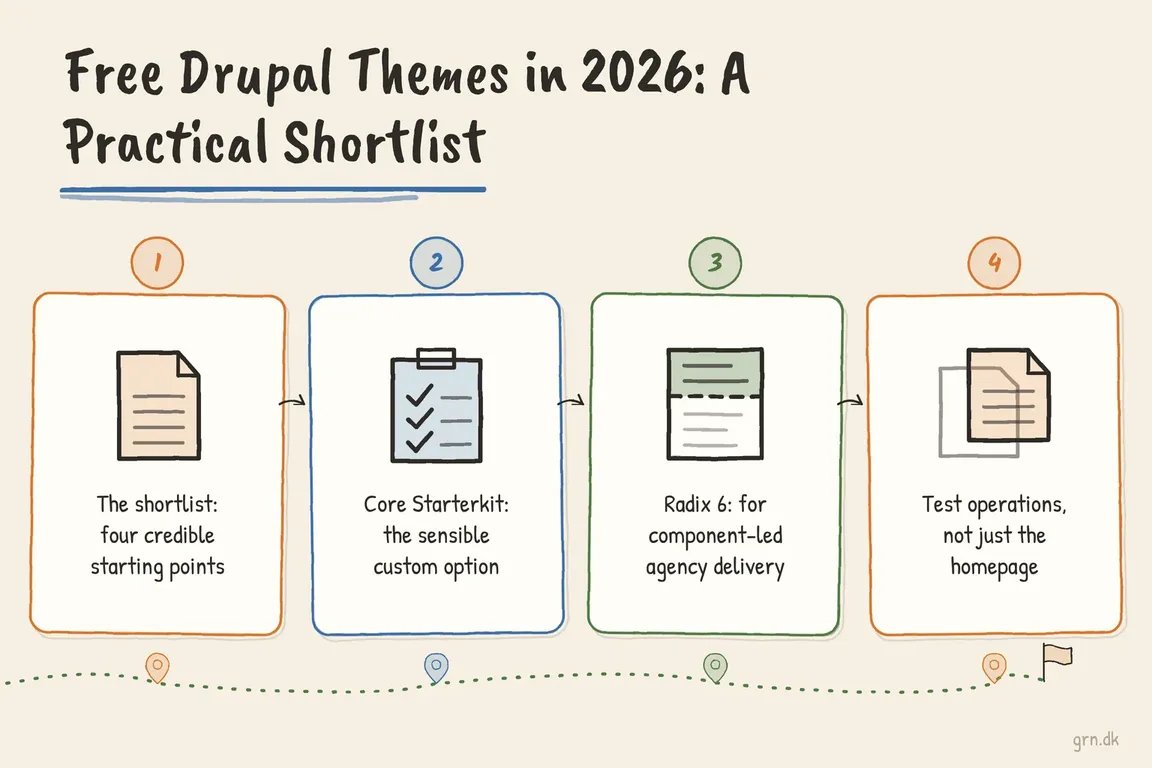
My shortlist remains Olivero, core Starterkit, the Bootstrap project's 5.x branch and Radix 6. Olivero supplies an established design. The others are foundations for development, with different demands on your team.
Which starting point fits your project?
| Starting point | Best fit | What to budget for |
|---|---|---|
| Olivero | A content site that suits an existing design | Brand settings, content presentation and upgrade planning |
| Core Starterkit | A custom design with direct ownership of the theme | Design implementation and maintenance of your own code |
| Bootstrap 5.x | An agency already comfortable with Bootstrap | A sub-theme, asset setup and integration testing |
| Radix 6 | A team building reusable components across page types | Component development, frontend tooling and documented builds |
Check the upgrade plan before the screenshots
Write down your installed Drupal version and the version planned for the next upgrade. Check each candidate's stable release, declared compatibility, security-advisory coverage and issues affecting your requirements. A compatible version number does not prove that your forms, layouts and custom modules will work together.
Ask whoever will maintain the site to explain the proposed customisation approach. Changes belong in your custom theme or supported sub-theme, rather than directly in downloaded core or contributed files where updates can overwrite them.
Olivero: a useful baseline for content websites
Olivero is worth trying when articles, service pages and navigation matter more than a distinctive page composition. Start with its logo and colour settings, then load real content: a long service page, a listing, a contact form and your actual menu.
There is an upgrade consideration now. The Olivero project page explains that Drupal 12 removes Olivero from core and provides it as a contributed theme. On Drupal 11 or earlier, the core copy remains the one used. For a planned Drupal 12 upgrade, include the contributed dependency and test the transition:
composer require 'drupal/olivero:^2.0'Run Composer from the project root. If the brief calls for extensive changes to Olivero's structure, compare that work with building a custom theme before committing.
Core Starterkit: for a custom design your team owns
Starterkit generates an independent theme. Choose it when you need your own design and want direct control over templates and assets.
The Starterkit documentation now distinguishes two command entry points. Through Drupal 11.3.x, run this from the Drupal web root, commonly web/ in a Composer project:
php core/scripts/drupal generate-theme company_theme --path themes/customFor Drupal 11.4 and later, use the newer entry point from the Composer project root:
vendor/bin/dr generate-theme company_theme --path themes/customGeneration provides a foundation; your team still implements the design. Upstream Starterkit improvements do not automatically update your independent theme. Preserve the generator metadata and assign someone to review relevant fixes, including accessibility improvements.
Bootstrap 5.x: choose it for team familiarity
The Drupal Bootstrap project has a 5.x line built around Bootstrap 5 and Single Directory Components, without jQuery. Its listed stable release, 5.0.2, supports Drupal ^10.3 || ^11.0 and has security-advisory coverage. That declaration does not include Drupal 12.
composer require 'drupal/bootstrap:^5.0'Run this from the Composer project root. Check the package name in tutorials: this recommendation concerns drupal/bootstrap.
The project offers CSS and Sass sub-theme options. Choose the approach your maintenance team can support, and document how assets reach production.
For existing Bootstrap 3 sites, allow for rebuilding customisations: 5.x is a complete rewrite of the older 8.x-3.x theme, with no formal upgrade path. Familiarity with Bootstrap helps implementation, but does not remove that migration work.
Radix 6: for reusable components and a maintained build process
Radix 6 combines Bootstrap 5, Sass and JavaScript tooling with Starterkit and Single Directory Components. It is worth evaluating when an agency wants shared components such as cards, navigation and calls to action across several page types.
composer require 'drupal/radix:^6.0'Installing the package is the first step. Follow the project's theme-generation instructions, then install and build the generated theme's frontend dependencies. Its documented production build command is:
npm run productionThe current stable release is Radix 6.0.9, released on 17 September 2026. It declares Drupal 10.3, 11 and 12 compatibility and fixes the generator's use of the deprecated Drupal CLI entry point.
Before choosing it, name the person responsible for the Node environment, dependency updates and production build. Include those tasks in the estimate.
Compare two candidates using the same business tasks
Build a small staging prototype with representative content. Ask an editor to assemble a campaign page, replace an image and preview the result. Theme selection alone does not provide a complete publishing workflow; content types, layout tools and permissions also affect the experience.
Test mobile navigation, long headings, missing images, search results and form errors. Check keyboard access, visible focus and zoom. Measure representative pages with realistic images and third-party scripts, rather than an empty demo.
For commerce, include product variations, cart changes, checkout validation and order history. For a redesign, check existing URLs and where visitors encounter enquiry or purchase links.
Make the next handover part of the decision
Ask for an estimate covering implementation, editor setup, testing and ongoing maintenance. The handover should record the release line, customisation approach, build commands, tested page types and upgrade owner.
If you want a second opinion, discuss your Drupal theme shortlist with Greg. Bring your Drupal version, key page types and design requirements so we can assess the options against the work your website needs to support.
Related on GrN.dk
- Cloudflare Page Rules Debt: How Quiet Configuration Drift Breaks Business Websites
- CMS Upgrades in 2026: Choosing the Right PHP Version for WordPress and Drupal
- Still on Drupal 8 in 2026? Safe Legacy Work and a Practical Upgrade Plan
Need help with this kind of work?
Discuss your Drupal theme shortlist with Greg Get in touch with Greg.