By Greg Nowak. Last updated 2026-07-04.
Cheap hose-end irrigation timers are useful until they become the smallest, weakest part of the system. That point can arrive quickly in Thailand, where a garden, villa, small farm, resort, or operations site may be fed from a tank, pump, long pipe run, or water supply that changes through the day.
The better DIY approach is usually simple: move the timing function away from the water path. Let a timer switch a properly sized solenoid valve instead of forcing the whole zone through a small plastic tap timer. That is not about making the system more complicated. It is about making the parts match the job.
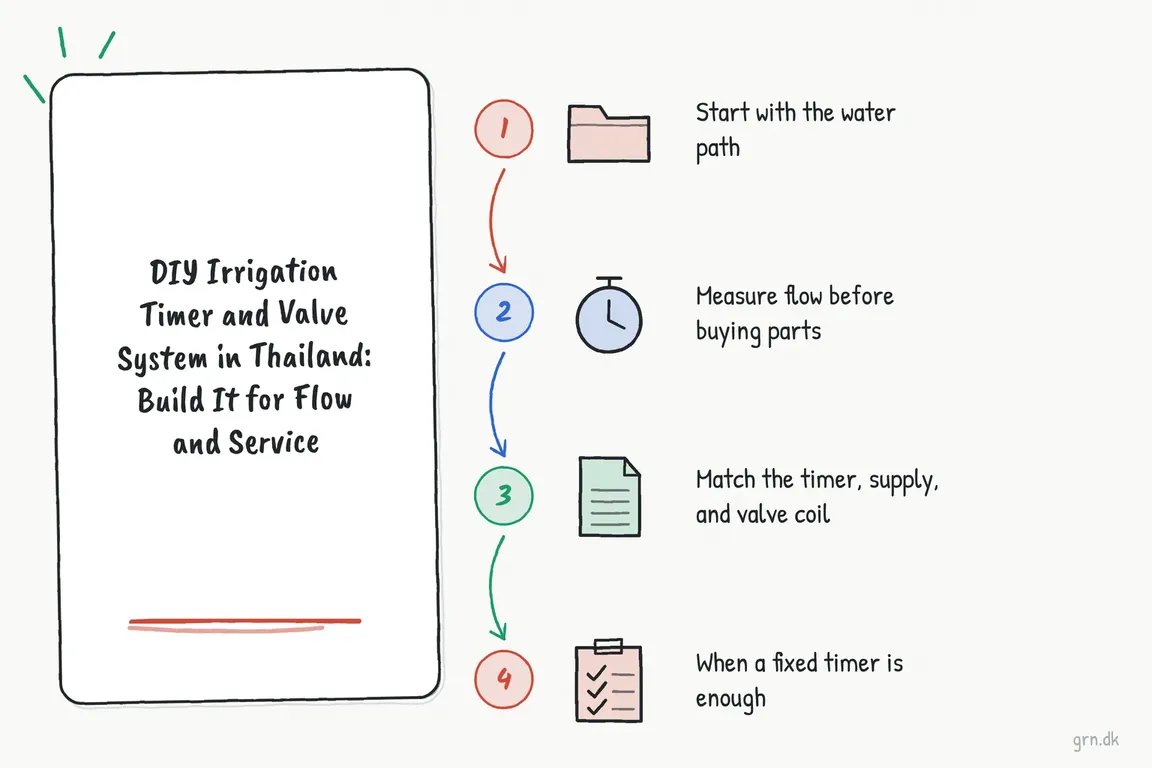
Start with the water path
For a one-zone build, keep the layout boring and serviceable: water source, manual isolation valve, filter, pressure regulation if the zone uses drip or low-volume irrigation, normally closed solenoid valve, then the irrigation line. Put the timer, power supply, relay if needed, and wire joins in a shaded weatherproof enclosure. Keep mains wiring out of wet field boxes unless a qualified person has designed and installed it properly.
If you are paying for the install, the real risk is rarely the price of the timer. It is the return visit: a valve that will not close, a filter nobody can clean, a buried joint that leaks, or a controller nobody understands six months later. Good DIY irrigation is less about clever electronics and more about making the system easy to isolate, test, repair, and explain.
| Decision | Practical default | Upgrade when |
|---|---|---|
| Timer | Box-mounted weekly timer switching the correct low-voltage valve circuit | You need weather adjustment, multiple zones, remote visibility, or logs |
| Valve | Normally closed irrigation solenoid valve sized to measured zone demand | Pressure varies, flow is high, or a standard serviceable valve is available locally |
| Filtration | Cleanable filter before the valve, with pressure regulation for drip zones | Water comes from tanks, ponds, wells, or dirty pipework |
| Plumbing | Ball valve, unions, labelled flow direction, and accessible parts | The system is buried, client-facing, or maintained by another team |
| Safety | Backflow protection where irrigation connects to potable water | The supply is shared with buildings, kitchens, guest areas, or public users |
Measure flow before buying parts
Do not choose the valve by thread size alone. A 1-inch valve can still be the wrong choice if the pressure loss is too high for the actual zone. Start with a bucket test: time how many seconds it takes to fill a 20-litre bucket at the supply point. Litres per minute is 1,200 divided by the number of seconds. Repeat the test as close as possible to the planned valve location, because long pipe runs and small fittings can change the result.
Use that measured flow to check valve specifications. As a reference point, a common 1-inch irrigation valve spec may cover a wide range, but the pressure-loss chart still matters. If the zone needs strong flow, avoid mystery valves with no usable data, no replacement coil, and no clear pressure range. A standard irrigation valve that can be serviced is usually cheaper over the life of the site than an anonymous part that works once and then becomes unfindable.
Match the timer, supply, and valve coil
THC15A-style digital timers are still useful for simple schedules, but do not treat them as a universal part. Current manufacturer information for the THC15A family lists versions for 220 Vac, 110 Vac, 12 Vac/dc, and 24 Vac/dc, with 16 on/off operations by day or week. That makes it suitable for basic timed switching, not for weather-aware irrigation decisions.
The electrical rule is straightforward: the timer version, power supply, and solenoid coil must match. If the valve is 12V, use a suitable 12V supply with current headroom. If the timer should not carry the load directly, use it to drive a relay or contactor instead. For an outdoor site, add strain relief, drip loops, clear labels, and a way to disconnect power before servicing. Avoid improvising mains wiring in wet locations.
Filtration and pressure control are not extras
Many irrigation faults blamed on automation are really water-quality faults. Grit can hold a valve open. Fine debris can clog drippers. Excess pressure can make low-volume irrigation behave badly. Put filtration before the valve, and clean it as part of routine site work. For drip and micro-irrigation, include pressure regulation instead of hoping the emitters will tolerate whatever the pump or supply delivers.
Products such as combined basket filters and pressure regulators show the pattern worth copying: a cleanable filter, known mesh size, and predictable outlet pressure in one serviceable assembly. You do not need that exact brand, but you do need the design principle. If nobody can open, clean, and reassemble the filter without cutting pipe, the installation is not finished.
If irrigation is connected to a potable water line, backflow protection is a safety requirement, not a nice-to-have. The exact device depends on the supply, local rules, and site risk, so this is a point where a practical DIY build should still respect plumbing code and professional judgement.
When a fixed timer is enough
A fixed weekly timer is fine for a single, predictable zone where someone can adjust the schedule as the weather changes. It is a poor fit when the site has several zones, changing seasons, public-facing landscaping, or a meaningful water bill. Weather-based controllers use local weather data and landscape conditions to decide when and how much to water, which is more appropriate when manual schedule changes are not happening reliably.
For owners and operations leads, the decision is simple: build the smallest system that can be maintained confidently. For agency teams, document the parts, voltage, schedule, valve location, and filter cleaning routine before handover. If this irrigation setup is part of a broader site automation or maintenance project, Greg can help turn the rough field idea into a practical parts list, wiring plan, and delivery scope your team can live with.
Related on GrN.dk
- Let's Encrypt's May 2026 profile changes turn certificate renewal into a live operations audit
- Long-running AI automations need queues before they meet real ops
- Cloudflare Tunnel observability is better in 2026, making undocumented tunnel sprawl harder to ignore
Need help with this kind of work?
Get help scoping a maintainable irrigation setup Get in touch with Greg.