By Greg Nowak. Last updated 2026-11-12.
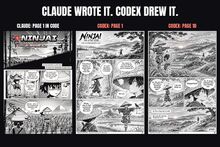
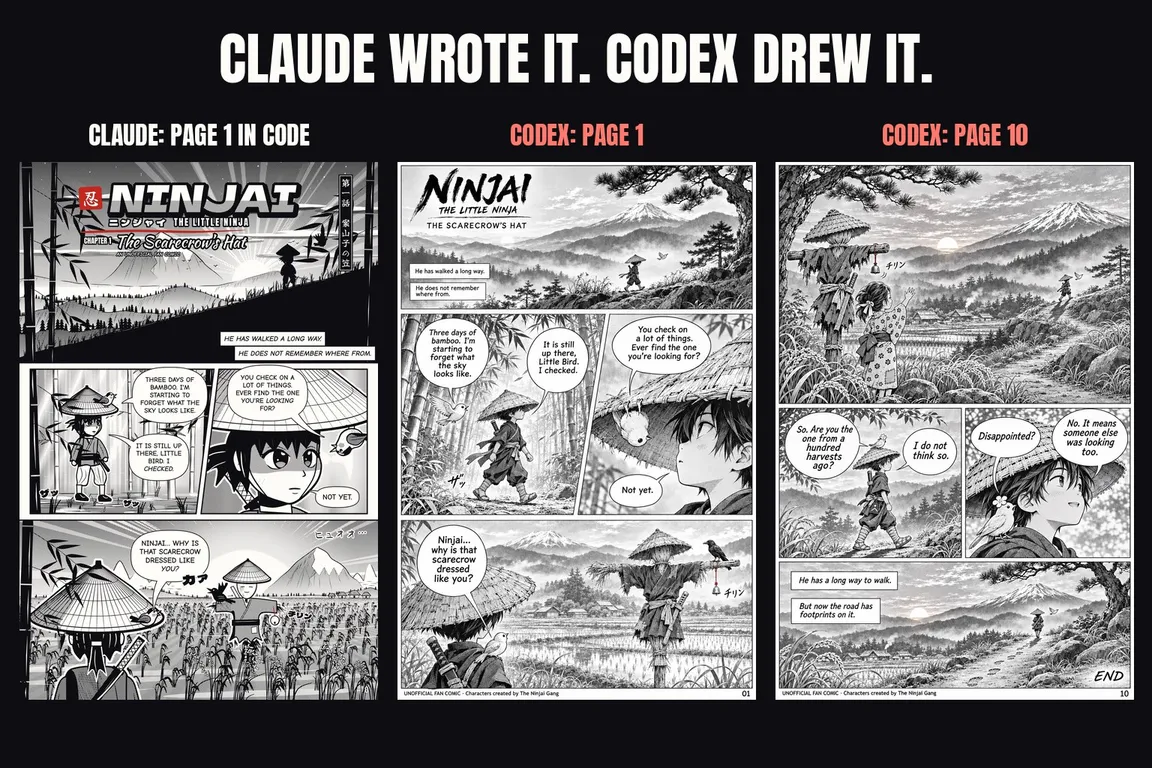
Claude's comic script survived my first test. Its artwork did not. When I gave Codex the same brief, it found that script in the project files and drew all ten pages.
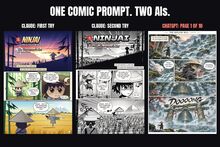
This was the third attempt at the comic. In Claude vs ChatGPT: One Comic Prompt, Two Very Different Results, ChatGPT delivered ten painted pages. Claude delivered a page drawn in code, which I rejected. Later, I gave the same prompt to Codex on my server.
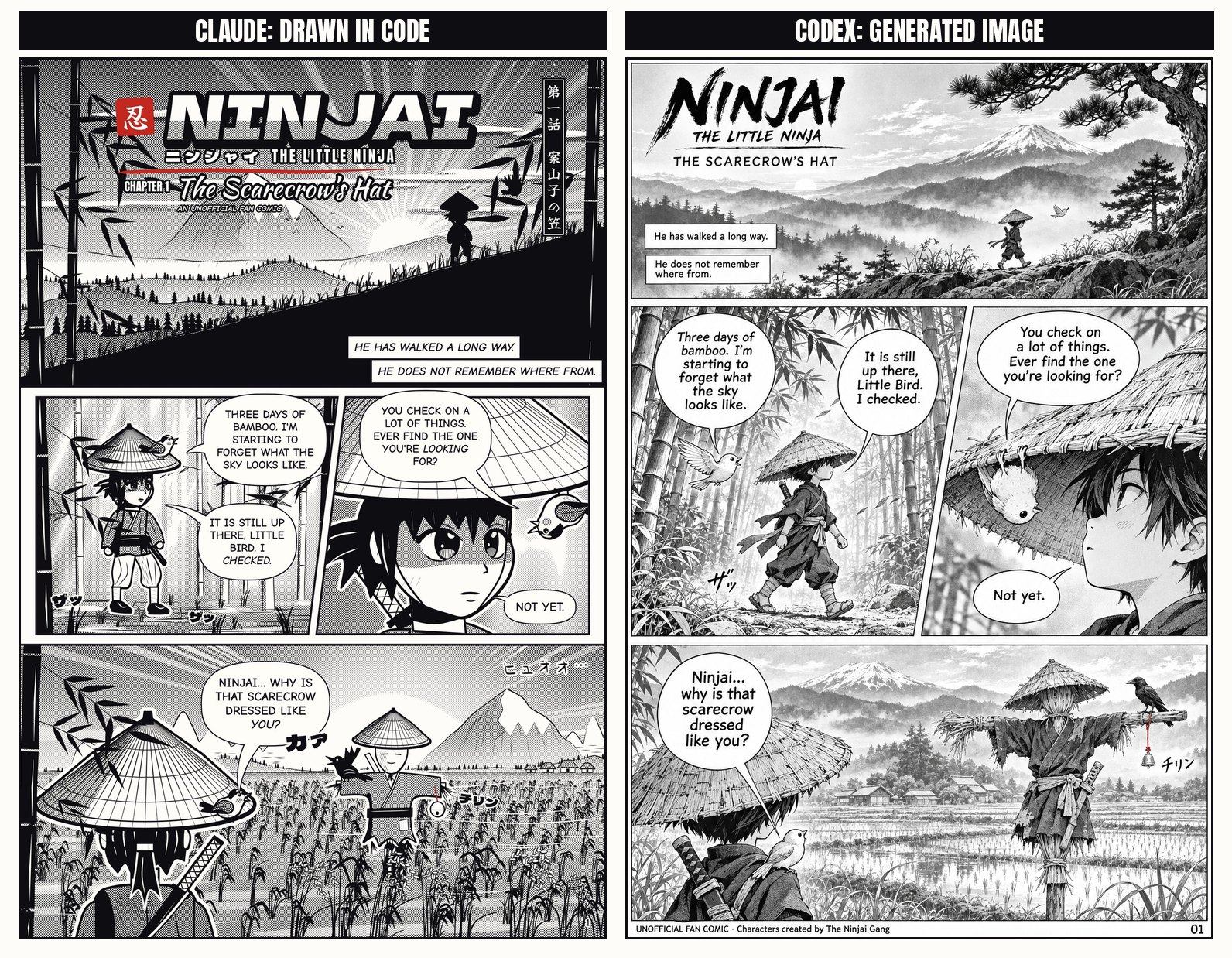
The prompt was: “Create an awesome comic 10 pages based on ninjai the little ninja. Start with page 1 for approval before you continue.” Codex ran as an unattended agent from a task card, using gpt-6-astra at high reasoning. Its built-in image generator made the pages.
What came back
Claude's story, The Scarecrow's Hat, follows Ninjai and Little Bird into a village where a scarecrow wears his hat. Three bandits threaten the rice harvest. Ninjai breaks their weapons without bloodshed, then receives a keepsake bearing a mark that matches his scabbard.
Codex turned it into ten PNG pages in black and white manga style, with screentone and one red accent: the bell cord. The English lettering is readable and follows the script. The pages also include a few Japanese sound effects, page numbers, a credit line and END on page 10.
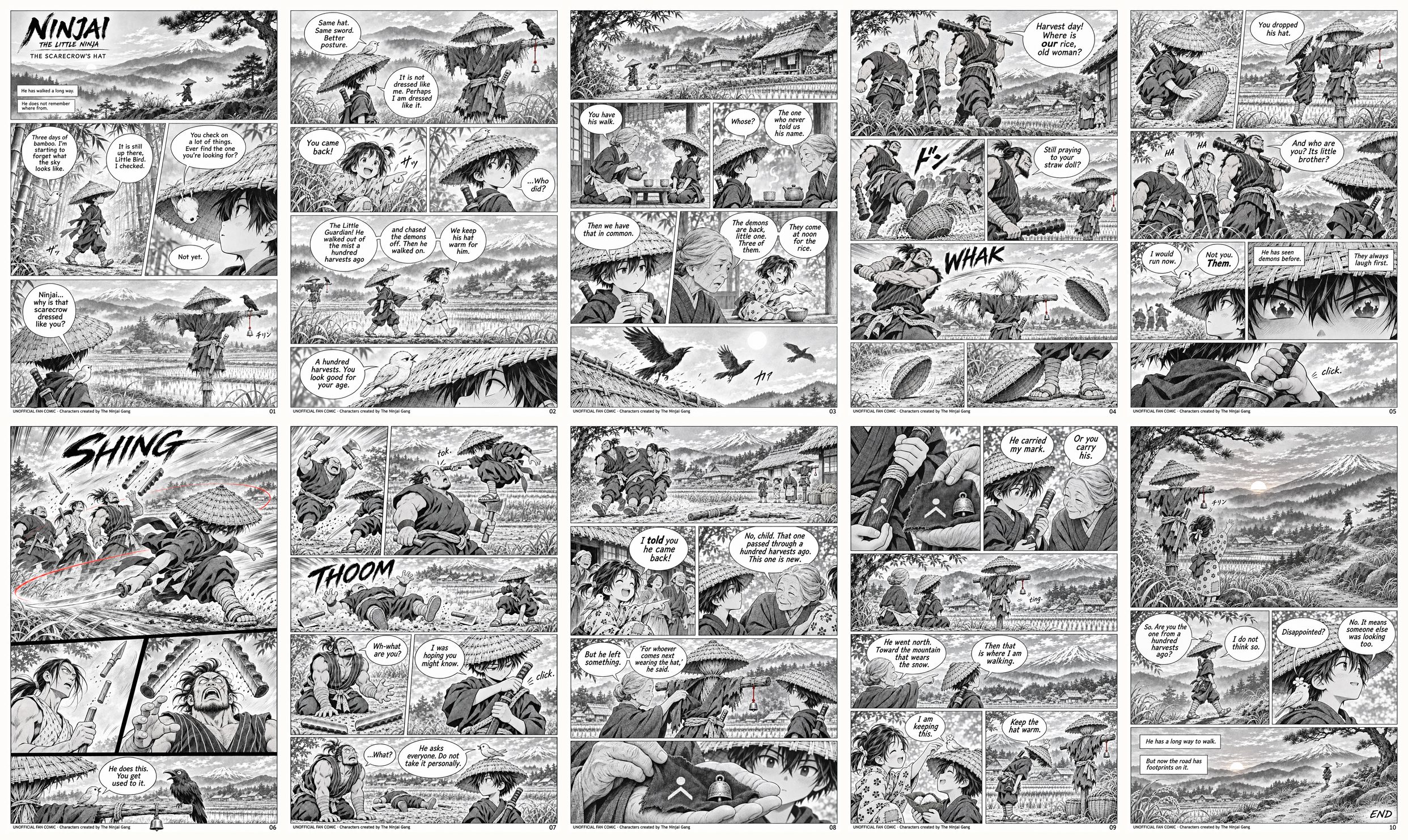
You can read the complete comic in the 8.2 MB PDF. My run log includes the pages, timings and usage. Each page is 1024 × 1536 pixels, so this is a screen edition. The pages are small for print.
| Detail | Claude: first test | ChatGPT: first test | Codex: this attempt |
|---|---|---|---|
| Story | Wrote The Scarecrow's Hat | Wrote The Hollow Bell | Kept Claude's script and dialogue |
| Artwork method | JavaScript drawing on HTML Canvas | Built-in image generation; painted colour | Built-in image generation; manga with screentone |
| Delivery | Ten-page script; page 1, then redrawn | Ten pages in a 14.6 MB PDF | Ten PNG pages and an 8.2 MB PDF |
| Agent time | 30 minutes for the first page; revised page delivered 24 minutes after feedback | About 42 minutes | About 49 minutes across five runs |
| My input | Feedback rejecting the drawing style | Four messages | Four short replies after the task card |
| Page dimensions | 2000 × 3000 pixels | 1024 × 1536 pixels | 1024 × 1536 pixels |
The comparison has limits. This is one run on one prompt, not a benchmark. ChatGPT told a different story in colour, and Codex had a finished script to work from. Claude and ChatGPT had both started from nothing.
A useful script was worth keeping
Claude had done useful writing. The illustration method was where the first attempt fell short. Anthropic explains that Claude does not generate photos or illustrations as image generators do, though it can build visuals using HTML and SVG. In my test, it used Canvas code.
Codex had access to an image generator. OpenAI's image generation documentation identifies the built-in model as gpt-image-2. That gave Claude's story a route to finished artwork.
On a business project, writing, exact lettering, illustration and final assembly deserve separate attention when you assign the work. Check what each tool or person can deliver before committing the whole brief. Here, keeping the script meant the writing did not have to start again.
The project files carried the handover
Claude's script was saved in the repository where Codex worked. Codex found it, kept the story and dialogue, and dropped its own idea for a story about a bell. It also read my feedback that Claude's drawing was “not enough manga”. Its notes called for generated brushwork and screentones instead.
Both the usable material and the rejected direction were available to the next worker. That is why I recommend keeping the current script, brief, references and feedback together in the project files. If a decision lives only in a separate chat, someone has to find it or guess what was agreed.
Codex then wrote a prompt for each page, ranging from 4,000 to 6,700 characters. Each covered the panels, dialogue and character appearances. It supplied earlier pages as reference images too: page 2 used page 1, page 3 used pages 1 and 2, and page 10 used pages 9 and 1.
Be clear about what an approval allows
Page 1 was on the card eight minutes after I created it. Codex asked whether I approved its artwork and storytelling for the remaining pages. I gave it permission to build the next two.
It stopped again after pages 3, 5 and 6. My replies stayed brief. The last told it to finish the remaining pages on that card without splitting the work.
For a commissioned job, I would spell out which pages are approved, whether that approval covers both style and story, and how much work can follow. Approving a sample establishes a direction. It also needs to give the person or agent doing the work a clear stopping point.
The work took 49 minutes. Delivery took longer.
Across five runs, Codex did about 49 minutes of agent work and needed four short answers from me. The elapsed time was 4 hours 9 minutes, mostly spent waiting for my replies or a usage reset.
The runner measured about 130 points of the five-hour Codex allowance across two windows, plus 21 points of the weekly limit. After page 6, the first window had 9% left. My runner starts no new work below 20%, so it waited for the reset.
OpenAI's documentation says image generation consumes Codex usage limits faster than text-only turns. Codex points also use a different meter from Claude's or ChatGPT's, so these figures do not provide a direct comparison between services.
For scheduling, the distinction matters: time spent making the pages was only part of the delivery window. A creative job needs capacity for images and revisions, with room for approval delays and usage resets.
Read the finished pages against the brief
Codex caught a continuity error on page 7. A bandit's iron club appeared snapped across, although page 6 had cut it lengthwise. It corrected page 7 with one targeted edit before delivery.
That follows OpenAI's guidance to use references and make targeted edits, stating what should change and what should stay. The Image generation API guide also describes limits with precise text, recurring characters and composition.
I still read the pages myself. Characters and key objects stayed recognisable throughout the comic, but one detail of the script had slipped. It asked for Japanese sound effects throughout, and the fight uses English ones such as WHAK, SHING and THOOM. The pages were readable. They still needed checking against what had been asked for.
As a freelance digital project manager, I look for these details in a handover: whether the next person can use the files, see the decisions and understand what has been approved. I also check whether there is enough capacity to finish. If your creative project needs that coordination, I can help as your digital project manager.
This article was drafted by my article pipeline, which runs on OpenAI Codex, from a run log compiled by Claude. Both tools had a hand in the write-up too.
Ninjai: The Little Ninja was created by The Ninjai Gang. The comic is an unofficial, non-commercial fan comic.
Related on GrN.dk
- Claude vs ChatGPT: One Comic Prompt, Two Very Different Results
- Give an AI Agent Its First Job on a Simple Task Board
- AI Agents Need a Spending Brake, Not Just a Billing Dashboard
Need help with this kind of work?
Work with me as your digital project manager Get in touch with Greg.