By Greg Nowak. Last updated 2026-11-21.
A page gets cited more often in AI answers. Should you spend more on it? Look first at whether it also attracts identifiable AI visits and relevant, verified enquiries. That gives you a reasonable basis for deciding where to invest, although it cannot prove that a particular citation caused an enquiry.
The reporting challenge is that citations, visits and enquiries come from different evidence. Your monthly report needs to bring them together while keeping those limits clear. Otherwise, a promising visibility figure can carry more commercial weight than it deserves.
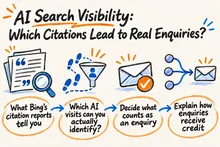
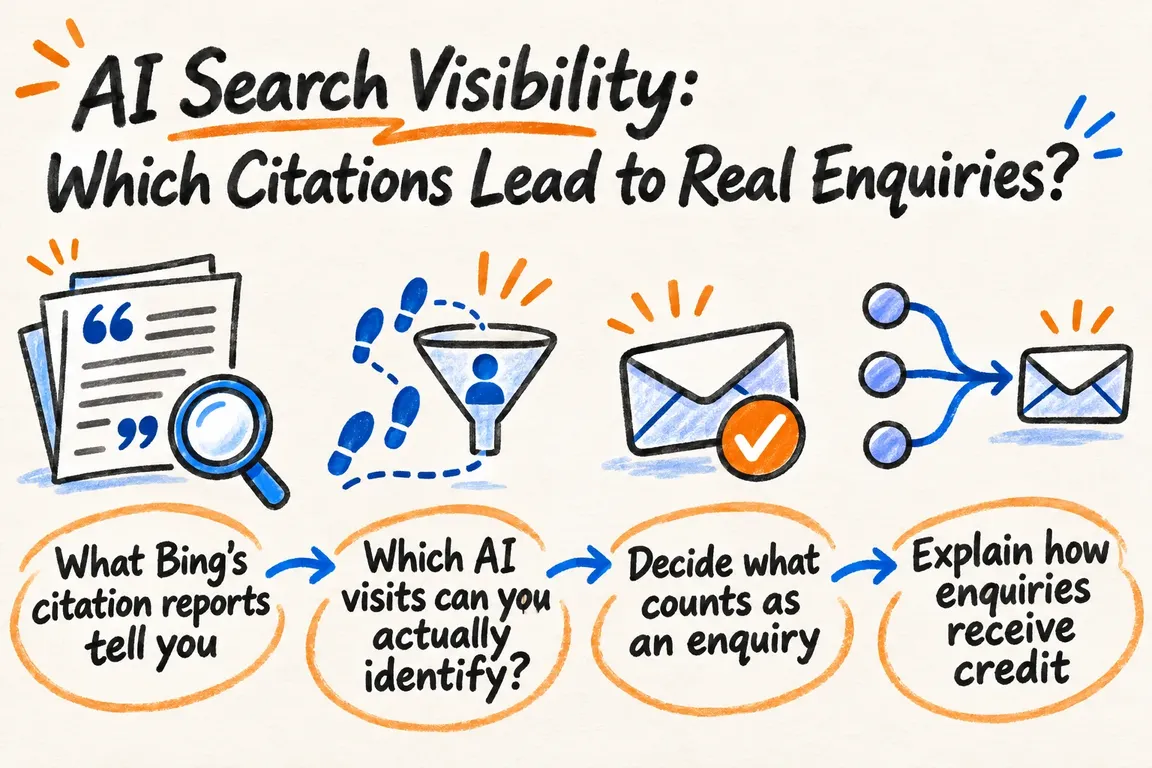
What Bing’s citation reports tell you
On 16 June 2026, Bing announced four additions to its AI Performance preview: Intents, Topics, Citation Share and Compare. The report covers Microsoft Copilot, Bing and selected partner AI experiences. Intents classifies query context, Topics groups related queries, and Compare overlays an earlier reporting period.
Citation Share measures your site’s proportion of citations for a particular grounding query. It is neither traffic share nor a content quality score. Bing also warns that classification labels can be broad during the preview. Bing’s announcement explains the measures and their limits.
Use the report to choose pages worth investigating. Do the topics and query contexts match the services you want to sell? A service page with modest citation numbers may deserve more attention than a widely cited educational article if it addresses the work you want enquiries about.
Which AI visits can you actually identify?
Matomo has a dedicated AI Assistant acquisition channel, an Acquisition > AI Assistants report, and a segment using Channel Type Is ai. The segment lets you examine behaviour and goal conversions for recognised AI traffic.
The upgrade date matters. The channel applies to data collected after upgrading to Matomo 5.5.0 or later; earlier visits keep their original classification. The AI Assistants report may recover some historical information by filtering known referrers, but historical channel detail remains limited. Matomo’s AI traffic guide sets out that distinction.
Put the upgrade date in your reporting notes and establish a baseline within a consistent measurement period. You need that context before treating a rise in reported AI traffic as a marketing improvement. Then look at the landing pages: what are those visitors arriving to read, and how easily can they make a relevant enquiry?
Decide what counts as an enquiry
Before building the dashboard, agree on the action you want to measure. For a service business, that might be a successfully submitted project enquiry or a completed consultation booking. An email-link click, a form start and a completed enquiry each tell you something different. Keep them separate.
Google Analytics defines a key event as an event measuring an action important to business success. You can identify or create the relevant event, mark it as a key event, and assess its performance across channels. Google’s key event guidance provides the measurement framework.
For an enquiry form, test the whole journey. Submit an enquiry, confirm that it reaches the intended destination, and check that the successful completion is recorded once. Test a failed submission too. If that also triggers your enquiry event, the report will overstate what happened.
Quality needs a separate check with whoever handles new business. Agree on a few usable criteria: whether the enquiry fits your services, includes enough project information, and offers a plausible next step. Keep recorded submissions and qualified opportunities distinguishable in the monthly figures.
Explain how enquiries receive credit
Matomo distinguishes the source of a visit from the source credited with a conversion. Its default Last Non-Direct attribution model can credit an earlier known source when someone returns directly to convert, provided the necessary visitor history is available.
Some AI visits arrive without a recognisable referrer and can appear as Direct Entry. Available visitor history, attribution settings and report scope all affect the figures. Matomo’s attribution documentation explains how these rules work.
Label the numbers accordingly. “Enquiries completed during identified AI visits” measures something different from “conversions credited to AI under the attribution model.” An increase in direct traffic, by itself, is no evidence of hidden AI success.
The same care applies when comparing citations with visits. A page appearing in a citation report and receiving an AI referral during the same month does not establish which answer, query or citation brought that visitor to the site.
A monthly report you can make decisions from
Start with a shortlist of commercially relevant cited pages that you can review properly. For each, bring together the available citation evidence, identified AI landing visits, verified enquiry activity and any qualification information you can reliably associate. Keep Microsoft’s citation coverage separate from analytics totals that include multiple assistants.
Use patterns like these to choose what to investigate. None is a verdict on its own.
| What you see | What to check | Decision to consider |
|---|---|---|
| More citations, with identified visits staying flat | Topic relevance, report coverage and whether sources are being detected | Check the evidence before increasing content spend |
| Identified AI visits, with no verified enquiries | Visitor needs, page clarity, the contact route and event accuracy | Test one improvement to the landing page or tracking |
| Verified enquiries, with few meeting qualification criteria | Who the service appears to serve and what the form asks for | Clarify the intended audience and the project details you need |
| Relevant enquiries recurring alongside identified AI visits | Whether the pattern holds across periods and measurement is reliable | Consider a limited investment in related content |
Include reporting dates, the analytics version, the enquiry event definition and the attribution model. Record content edits and tracking changes alongside the results so you can interpret a shift in the numbers.
Whenever you show a rate, show the underlying enquiry counts and define the population used in the calculation. Dividing enquiries by citations would imply a measurable journey between the two that this setup has not established.
Give the next investment a clear limit
Choose one decision for each monthly review. Perhaps a cited service page needs a clearer contact route. An article may need to make its intended audience more obvious, or a commercially relevant topic may warrant supporting content. State the business benefit you expect and what evidence would justify continuing.
If enquiries are sparse, keep the counts visible and review a longer, consistent period before committing substantial budget. If tracking is uncertain, fix it first. When relevant enquiries recur, document the pattern and the attribution gaps before expanding the work.
How Greg could help
Greg could configure Bing Webmaster Tools and your analytics, verify enquiry tracking, and set up a monthly report that compares cited pages with commercial outcomes. That would include recording coverage limits, historical reporting boundaries and attribution settings, so the figures come with enough context to use them.
A useful starting brief is straightforward: which services do you want to grow, which pages support them, and what counts as an enquiry? From there, Greg could help turn the reporting into a concrete decision about what to improve and where further spending is justified.
Related on GrN.dk
- AI Content and Google: Fix the Process Before You Publish More
- AI Search Visibility: Are Your Snippet Rules Working Against You?
- Your PHP Upgrade Needs More Than a Working Homepage
Need help with this kind of work?
Discuss your AI visibility and enquiry tracking Get in touch with Greg.