By Greg Nowak. Last updated 2026-09-10.
Borax and boric acid can be used in bamboo preservation, but a mixing ratio alone does not tell you whether the finished material will be suitable for your project. The treatment method, penetration, drying and exposure to rain all matter.
If you are sourcing bamboo for a shop interior, display or client installation, start with its intended use. That decision determines what to ask the supplier and whether treating it yourself makes practical sense.
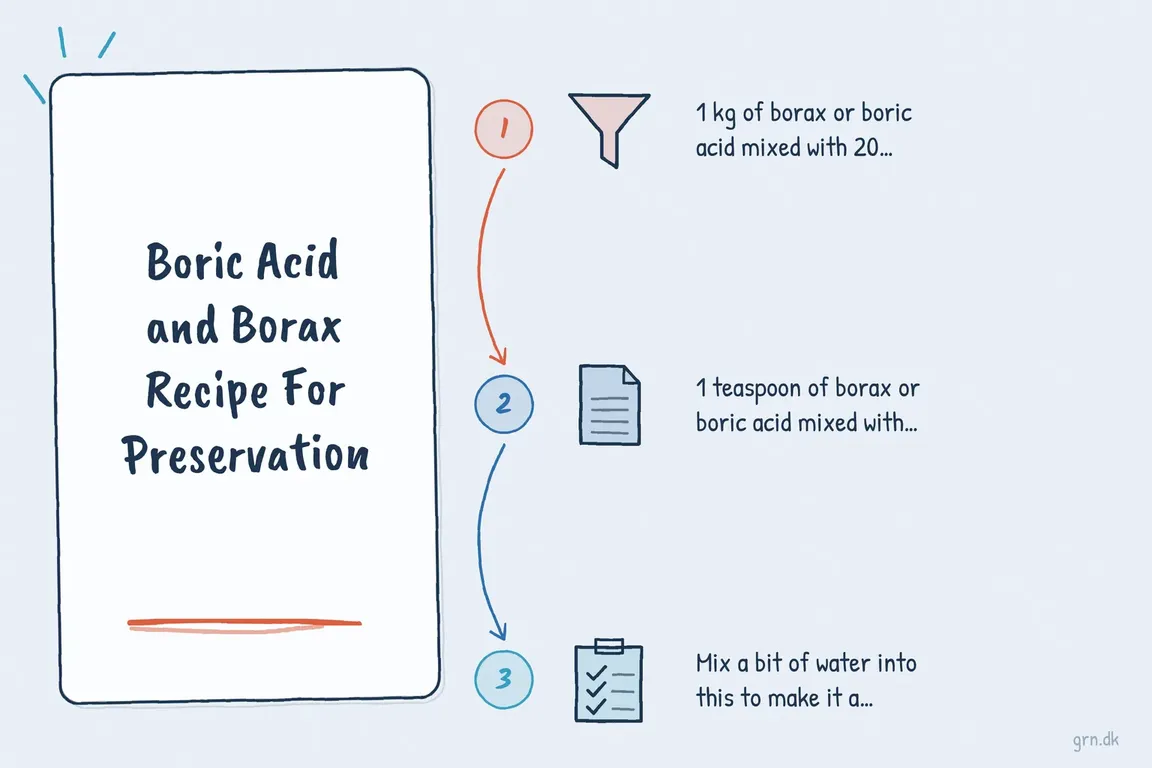
The original version of this article suggested dissolving 1 kg of either chemical in 20 litres of water. It also included a sugar paste for ants and termites. Both instructions needed qualification: borax and boric acid are different compounds, and bamboo preservation and pest baiting require separate approaches.
A documented bamboo preservation recipe
INBAR’s Construction Manual for Bamboo describes an immersion bath using 2–2.5 kg each of borax and boric acid per 100 litres of water. Scaled down, that is 400–500 g of borax plus 400–500 g of boric acid per 20 litres of water.
This is a reference formulation from a construction manual. Before using it, check that the treatment is permitted locally and that the chemical forms match the chosen specification. For a formulated preservative, follow its authorised label instead.
| Ingredient | Lower end of the manual’s range | Upper end of the manual’s range |
|---|---|---|
| Water | 20 litres | 20 litres |
| Borax | 400 g | 500 g |
| Boric acid | 400 g | 500 g |
| Total chemicals | 800 g | 1,000 g |
The upper end retains the original note’s total of 1 kg per 20 litres, but divides it between two specified ingredients. Do not substitute one for the other gram for gram or assume that any product labelled “borax” matches the formulation.
Will the bamboo stay dry?
Boron preservatives can wash out when treated bamboo is exposed to rain. INBAR’s technical guidance on bamboo treatment and seasoning identifies this as a key limitation. A borate bath therefore does not make bamboo suitable for every outdoor application.
For sheltered use, establish how the material will remain protected from water. For exposed fencing, ground contact or regularly wet installations, ask a specialist supplier for a preservation system and material specification suitable for those conditions.
Seasoning also matters. Bamboo needs to dry towards the moisture conditions it will experience in service; otherwise subsequent shrinkage can cause splitting and problems at connections. Chemical treatment does not replace drying or structural design.
Plan the treatment as a complete process
Before buying chemicals or booking installation, get the following points settled:
- Identify the material. Record the bamboo species, dimensions and whether it is fresh, dried or already treated. INBAR’s immersion example discusses recently harvested poles; do not assume the same process suits old, dry stock.
- Confirm access for the solution. The manual describes opening the internal partitions so liquid can enter the pole. For structural bamboo, have the designer approve that preparation: altering the partitions can affect connections and performance.
- Obtain a treatment schedule. Ask the supplier to specify preparation, immersion time, penetration checks and drying requirements for your material. Avoid choosing a universal soaking time from an unrelated recipe.
- Reserve space and time. Include the tank, handling area, drainage and drying space in the job plan. Agree who decides when the bamboo is ready for fabrication.
- Keep a batch record. Note product names, quantities, treatment dates and the person responsible. Request equivalent documentation when purchasing treated bamboo.
For a business purchasing a small quantity, compare the complete cost of doing this yourself with buying material supplied to an agreed specification. Include labour, storage, waste handling and possible delays in that comparison.
Handling and product approval
Boric acid and borax should not be treated as harmless household ingredients. The National Pesticide Information Center describes exposure through swallowing, inhalation and contact with skin or eyes. Follow the label and safety data sheet for protective equipment, handling and first aid. Keep chemicals and treatment baths away from children, pets and food preparation areas.
For work in Denmark, check the Danish EPA’s pesticide and biocide database. The agency states that only approved products may be used. Its database also contains former approvals, so check the current status and authorised use. A recipe in an international manual does not establish Danish approval.
Arrange disposal according to the product instructions and local waste guidance before starting the batch.
Why the sugar-paste advice has been removed
The earlier teaspoon recipe did not specify a final concentration. That makes it unsuitable as repeatable pest-control guidance.
University of California IPM guidance explains that ant baits must act slowly enough for workers to carry the active ingredient back to the colony. For Argentine ants, it discusses liquid borate baits at 0.5–1% concentration; stronger mixtures can kill foragers before they distribute enough bait.
Choose a locally authorised bait labelled for the identified ant species and location. Suspected termites need identification and an appropriate inspection; an ant-bait recipe provides no basis for treating a termite infestation.
Make technical instructions easier to use
A useful instruction gives the next person enough context to make a sound decision: what it applies to, what to measure and when specialist input is needed. That principle also applies to business websites and internal documentation.
If your team needs help planning a digital project that makes technical information clearer and easier to maintain, talk to Greg about digital project management.
Related on GrN.dk
- NGINX 1.30 changed upstream connection reuse: what to check before you upgrade
- Before Your Support Bot Learns the Help Center, Test Whether It Can Forget
- Headless WordPress menus: what to check before launch
Need help with this kind of work?
Talk to Greg about your digital project Get in touch with Greg.