GrN.dk

Main navigation

  • Articles
  • Cases
  • Contact
  • Your Digital Project Manager
  • About Greg Nowak
  • Services
  • Portfolio
  • Container
    • Excel Freelancer
    • Kubuntu - tips and tricks
    • Linux Apache MySQL and PHP
    • News
    • Image Gallery
User account menu
  • Log in

Join my community / free newsletter — sign up here

Breadcrumb

  1. Home

Bing AI Search Puts Fresh Sitemaps and IndexNow on the Clock

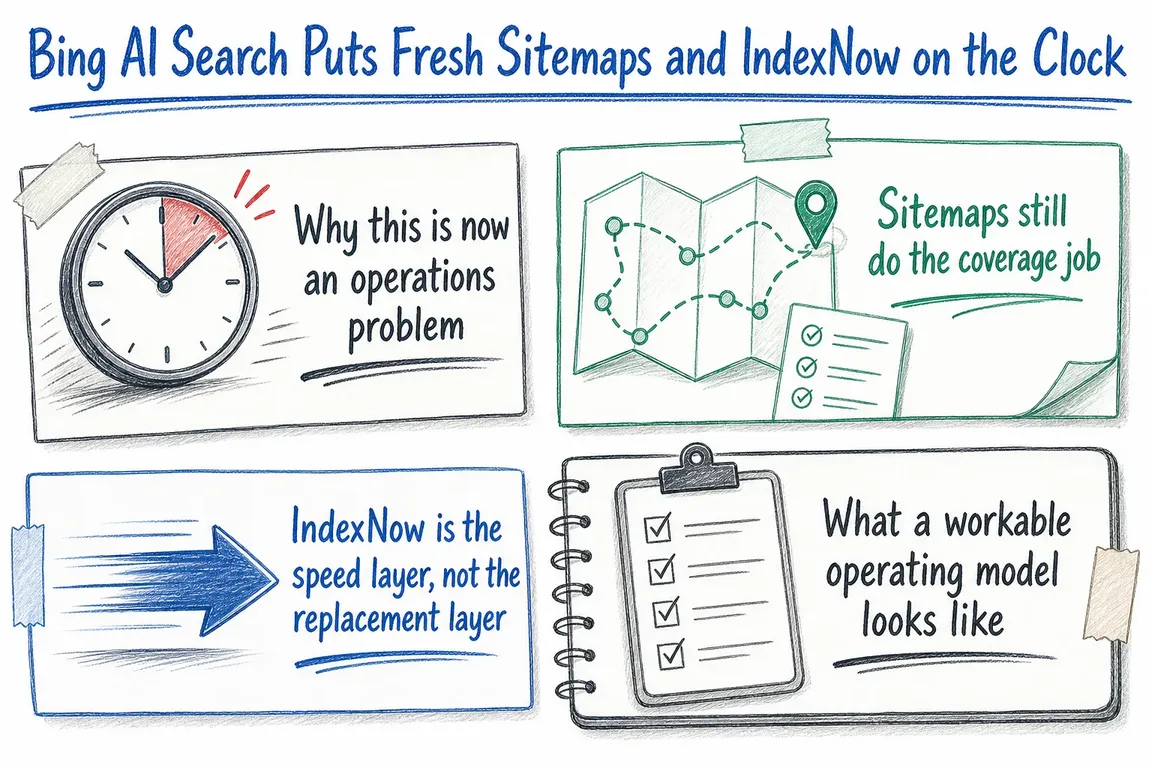
Illustrated infographic summarizing: Bing AI Search Puts Fresh Sitemaps and IndexNow on the Clock

For years, XML sitemaps and IndexNow sat in the technical SEO bucket. Bing’s recent guidance changes how that work should be treated. In Microsoft’s own framing, AI-driven discovery still depends on clean crawl signals, and freshness signals affect how quickly updates appear in search results and AI-generated answers. If those signals are late or wrong, stale prices, retired URLs, and outdated page states can surface where customers actually see them.

This is not a niche recommendation buried in documentation. In June 2025, Microsoft presented Bing Webmaster Tools as part of improving visibility across its AI and search experiences and specifically called out enabling IndexNow and submitting a sitemap. In July 2025, Bing made the division of labor more explicit: sitemaps are still the foundation for complete URL discovery, while IndexNow handles immediate, URL-level change notification. One gives Bing coverage. The other gives it speed. Serious sites need both.

Why this is now an operations problem

A lot of teams still treat the sitemap as a background file the CMS happens to emit. Bing’s guidance does not leave much room for that casual approach. It ties freshness directly to recrawling and reindexing decisions and says the lastmod value helps Bing decide which URLs to revisit quickly and which ones can wait. If your platform stamps lastmod with sitemap build time or deploy time instead of the page’s real modification time, you are feeding bad scheduling data into the crawl process.

Bing is also specific about what accurate looks like. The lastmod field should reflect the page’s actual modification time, not the moment the sitemap file was generated. It recommends ISO 8601 formatting with both date and time, which matters for pages that change frequently or carry time-sensitive information. Bing also says optional sitemap tags such as changefreq and priority do not influence how it crawls or ranks content. So the real work is not adding decorative sitemap metadata. It is maintaining a trustworthy URL inventory and trustworthy modification timestamps.

That is where this shifts from SEO theory into operational reality. If your content, commerce, or support teams can change important pages faster than your discovery layer can report those changes, the lag becomes visible in search and AI surfaces.

Sitemaps still do the coverage job

Bing’s July guidance is useful partly because it pushes back on a common assumption: that real-time notifications make sitemaps obsolete. Bing says the opposite. Sitemaps are still the base layer for comprehensive discovery. It continues to support the standard XML sitemap protocol at large scale, and XML remains the preferred format because it can carry structured metadata such as lastmod. For large sites, Bing supports substantial sitemap capacity, including large sitemap indexes, so this remains workable even on more complex platforms.

In practice, that makes the sitemap the system of record for URL discovery. Bing recommends exposing it in robots.txt or submitting it directly through Bing Webmaster Tools. Once Bing finds or receives it, the platform says it will try to fetch the sitemap immediately and then revisit it regularly, typically at least daily, to look for updates. Bing Webmaster Tools also gives you concrete checkpoints: submission status, the last read date, and processing errors.

Those details matter because they make sitemap management measurable. A sitemap that exists but is unread, broken, stale, or full of misleading lastmod values is not doing the job Bing is describing. A sensible audit should answer questions like these:

  • Is every indexable URL represented in the sitemap inventory?
  • Does lastmod change only when the page content actually changes?
  • Are time-sensitive pages emitting full timestamps rather than dates alone?
  • Is the sitemap referenced in robots.txt and visible in Bing Webmaster Tools?
  • Are sitemap read errors or stale read dates being checked regularly?

If any of those answers are no, the site is already out of step with Microsoft’s current guidance.

IndexNow is the speed layer, not the replacement layer

Where sitemaps provide breadth, IndexNow provides speed. Bing and IndexNow.org both describe it as a way to notify participating search engines immediately when content is added, updated, or deleted. Bing’s product page also stresses the control this gives site owners: you can push update and removal signals when the change happens instead of waiting for the next crawl cycle. That matters when the update affects what people may see in search, shopping surfaces, or AI-assisted results.

The May 2025 Bing posts make the business case more concrete. One positions IndexNow as a core mechanism for a fresher web and points to adoption by platforms such as Shopify and Milestone, with Amazon preparing adoption at that time. Another focuses directly on commerce: when price, stock, or product details change, slow discovery leaves outdated information visible for longer than it should be. Bing’s argument is that IndexNow shortens that window, and that structured product data helps search engines understand what changed. For product-heavy sites, that is a reliability issue, not just an abstract ranking discussion.

The implementation is straightforward enough to operationalize. IndexNow.org documents single-URL submission by HTTP request and bulk submission by JSON POST, with support for batches of up to 10,000 URLs. Ownership is verified by hosting a text key file on the same host, ideally at the root. The FAQ is also clear about the recommended pattern: automate this with CMS hooks or backend scripts, trigger it on added, updated, or deleted content, and filter for meaningful changes rather than cosmetic edits.

That last part matters. IndexNow is not meant to become another noisy cron job. The FAQ recommends submitting only real content changes, avoiding duplicate resubmissions, and waiting before submitting the same URL again. It also says redirected URLs and pages returning 404 or 410 should be submitted, which is exactly what teams need if they want dead URLs retired and structural changes reflected faster.

It also draws a useful line between current and historical changes. If a site starts using IndexNow today, the protocol is not intended for replaying every old edit in the backlog. The recommended approach is to use IndexNow for changes going forward and rely on sitemaps with accurate lastmod values to surface older updates. That combined model is really the point.

What a workable operating model looks like

For most organizations, the answer is not a giant SEO programme. It is a small, disciplined operating model:

  • Inventory sitemap generation across the CMS, commerce stack, and any custom applications.
  • Fix lastmod so it reflects true page-content changes, not deploy time or sitemap build time.
  • Wire IndexNow triggers to meaningful events such as publish, price change, availability change, redirect, delete, and migration.
  • Use bulk submission when many URLs change together, such as after a launch or redesign.
  • Log submission responses and watch for 200, 202, 400, and 429 patterns so failures are visible.
  • Use Bing Webmaster Tools to confirm sitemap processing, inspect individual URLs, and spot crawl or indexing problems.

That is the difference between having a sitemap and actually operating one. It is also the difference between saying a site supports IndexNow and knowing that the right pages are being pushed when something important changes.

No one can promise when or how a specific page will appear inside an AI-generated result. Bing is careful about that. What its recent guidance does make clear is which inputs matter on the site-owner side: complete sitemap coverage, accurate lastmod values, and immediate change notification through IndexNow. If those signals are missing or unreliable, you are making Bing’s job harder at the same moment Microsoft is putting more weight on AI search.

For site owners, that makes freshness a real operational concern. Greg can help audit sitemap generation, correct lastmod behaviour, repair or add IndexNow submission flows, connect the right CMS or custom-platform hooks, and put a lightweight monitoring routine around the setup so important changes are pushed quickly and correctly.

Need help with this kind of work?

Talk to Greg about sitemap and IndexNow ops Get in touch with Greg.

Sources

  • Keeping Content Discoverable with Sitemaps in AI Powered Search
  • IndexNow Enables Faster and More Reliable Updates for Shopping and Ads
  • IndexNow Drives Smarter and Faster Content Discovery
  • Start Using Bing Webmaster Tools to Improve Your Site Visibility
  • Why IndexNow
  • Documentation
  • FAQ
Last modified
2026-07-17

Tags

  • ai-search
  • indexnow
  • sitemaps
  • bing
  • technical-ops

Review Greg on Google

Greg Nowak Google Reviews


Illustrated infographic summarizing: Cloudflare Changed DoH JSON. What Else Is Parsing DNS as Text?
Cloudflare Changed DoH JSON. What Else Is Parsing DNS as Text?
2026-08-12

Cloudflare’s DoH JSON change exposes brittle DNS parsing. Find affected scripts, test both formats, and choose a safer integration contract.

Illustrated infographic summarizing: Your Website Can Answer Questions Now. Should It?
Your Website Can Answer Questions Now. Should It?
2026-08-11

NLWeb makes conversational website search practical to deploy. The real question is whether your content, users and team are ready to support it.

Illustrated infographic summarizing: AI Search Finally Has Reports. Now Connect Visibility to Revenue
AI Search Finally Has Reports. Now Connect Visibility to Revenue
2026-08-11

Google and Bing now expose first-party AI search data. The real task is connecting citations and impressions to analytics, CRM outcomes, and revenue.

Illustrated infographic summarizing: The Bot Passed Your CAPTCHA. What Did It Do Next?
The Bot Passed Your CAPTCHA. What Did It Do Next?
2026-08-11

Passing a challenge is only one signal. Session analysis, server-side validation and endpoint-specific controls help reduce bot abuse without blocking customers.

Illustrated infographic summarizing: WordPress 7.1 Moves Image Work Into the Browser—Test Every Media Hook
WordPress 7.1 Moves Image Work Into the Browser—Test Every Media Hook
2026-08-11

WordPress 7.1 shifts image processing into supported browsers. Here is what to test across hooks, CDNs, formats, security headers, and fallbacks.

Illustrated infographic summarizing: Prompt Caches Have Write Costs Now—Audit What Your Workflow Reuses
Prompt Caches Have Write Costs Now—Audit What Your Workflow Reuses
2026-08-10

GPT-5.6 makes cache writes billable. See how to spot wasted writes, stabilise prompt prefixes, place breakpoints and measure whether caching pays.

Illustrated infographic summarizing: The AI Crawler in Your Logs May Be Wearing a Borrowed Name
The AI Crawler in Your Logs May Be Wearing a Borrowed Name
2026-08-09

A User-Agent is a claim, not proof. See how to verify AI crawler traffic before it shapes reporting, robots.txt decisions, or WAF exceptions.

Illustrated infographic summarizing: AI Agents Need a Spending Brake, Not Just a Billing Dashboard
AI Agents Need a Spending Brake, Not Just a Billing Dashboard
2026-08-08

AI agent costs can climb inside a single workflow. Runtime budgets, loop detection, outcome metrics, and safe handoffs keep that spending under control.

Illustrated infographic summarizing: Drupal 12 Slipped to December. Drupal 10 Still Runs Out of Road
Drupal 12 Slipped to December. Drupal 10 Still Runs Out of Road
2026-08-07

Drupal 12 arrives as Drupal 10 support ends in December 2026. Moving to Drupal 11.3+ first keeps two mandatory upgrades manageable.

Illustrated infographic summarizing: EU OpenAI Residency Is a Migration Project, Not a Dashboard Toggle
EU OpenAI Residency Is a Migration Project, Not a Dashboard Toggle
2026-08-05

An EU-resident OpenAI API setup needs a new project, regional routing, dependency and state migration, compatibility testing, and clear governance evidence.

More articles
RSS feed

Footer

  • All articles
  • Contact

GrN.dk web platforms, web optimization, data analysis, data handling and logistics.