By Greg Nowak. Last updated 2026-09-28.
Until recently, measuring AI search visibility often meant collecting screenshots, running a few prompts, and noting when a brand appeared in an answer. That can produce an interesting example. It cannot produce a dependable baseline, because the result may change with the prompt, user, location, model, or timing.
Google and Bing have now made first-party reporting available for generative search experiences. Their reports measure different events, and neither provides a complete view of commercial performance. Used carefully, though, they make regular measurement much more practical.
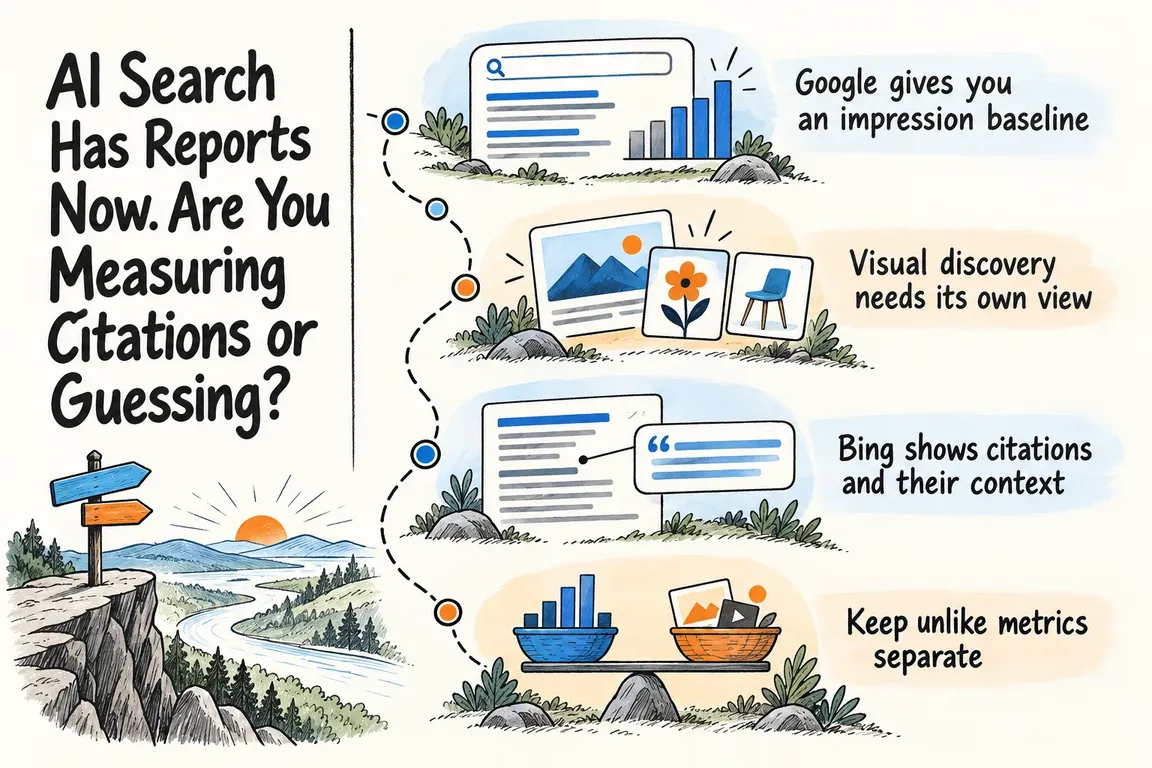
Google gives you an impression baseline
Google says its Generative AI performance report became available to websites worldwide on August 31, 2026. It covers impressions from AI Overviews and AI Mode, while excluding experiments that are still running in Search Labs.
Google records an impression when a link to the site appears in a supported generative AI feature. Results can be grouped by page, country, date, or device. That gives a team something concrete to work with: which pages are appearing, where the exposure comes from, whether it is mainly mobile, and whether visibility is moving over time.
There are reporting details worth documenting from the start. Page data is generally assigned to the canonical URL rather than every duplicate URL that resolves to the same content. Dates use Pacific Time, and the report carries familiar Search Console limitations, including a 1,000-row limit. Property-level chart totals may also differ from page-table totals because those views aggregate data differently.
An export still needs interpretation. Google notes that values shown as unavailable in the interface appear as zero in downloaded data. If that distinction disappears from the reporting notes, someone may later read every zero as proof that no activity occurred.
Visual discovery needs its own view
On September 24, Google announced web multimodal Search performance reporting. Its new search-type filter covers searches where an image forms part of the query, including Lens, Circle to Search on Android, image uploads to Google Search, and Chrome’s “Search this image” action.
This matters for retailers, manufacturers, travel businesses, publishers, and other sites where images carry real discovery value. A product page could receive little exposure from text queries while appearing regularly when people search with photographs. Reporting those modes separately reveals the pattern without implying that an impression became a visit or sale.
Bing shows citations and their context
Bing takes a citation-led approach. Its February AI Performance public preview reports how publisher content appears across Microsoft Copilot, AI-generated Bing summaries, and selected partner integrations.
The dashboard includes total citations, the average number of unique cited pages per day, sampled grounding queries, URL-level citation activity, and trends over time. Those numbers have clear limits. Microsoft says a citation count does not reveal where the citation appeared in an answer. Average cited pages does not indicate ranking, authority, or the role a page played in a particular response. URL-level activity measures citation frequency, not page importance.
In June, Bing added Intents, Topics, Citation Share, and Compare. Intents place grounding queries into broader contexts such as informational, commercial, navigational, research, creation, local, and learning or problem-solving. Topics cluster related queries, while Compare overlays reporting periods to make changes easier to examine.
Citation Share supplies relative context. It represents the percentage of citations attributed to a site among all citations shown for the same grounding query. Microsoft describes it as an observational metric. It is not a ranking system, traffic share, quality score, or competitive scoreboard, and it does not disclose competitor domains.
| Reporting view | Useful business question | What it cannot establish |
|---|---|---|
| Google AI impressions | Which canonical pages appear, and how exposure varies by date, country, or device | Whether an appearance produced a visit, lead, or sale |
| Google multimodal filter | Whether visibility came from an image-assisted search instead of a text-only search | Which individual visual asset caused the appearance |
| Bing URL citations | Which URLs were cited and how their citation activity changed | Placement, authority, ranking, or a page’s role in an individual answer |
| Bing intent, topic, and share | Where citations are concentrated by context and theme, and their relative share | A universal GEO score, traffic share, or content-quality grade |
Keep unlike metrics separate
A Google impression and a Bing citation are different events from different ecosystems. Adding them together would create a neat total with no reliable meaning. A sound reporting model keeps the original platform, surface, metric, date range, and dimensions attached to every record.
URL normalization deserves particular attention. Google generally assigns page data to the canonical URL, whereas Bing reports citation activity for specific URLs. Differences in protocol, hostname, redirects, tracking parameters, and duplicate paths can split one logical page across several rows. A canonical URL map can consolidate those identities while preserving the reported URL for investigation.
Timing can distort comparisons too. Google dates operate in Pacific Time, so daily figures may not line up cleanly with an export from another platform. Weekly or monthly periods are often easier to use in management reporting, as long as the boundaries remain consistent.
Build a workflow that produces decisions
The report becomes useful when the same sequence can be repeated each period:
- Confirm access and record the baseline. Check that the correct properties are available in both webmaster platforms, then document the first reporting period and its coverage.
- Export the context with the numbers. Retain the platform, search type, date range, URL, country, device, intent, topic, and query-level fields whenever they are supplied.
- Reconcile page identities. Map redirects and duplicate URLs to the intended canonical page. Keep the originally reported URL so technical issues can still be traced.
- Segment the data before reading the trend. Separate Google’s text-based and multimodal impressions. For Bing, keep raw citation volume distinct from intent, topic, and Citation Share.
- Compare stable periods. Look for sustained movement rather than reacting to a single day. Bing warns that citation patterns can shift with user behaviour, model changes, freshness signals, partner refresh cycles, and wider changes across the web.
- Use patterns to frame investigations. Check crawl access, canonical duplication, freshness, page structure, completeness, and internal routes to important pages. These are sensible diagnostic areas, not guaranteed ways to earn a citation.
That final distinction matters. When visibility falls, first identify where and when the change occurred. A rewrite may be appropriate, but the report should provide evidence before anyone reaches for one. If a topic grows, inspect the relevant pages and the context in which they appeared. Avoid turning a promising movement into a claim that the site has somehow “won” AI search.
Measure first, then decide what to improve
There is still plenty these reports cannot show. Google provides impressions rather than answer-level citation share. Bing’s features remain in preview, its grounding queries are sampled, and its classifications may be broad for specialised subjects. Neither platform’s visibility metrics can stand in for commercial outcome data.
They do replace a large part of the guesswork with observable platform data. Greg can configure both webmaster platforms, normalize the exports, reconcile canonical URLs, and build a recurring report that keeps each metric in context. The result is a baseline that can guide technical and editorial priorities without relying on an invented “GEO score.”
If AI visibility matters to your acquisition strategy, start with a measurement system you can inspect and explain. Once that baseline is reliable, decisions about crawlability, duplication, freshness, internal linking, images, and content structure become easier to prioritise and evaluate over time.
Related on GrN.dk
- That AI Crawler Says It’s Google. Can Your Edge Prove It?
- WordPress 7.1 Adds a Performance Lever Your Host May Already Use
- Before You Buy a GPU: Test Your Team’s Local AI Workload
Need help with this kind of work?
Build your AI visibility baseline Get in touch with Greg.