By Greg Nowak. Last updated 2026-10-10.
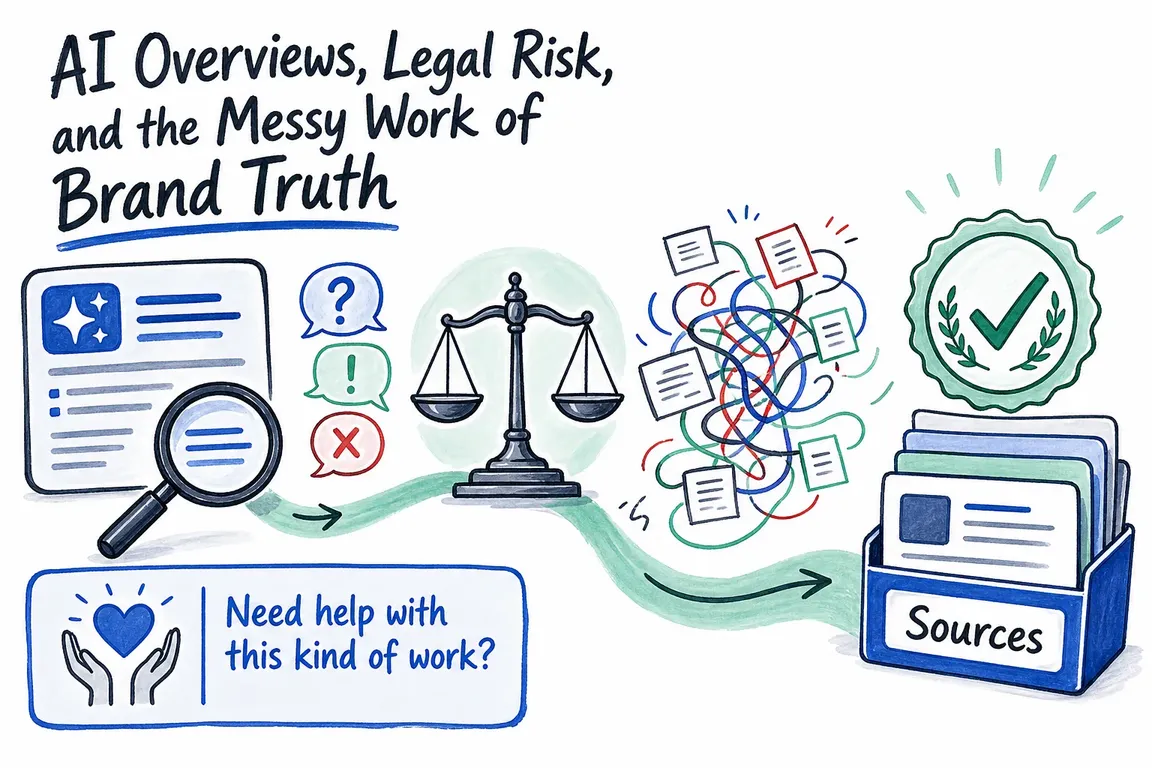
A potential customer searches for your company and sees an AI Overview with the wrong price, an outdated service description, or an allegation about another business. Before they reach your website, you have a trust problem. For business owners, operations leads, and agency teams, the useful question is what to do next: preserve the evidence, identify where the claim came from, correct what you control, and give someone responsibility for following through.
Clearer public information helps buyers verify your business and gives search systems better evidence. It cannot guarantee that an AI answer will be accurate. That distinction matters when deciding what work to commission and what results to expect.
What the legal developments actually tell us
On 28 May 2026, the Munich I Regional Court issued a judgment in interim injunction proceedings concerning false AI Overview claims about two publishers. It treated the generated statements as content attributable to Google, rather than ordinary links to third-party material. However, the official Bavarian court record now states that the parties settled after Google appealed, leaving the judgment without effect. It illustrates a liability argument; it does not establish a settled rule governing every AI search error.
Separately, the UK Competition and Markets Authority imposed publisher requirements on 3 June 2026. Its August implementation summary sets 3 December 2026 as the compliance deadline, with three additional months for page-level controls. The requirements cover content-use controls, attribution, and transparency, without penalising publishers elsewhere in Search for opting out. As of 10 October 2026, the implementation period is still running. Check what is available for your market before changing settings.
Start with the searches that affect buying decisions
Build a manageable watchlist using questions customers and sales teams actually encounter: company name, pricing, service availability, product comparisons, cancellation terms, reviews, and complaints. Include executive names or similarly named businesses where confusion is plausible. Prioritise errors that could change a purchase decision or damage trust.
For each problematic answer, save the exact query, date, country, language, screenshot, generated wording, and cited URLs. Note whether you used AI Overviews or AI Mode. Repeat important checks under comparable conditions; one screenshot is evidence of one answer, rather than a complete picture of visibility.
Open the cited pages and find the passage that supposedly supports the claim. Google says its AI search features may run multiple related searches, so examine the actual citations rather than assuming the first organic result supplied the answer.
| What you find | First action | Suggested owner |
|---|---|---|
| An outdated fact on your website | Correct the primary page and related documents | Content or product owner |
| Conflicting prices or policies | Agree the current fact and align every active version | Operations with marketing |
| Confusion with another company | Clarify identity, location, and relevant relationships | Web team with communications |
| An inaccurate external source | Request a correction with supporting evidence | Communications or account lead |
| A claim unsupported by its citations | Preserve the answer and report the specific error | Incident owner; legal where warranted |
Give important claims a clear home
Create a claim inventory: legal company identity, services, operating locations, pricing conditions, refund policies, security statements, and current partnerships. For each claim, record its approved wording, supporting evidence, responsible person, primary public URL, and next review date. A shared spreadsheet is enough to start.
Then work through contradictions. Align the pricing page with sales documents. Update old biographies and directory listings you control. Replace superseded PDFs or clearly identify them as historical. Consolidate duplicate pages where appropriate, preserving useful material and redirecting replaced URLs to relevant content.
Write facts with their conditions attached. For example, an illustrative price statement such as “Plans start at €X per month, excluding VAT, with annual billing” is easier to interpret than a price detached from its terms. Put essential information in visible text and clear headings.
According to Google’s guidance for website owners, supporting pages must be indexed and eligible for snippets. Check important URLs in Search Console, confirm that crawling is allowed, and keep structured data consistent with visible content. No special AI schema or AI text file is required, and eligibility does not guarantee inclusion.
Understand controls before applying them
Google-Extended governs specified Gemini training and grounding uses; blocking it does not remove a site from Google Search or switch off AI Overviews. Treat claims that an “AI crawler block” fixes Search summaries with care.
Google documents nosnippet, data-nosnippet, max-snippet, and noindex as controls for limiting information in Search. Their effects extend beyond a single inaccurate answer; noindex removes a page from search eligibility. Review the visibility trade-off and allow for recrawling before judging a change.
For an inaccurate Overview, use its negative-feedback option and Report a problem. Identify the exact statement, explain the error, and provide supporting evidence. Keep the submission record. Serious allegations deserve prompt review by an appropriate legal adviser alongside operational corrections.
Make correction work part of normal operations
Assign one person to coordinate the issue, even when marketing, legal, product, and an agency all contribute. Keep an issue log linking each observed error to evidence, source changes, reports, and follow-up checks. Agree who approves sensitive claims before publication.
Measure what you can observe: fewer contradictory pages, completed corrections, recurring answer errors, and relevant enquiries. Google currently includes AI feature traffic within Search Console’s Web reporting, so that report alone cannot isolate the accuracy or commercial effect of AI Overviews. Avoid promising a visibility uplift from cleanup.
Get the first audit into motion
A useful starting brief is a priority query list, an evidence log, a claim-to-page map, and a correction backlog with named owners. Greg can help structure this work through GrN and coordinate the people responsible for publishing and follow-up. Discuss your AI search brand accuracy work with Greg if you need a practical plan your team can maintain.
Related on GrN.dk
- AI Search Is Eating the Click: Measure Before You Rewrite
- Google Review Link Generators: What Small Teams Actually Need
- Google’s AI Search Toggle Is a Publishing Decision, Not an SEO Setting
Need help with this kind of work?
Discuss your AI search brand accuracy work with Greg Get in touch with Greg.