By Greg Nowak. Last updated 2026-09-20.
A scanner finds an Apache version below 2.4.68 and raises an alert. At first glance, the conclusion seems obvious: Apache lists several vulnerabilities as fixed in 2.4.68, so an older version must still be exposed.
On many Linux servers, that is only part of the story. Supported distributions often apply security fixes to an older software branch without moving the package to the latest upstream release. A package labelled 2.4.58 or 2.4.52 may therefore include the relevant fix. The reverse can also be true: a reassuring version number means little when Apache came from an unmanaged repository, an old container image, a custom build or a stale package mirror.
The practical question is whether the installed and running Apache instance contains the fixes that matter for its configuration—and whether you can prove it.
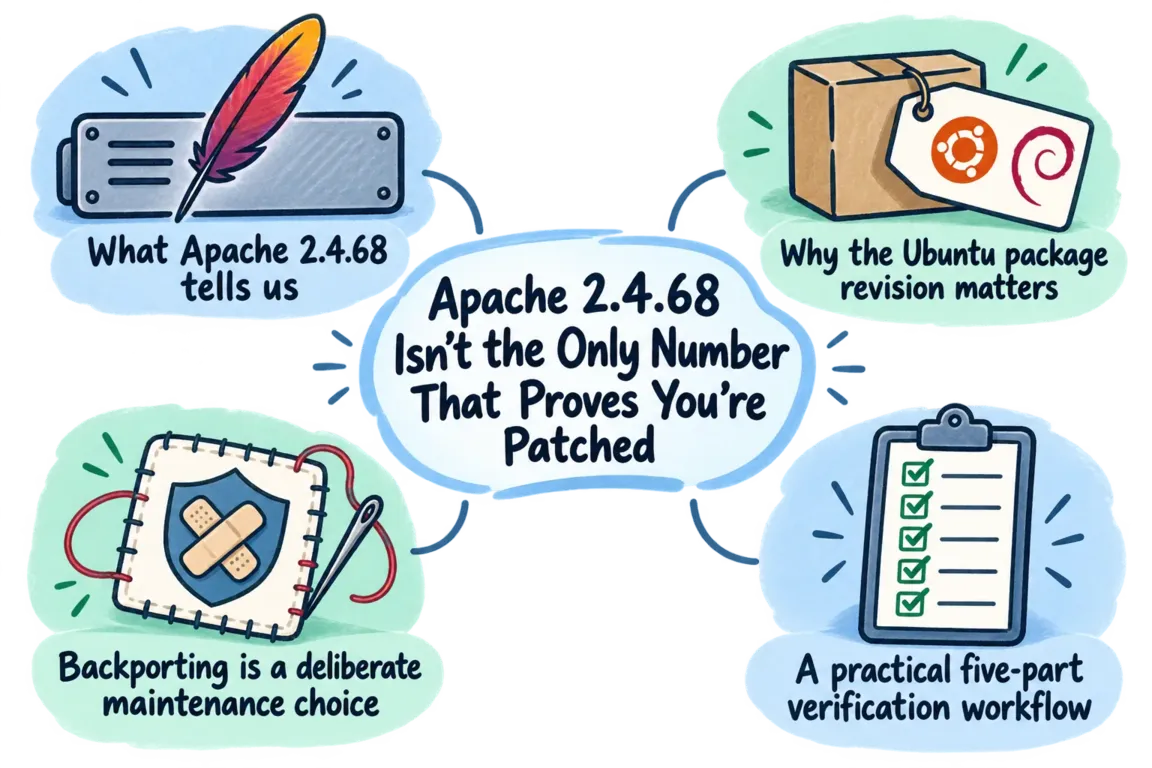
What Apache 2.4.68 tells us
The Apache Software Foundation released Apache HTTP Server 2.4.68 on 8 June 2026 as a security, feature and bug-fix release. Its vulnerability list records several issues as fixed in that release, affecting components including mod_ldap, mod_proxy_ftp, mod_proxy_html, mod_dav_fs, mod_xml2enc, mod_ssl and mod_http2.
That makes 2.4.68 the relevant upstream reference point. It does not turn the upstream version string into a universal pass-or-fail test for Linux packages. Apache’s release information shows where fixes entered the upstream branch. A distribution advisory shows where they entered that vendor’s package branch.
The vulnerability descriptions also have different prerequisites. One issue concerns outbound OCSP requests in mod_ssl; others depend on specific proxy, WebDAV, header, MIME or HTTP/2 behaviour. The version can identify a finding worth investigating, but the exposure assessment still depends on which modules and features are actually in use.
Why the Ubuntu package revision matters
Ubuntu’s status page for CVE-2026-44185 is a useful example. Apache identifies versions 2.4.0 through 2.4.67 as affected, with 2.4.68 as the upstream fix. Ubuntu records the same issue as fixed in packages based on earlier upstream versions: 2.4.66-2ubuntu2.4 for Ubuntu 26.04 LTS, 2.4.58-1ubuntu8.15 for 24.04 LTS and 2.4.52-1ubuntu4.23 for 22.04 LTS. Older supported channels have their own fixed revisions.
Comparing only the first three numbers with 2.4.68 would misclassify those packages. The full distribution revision, checked against the vendor’s CVE status, is the evidence that matters.
Ubuntu security notice USN-8384-1 shows the same pattern from another angle. Published on 4 June 2026, it addressed the HTTP/2 denial-of-service issue CVE-2026-49975 and listed fixed Apache packages for four Ubuntu releases. These included 2.4.58-1ubuntu8.13 for Ubuntu 24.04 LTS and 2.4.52-1ubuntu4.21 for 22.04 LTS. Apache’s upstream list later included that CVE among the issues fixed in 2.4.68.
A scanner that understands only upstream release numbers can therefore flag a correctly updated distribution package. Red Hat explicitly warns that version-only scanning and auditing can produce false positives because backported fixes are invisible to that method. Its guidance recommends correlating findings with vendor advisories and points to machine-readable advisory data for automated checks.
| Evidence to collect | What it establishes | What still needs checking |
|---|---|---|
| Apache banner or upstream version | The upstream release the build resembles | Whether the distribution backported a fix |
| Full installed package revision | The exact vendor package on the system | Whether it came from a supported source |
| Vendor CVE page or security notice | The package revision containing the vendor’s fix | Whether the updated binary is running |
| Module and configuration inventory | Whether issue-specific components and conditions are present | Whether the reachable service has been retested |
| Runtime and external verification | What is running and exposed now | How the package was built and maintained |
Backporting is a deliberate maintenance choice
Red Hat describes backporting as taking the fix for a security flaw from a newer upstream release and applying it to the older package version maintained by the distribution. There is a practical reason for doing this. An upstream release may bundle a security correction with new features, unrelated bug fixes or interface changes. Replacing the entire package can create compatibility work, including the need to rebuild modules.
By isolating and testing the security correction, a distribution can protect a stable package branch without importing every other upstream change. “Latest upstream” and “secure vendor package” are related ideas, but they are not interchangeable. A direct upstream installation may need 2.4.68 for these fixes; a maintained distribution package may carry selected fixes under an older-looking version. Package origin decides which rule applies.
A practical five-part verification workflow
1. Establish the operating system and package origin
Begin with the host or image itself, not the HTTP banner. Record the distribution release, support channel, Apache package name, complete package revision and repository origin. Find out whether the software is a vendor package, a third-party build, a container layer or a locally compiled binary. Vendor guidance only applies when the installed software belongs to the package stream covered by that guidance.
2. Match the complete revision to vendor guidance
Check the full revision against the vendor’s CVE page or security notice. Do not shorten 2.4.58-1ubuntu8.15 to 2.4.58. That suffix identifies Ubuntu’s successive package updates and may be the difference between vulnerable and fixed. Keep a record of the advisory, its fixed revision and the installed revision so someone else can reproduce the decision.
3. Check whether the vulnerable conditions are present
Use Apache’s vulnerability descriptions to test relevance. Is the named module loaded? Is the affected protocol or proxy mode enabled? Does exploitation depend on an untrusted backend, a WebDAV content author, outbound OCSP communication or local permission to create .htaccess files? Configuration checks do not replace patching, but they do show whether the vulnerable path is active.
4. Verify that the updated process is running
A fixed package on disk does not help if an older Apache process remains in memory. Confirm that the service was restarted after the update, then verify that the live process is using the expected packaged binary and libraries. This closes a common gap between package-manager records and runtime reality.
5. Retest the service clients actually reach
Repeat the external check from the relevant network position. Include reverse proxies, load balancers, multiple nodes and stale container replicas in the investigation. Evidence from one host cannot prove that every responding instance has been updated.
What a defensible remediation record contains
A useful remediation note records the operating-system release, package source, complete installed revision, applicable CVE or advisory, relevant module state, restart confirmation and external retest result. Any remaining exception should be explicit—for example, an unmanaged build that cannot inherit the distribution vendor’s security status.
This gives the scanner result proper context without waving it away. It can close a false positive when the evidence supports that conclusion, while still uncovering outdated processes, unmanaged packages or inconsistent nodes that a banner check would miss.
Greg can coordinate the work: trace the package’s provenance, map its revision to vendor advisories, inspect the Apache modules that matter, confirm the updated process is live and retest the public endpoint. The deliverable is a patch conclusion that a client, security reviewer or auditor can follow and verify.
Related on GrN.dk
- Apache 2.4.67: Why Legacy Reverse Proxies Belong Back on the Risk List
- MCP 2026-07-28 Is an Auth Migration, Not a Version Bump
- Before You Buy a GPU: Test Your Team’s Local AI Workload
Need help with this kind of work?
Get a defensible Apache patch review Get in touch with Greg.