By Greg Nowak. Last updated 2026-10-23.
When a customer asks where their parcel is, the answer needs to match their specific order. AI customer service can retrieve information from the online store and shipping setup and explain it in Danish. This requires a defined workflow: verify the customer's identity, find the order, retrieve the available delivery information and hand over the case if anything is missing or inconsistent. Agree from the outset on what the AI is allowed to answer.
Could your business use this? nowa.dk sets up AI automation for Danish companies.
In the run-up to the Christmas shopping season, repetitive order questions are a natural starting point for trying out the solution. Keep the first version focused on reading and explaining status information. Address changes, cancellations and other actions can wait until you have seen the information workflow work in practice.
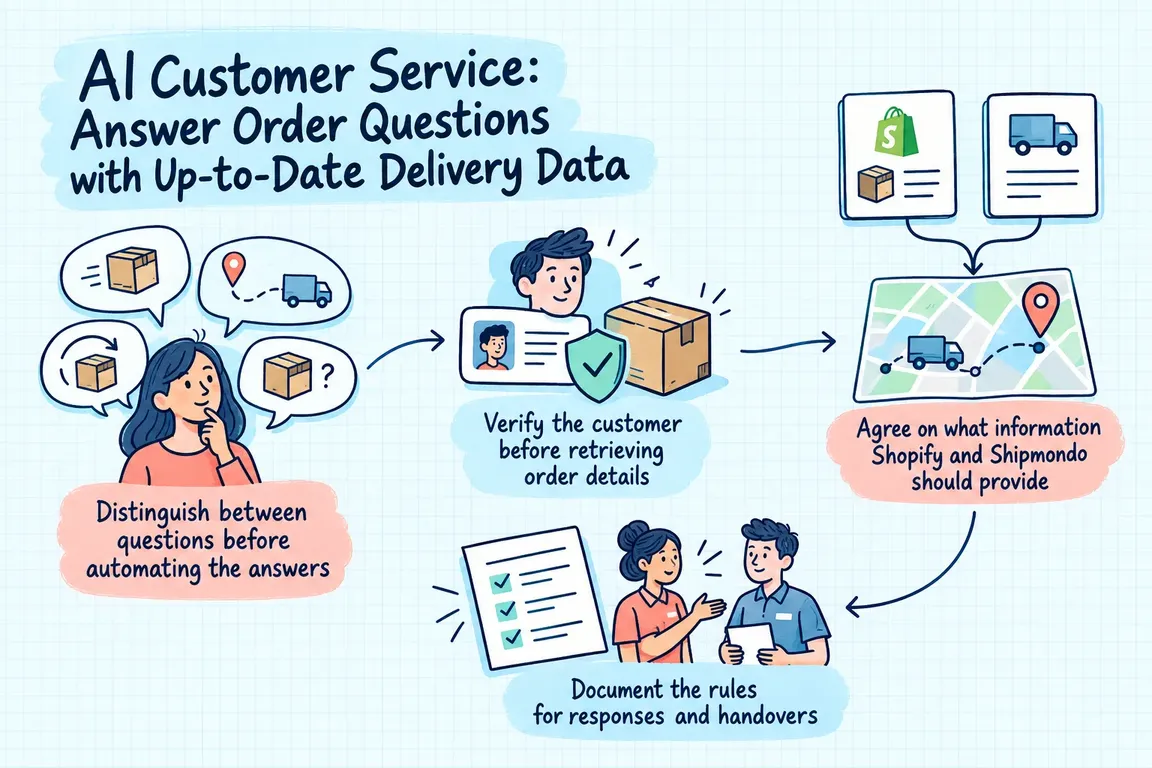
Distinguish between questions before automating the answers
Questions about dispatch, tracking and missing deliveries can look similar in the inbox. Yet they require different information and sometimes a member of staff's judgement. Review a sample of your own enquiries and use them to define the situations the solution should handle.
Zendesk's guide to use cases for AI agents describes how a customer's question is linked to a particular procedure, dialogue or response. Order status is one of the examples. Both the name and the description of the use case affect how the AI agent recognises the enquiry.
Describe each situation briefly: what information does the answer require, what may the customer be told and when should a member of staff take over? If a parcel is marked as delivered but the customer has not received it, the first version should hand over the case. That boundary needs to be written into the workflow so that both implementation and quality checks can follow it.
Verify the customer before retrieving order details
Identity verification must happen before the lookup that brings order details into the conversation. For example, you could use an authenticated customer session or verification through a contact channel already associated with the customer. Choose a method that fits your existing customer access arrangements and have the technical verification mechanism tested separately.
An order number entered by the customer is not sufficient proof of identity. The integration layer must check which orders the verified customer is authorised to access. Only then may the AI receive the order details. If verification fails, the customer should still be able to get help, but the response must not reveal any information about the order.
It is important here to distinguish between two types of access. The integration's access to the online store allows it to retrieve data. Customer verification determines which of that information each customer may see. Both must be explicitly addressed in the solution.
Agree on what information Shopify and Shipmondo should provide
Shopify's documentation for order lookups describes how to retrieve an order using its ID. Among other things, the lookup provides access to order information and fulfilment status. The examples also show shipments with a carrier, tracking number and tracking URL. By default, only orders from the past 60 days are available; access to older orders requires additional permission.
The customer's order number must therefore be linked to the correct internal order ID after identity verification. At the same time, decide which fields the AI needs. It should be possible to answer a question about dispatch without sending the customer's entire order history to the language model.
Shipmondo's API introduction describes a REST API covering shipments and orders, among other things, along with webhooks that can notify you of specific events. This provides a foundation for the integration. However, the introduction does not establish that all the carrier statuses you want are available. You need to confirm this for your specific setup, along with how current the information is.
Agree on a source for each piece of information and record both the time of the lookup and the timestamp of the status, where available. A new lookup can return an old status. If the systems show different information, the case must be passed to a member of staff with both observations attached.
Document the rules for responses and handovers
The table below can serve as a starting point for the first version. Adapt the rules to the information the integration actually provides and have the person responsible for customer service approve them.
| Situation | What the AI may say | What the solution must do |
|---|---|---|
| The customer's identity has not been verified | Ask the customer to complete identity verification. | Stop before looking up order details. |
| Verified customer, unambiguous status and valid tracking | Explain the recorded status and provide the tracking option. | Answer the question within the approved workflow. |
| The order is split across multiple shipments | Describe the shipments separately if their relationship to the order is clear. | Hand over the case if it is unclear which items are included in each shipment. |
| Status information is missing or the lookup fails | Explain that the status cannot be confirmed. | Hand over the case with the reason for the error. |
| The sources show conflicting information | Explain that the delivery needs further investigation. | Send both sets of status information to the member of staff. |
| The parcel is marked as delivered, but the customer has not received it | Acknowledge the problem without drawing conclusions about the cause. | Have a member of staff investigate the case. |
The Danish response must stick to what you know
The AI's writing task can be quite simple: explain the retrieved status in plain Danish, include relevant tracking information and tell the customer what happens next. An estimated delivery date may only be included if it is present in the underlying data. Any qualifications attached to that date must also appear in the response.
Review what your status labels mean. A shipment that has been created may only be described as handed over to the carrier if the information supports that statement. If no delivery date is available, the response should leave it open rather than insert a likely date or time.
Have the customer service team read the responses as part of the approval process. Customers need to understand what you know, what remains uncertain and what happens next. That assessment is necessary even when the order lookup itself works technically.
Give staff what they need to take the case forward
A handover requires more than a message to the customer. You also need to agree on who receives the case and when automation may take over again.
In Zendesk's description of handovers, the conversation is passed from AI to a member of staff through the established routing process. The AI agent can then no longer respond in that conversation. The guide also describes how closing the case allows the AI to handle a new conversation.
Send a brief summary containing the customer's question, the identity verification result, the relevant status information and the reason for the handover. If a lookup failed, the member of staff needs to be able to see that. An empty status does not show whether the information is missing or the system was unable to retrieve it.
The customer must receive a clear message that the case has been passed on. Only give an expected response time if the business has defined one that applies to the specific queue and opening hours.
Test the workflow while there is still time to fix it
Start with draft responses approved by a member of staff. Test both ordinary orders and cases that could cause the workflow to go wrong: an incorrect order number, failed identity verification, multiple parcels, older orders and unresponsive systems. Pay particular attention to whether the solution stops at the points you agreed on.
Then use the results to assess the proportion of correct answers, the reasons for handovers and the need for subsequent corrections. Weigh this against integration and operating costs. You can add more types of questions once the initial, clearly defined workflow is working satisfactorily.
At nowa.dk, Greg's AI automation service for Danish businesses, Greg can help map your enquiries, set up lookups in Shopify and Shipmondo and configure AI to write Danish responses based on the information. An initial project can focus on order status, with agreed identity verification, data sources and handover procedures. This gives you a concrete workflow to test before the Christmas shopping season and evaluate before deciding on a wider rollout.
Related on GrN.dk
- Jeg bygger AI-agenter til små virksomheder. Jeg mangler en, der kan sælge dem.
- AI på bookingsiden: Hvad må den love kunden, før I taler sammen?
- Kunden beder om indsigt: Sådan hjælper AI med at samle svaret
Need help with this kind of work?
Talk to Greg about AI customer service Get in touch with Greg.