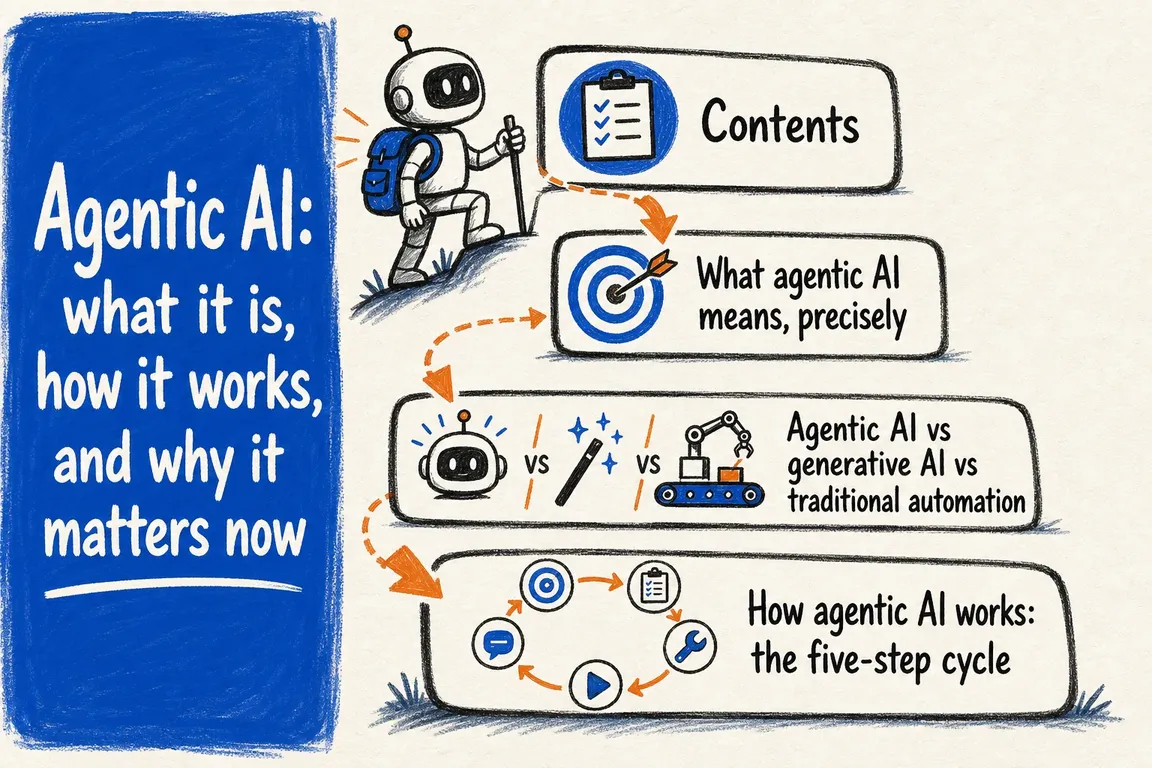
By 2023, 35% of organizations surveyed by MIT Sloan Management Review and Boston Consulting Group had already deployed AI agents, with another 44% planning to follow soon. Agentic AI is not a future concept. It is already running inside enterprise software, supply chains, and customer-facing platforms at scale, and the gap between organizations that understand it and those that do not is widening fast.
This article explains what agentic AI actually is, how it differs from generative AI and traditional automation, how the underlying architecture works, and what risks and governance challenges come with deploying it. Whether you are evaluating vendor platforms, designing a first deployment, or simply trying to understand what Nvidia CEO Jensen Huang meant when he called enterprise AI agents a multi-trillion-dollar opportunity at the 2025 CES keynote, this is the grounded starting point.
What agentic AI means, precisely
IBM defines agentic AI as an AI system that can accomplish a specific goal with limited human supervision. The system consists of AI agents, which are machine learning models that mimic human decision-making. In a multiagent setup, each agent handles a specific subtask, and an orchestration layer coordinates the whole process.
AWS adds two characteristics that sharpen the definition: agentic systems are proactive rather than reactive (they anticipate needs instead of waiting for instructions) and adaptable (they adjust behavior based on context and domain knowledge as conditions change).
Red Hat frames it more simply: agentic AI is software that requires minimal human intervention to complete a task. UiPath emphasizes the decision layer: an agentic system understands context, makes decisions, and takes action rather than just producing output.
The OECD published a February 2026 report (No. 56) that draws a useful distinction between AI agents and agentic AI. Agentic AI places stronger emphasis on coordination among multiple agents, task decomposition and delegation, sustained operation over time, and operation in genuinely complex environments. A single AI agent answering a question is not agentic AI. A system that breaks a procurement task into subtasks, assigns them to specialized agents, monitors progress, and adjusts when a supplier is out of stock, that is agentic AI.
MIT Sloan professor Sinan Aral, who studies management, IT, and marketing, states plainly that the agentic AI age is already here, with agents deployed at scale across industries. The challenge is no longer whether to adopt, but how to do it without creating governance and accountability gaps.
Agentic AI vs generative AI vs traditional automation
The distinction matters because the three categories require different infrastructure, different oversight, and different risk models.
Traditional automation follows fixed rules. A workflow tool executes step A, then step B, then step C. It does not reason about whether step B still makes sense if conditions changed between A and B. It is fast and predictable, but brittle when reality diverges from the script.
Generative AI, the category that includes large language models (LLMs) like GPT-4 or Claude, creates content based on a prompt. You give it a question or a task description, and it produces text, code, or structured data. It does not set goals, plan sequences of actions, or execute anything in the world. It generates.
Agentic AI goes further. It sets goals, plans multi-step sequences, executes actions (including calling external tools, APIs, and databases), evaluates results, and adjusts its approach. The LLM is still the reasoning engine inside an agentic system, but it is wrapped in a loop that gives it memory, tools, and the ability to act across time.
The UK Government AI Insights team illustrates this with an online ordering example. Traditional software follows a fixed sequence: create order, add items, process payment, distribute. An agentic system doing the same job autonomously looks up the best price across suppliers, considers competing prices, back-orders out-of-stock items, and offers different prices for different delivery schedules, all without a human directing each step. The output is the same (an order is placed), but the path is dynamic and goal-directed.
Understanding this difference is practical, not academic. If you are evaluating whether to use a workflow automation tool, a generative AI assistant, or a full agentic system for a given business process, the answer depends on how much variability and decision-making the task actually requires. For logistics optimization work, for example, the case for agentic approaches is strong precisely because supply chain conditions change constantly. You can read more about how AI is reshaping that domain in the logistics optimization in 2026 overview on GrN.dk.
How agentic AI works: the five-step cycle
Google Cloud describes agentic AI operation through a five-step framework that maps cleanly onto how most production systems are actually built.
Perception
The agent gathers data from sensors, databases, user interfaces, APIs, or documents. This is the input layer. Without good perception, the rest of the cycle produces unreliable results. Data quality and source governance matter here more than most teams expect before their first deployment.
Reasoning
An LLM analyzes the gathered data to understand context, identify what is being asked, and determine what information is still missing. This is where the generative AI component lives inside an agentic system. The LLM does not act here; it interprets.
Planning
The agent sets a goal (or receives one), breaks it into steps, and sequences those steps. In a multiagent system, this is where task decomposition and delegation happen. One agent might handle price lookups while another handles inventory checks, with an orchestrator managing the sequence and handling failures.
Action
The agent executes tasks: calling APIs, writing to databases, sending messages, triggering other agents, or interacting with external services. This is the step that makes agentic AI genuinely different from a chatbot. It does things in the world, not just in a conversation window.
Reflection
After acting, the agent evaluates results against the goal. Did the action succeed? Did conditions change? Does the plan need adjustment? This feedback loop is what allows agentic systems to handle unexpected situations rather than failing silently or producing wrong outputs without flagging them.
The Springer Nature Artificial Intelligence Review published a comprehensive PRISMA-based survey of 90 agentic AI studies from 2018 to 2025 (published November 2025). It maps this cycle onto a broader architectural framework that adds memory, role adoption, and online learning as distinct components. The infrastructure layer underneath includes state and memory management, orchestration, MLOps tooling, and agent safety mechanisms. Each of those components is a real engineering problem, not a checkbox.
For teams building on top of hosted AI platforms, the action and orchestration layers are where most of the implementation complexity concentrates. The shift from prompt design to schema design in intake automation is one concrete example of how that complexity surfaces in practice.
The two paradigms: symbolic vs neural agentic systems
The Springer survey introduces a dual-paradigm framework that most commercial vendor pages skip entirely, but it is practically important when choosing an architecture.
Symbolic (classical) agentic systems use explicit rules, logic, and structured knowledge representations
Symbolic (classical) agentic systems use explicit rules, logic, and structured knowledge representations. They are interpretable, auditable, and predictable. The Springer survey finding is clear: symbolic systems dominate safety-critical domains such as healthcare, where you need to explain every decision and guarantee that the system will not produce an unexpected output under edge conditions.
Neural (generative) agentic systems use LLMs and learned representations
Neural (generative) agentic systems use LLMs and learned representations. They handle ambiguity, natural language, and data-rich environments well. The survey finds neural systems prevail in adaptive, data-rich environments such as finance, where conditions change faster than rules can be updated.
Most real deployments are not purely one or the other. The Springer review identifies hybrid neuro-symbolic architectures as a critical research gap, meaning the field does not yet have mature, reproducible methods for combining the two approaches. Organizations building in regulated industries should treat this as a signal to be conservative about how much they rely on neural components for decisions that require auditability.
This also connects to how you evaluate an agentic system. The Springer review identifies a deficit in reproducible evaluation protocols, particularly for long-horizon tasks and interactive testing. If a vendor cannot explain how they test their agentic system across multi-step tasks, that is a real gap, not a minor detail.
Major vendor platforms and where they sit
Several large vendors have moved from describing agentic AI to shipping production platforms. The table below summarizes the main options based on publicly available information. Pricing and feature sets change frequently; treat this as a starting orientation, not a procurement guide.
| Vendor | Platform name | Primary positioning | Notable characteristic |
|---|---|---|---|
| Google Cloud | Gemini Enterprise Agent Platform | Train, build, and deploy agentic models with MLOps tools | Full ML lifecycle management; Gemini model family |
| AWS | Amazon Bedrock Agents | Autonomous agents acting toward pre-determined goals | Multi-agent orchestration; proactive and adaptable design |
| IBM | watsonx | Goal-directed agents with limited supervision | Multiagent coordination; enterprise governance focus |
| Microsoft | Copilot Studio | Agentic capabilities embedded directly in software platforms | Deep integration with Microsoft 365 and Azure |
| Salesforce | Agentforce | Agentic capabilities embedded in CRM workflows | Customer-facing automation; Sales Cloud integration |
Microsoft and Salesforce are particularly notable because they are embedding agentic capabilities directly into software that organizations already use, rather than requiring a separate platform adoption. That lowers the barrier to a first deployment but also means agentic behavior can appear in production environments before teams have thought through the governance implications.
For teams running on OpenAI's API stack, the shift toward agentic patterns has its own infrastructure implications. The guardrails and run-state design for internal agent rollouts is one area where the operational complexity becomes concrete quickly. Similarly, MCP access and internal tool exposure introduces governance questions that do not exist in simpler prompt-response setups.
Adoption rates and business context
The MIT Sloan Management Review and BCG spring 2025 survey found that 35% of respondents had adopted AI agents by 2023, with 44% planning deployment in the near term. That is a fast adoption curve for enterprise technology.
Anthropic's 2026 State of AI Agents Report adds specificity to where the value is landing. Beyond coding assistance, the highest-impact use cases are data analysis and report generation (60% of respondents cite this as one of the most impactful applications) and internal process automation (48%). Enterprises specifically are bullish on data analysis and reporting, with 65% citing these as high-impact applications.
Jensen Huang's framing at the 2025 CES keynote, that enterprise AI agents represent a multi-trillion-dollar opportunity across industries including medicine and software engineering, reflects where the market is heading. But MIT Sloan's Sinan Aral adds a necessary counterweight: even cutting-edge companies do not fully grasp how to use AI agents to maximize productivity. The gap between deploying agents and deploying them well is significant.
Anthropic's research on agent autonomy shows a pattern worth noting: users grant Claude Code more autonomy as they gain experience. Newer users (under 50 sessions) use full auto-approve roughly 20% of the time. By 750 sessions, that figure rises to over 40%. Autonomy tends to expand with familiarity, which makes it important to set governance boundaries before familiarity builds, not after.
For teams running AI-assisted workflows, cost control is a real operational concern as agent usage scales. The Cloudflare AI Gateway spend limits article on GrN.dk covers how token-based cost tracking works in practice, which becomes relevant as agentic systems make more API calls per task than simple prompt-response setups.
Risks, governance, and what organizations need before deploying
Agentic AI introduces risks that do not exist in simpler AI setups, and most organizations are not fully prepared for them.
Multi-agent security and accountability gaps
When multiple agents coordinate, the question of who is responsible for a bad outcome becomes genuinely difficult. If agent A passes a flawed instruction to agent B, which then calls an external API that produces a harmful result, the accountability chain is not obvious. The Springer survey identifies multi-agent safety frameworks as a critical research gap, meaning the field does not yet have consensus on how to handle this.
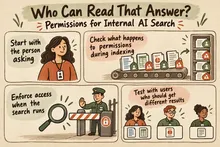
Prompt injection is a specific attack vector that becomes more dangerous in agentic systems because the agent has real tools and can take real actions. A visitor injecting malicious instructions into a chat interface that connects to an agentic backend can potentially trigger actions far beyond what a simple chatbot would allow. The prompt injection controls article on GrN.dk covers the attack surface in practical terms.
Data quality and retrieval governance
Agentic systems that retrieve information to support decisions are only as good as the knowledge they can access. Agentic RAG (Retrieval Augmented Generation), identified in the Springer review as a key method for next-generation trustworthy agentic systems, requires careful attention to what enters the knowledge base, how it is segmented, and how it expires. The retrieval governance challenges with OpenAI File Search illustrate what this looks like in a real deployment context.
Emergent behaviors and energy costs
Agentic systems can produce emergent behaviors: outcomes that were not explicitly programmed and that arise from the interaction of multiple agents or from the agent's learned behavior over time. These are difficult to predict and test for, particularly in neural systems. The Springer review flags this as an open research problem.
Running agentic systems at scale also carries real energy costs. Each task that previously required one LLM call now requires multiple calls across a planning-action-reflection cycle, plus tool calls to external services. Organizations with sustainability commitments should factor this into their deployment planning.
Formal strategy and risk assessment
MIT Sloan's Sinan Aral calls for every organization to have a formal agentic AI strategy with systematic risk assessment. That means documenting which processes are candidates for agentic automation, what the failure modes are, what human oversight checkpoints exist, and how the system will be audited over time. Most organizations that have deployed AI agents have not done this work explicitly.
For teams managing API keys and credentials that agentic systems use to take actions, key hygiene is a direct security concern. The API key expiry and access control guidance on GrN.dk is a practical starting point. The AI automation tag on GrN.dk collects related operational articles in one place.
Memory, state management, and long-horizon tasks
One of the less-discussed but practically important aspects of agentic AI is how systems handle memory and state across a long task. A simple LLM call is stateless: the model has no memory of previous interactions unless you explicitly include them in the prompt. Agentic systems need persistent memory to function across multi-step tasks that may span minutes, hours, or longer.
The Springer holistic review identifies state and memory management as a distinct infrastructure component, separate from the reasoning and planning layers. In practice, this means decisions about what to store, how long to retain it, and how to retrieve it efficiently are architectural decisions that affect both system performance and data governance.
Agentic RAG is the primary technical approach for giving agents access to external knowledge during long tasks. Rather than loading all relevant information into a context window (which has size limits and cost implications), the agent retrieves relevant chunks on demand. The quality of that retrieval directly affects the quality of the agent's decisions. Poor retrieval produces confident-sounding but wrong actions, which is worse than a system that fails visibly.
For teams building internal knowledge retrieval into agentic workflows, the retrieval governance article on GrN.dk covers the organizational decisions that sit underneath the technical implementation. The web search and citation controls article covers the equivalent challenges when the agent retrieves from the open web rather than internal documents.
Agentic AI in practice: what deployment actually looks like
The gap between a demo and a production agentic system is larger than most teams expect. A demo shows the happy path: the agent receives a clear goal, retrieves accurate information, plans correctly, and executes without errors. Production systems encounter ambiguous goals, missing data, API failures, conflicting instructions, and edge cases that were not in the training distribution.
Several patterns appear consistently in successful deployments. First, narrow scope at launch. An agent that handles one well-defined process reliably is more valuable than an agent that handles ten processes inconsistently. Second, human-in-the-loop checkpoints for high-stakes actions. The Anthropic autonomy research shows that users expand autonomy over time as trust builds; starting with more oversight and relaxing it deliberately is safer than starting permissive and trying to add controls later. Third, structured outputs at integration points. When one agent passes results to another, or when an agent writes to a database, structured output formats reduce the failure rate significantly. The structured outputs and intake automation article on GrN.dk covers why this matters operationally.
The arxiv paper analyzing 177,000 MCP (Model Context Protocol) tools found that Claude dominates MCP tool usage, with its share rising from lower figures to 62% by February 2026. MCP is the emerging standard for giving agentic systems access to external tools and data sources. Understanding how MCP works and what governance it requires is becoming a practical necessity for teams building agentic systems. The MCP access governance article on GrN.dk covers the control surface in detail.
For organizations running content-heavy websites alongside agentic AI tools, the interaction between AI crawlers and your content is a separate operational question. The AI crawler control guide on GrN.dk covers how to manage that boundary. And as AI systems increasingly surface brand information in search results, the brand summary accuracy and source-of-truth cleanup article addresses what happens when agentic AI search surfaces incorrect information about your organization.
What comes next in agentic AI research
The Springer review identifies several open problems that will shape how agentic AI develops over the next few years. Hybrid neuro-symbolic architectures are the most significant: combining the interpretability of symbolic systems with the flexibility of neural systems is an unsolved engineering challenge. Governance models for symbolic agentic systems are underdeveloped. Reproducible evaluation protocols for long-horizon tasks do not yet exist in standardized form. Multi-agent safety frameworks are still early-stage research.
The OECD's February 2026 report signals that regulatory attention is increasing. The report analyzes how agentic AI features relate to core AI system elements under the OECD AI system definition, which is the framework that informs AI policy in most OECD member countries, including Denmark. Organizations operating in regulated sectors should track how that framework develops, because it will shape what documentation and oversight agentic deployments require.
vThe integration of online learning with long-term memory is another open problem. Current agentic systems mostly operate with fixed model weights and dynamic retrieval. Systems that genuinely learn from their own operational history, updating their behavior based on what worked and what did not, are technically possible but raise significant alignment and safety questions that the research community has not resolved.
Frequently asked questions about agentic AI
What is the simplest definition of agentic AI?
Agentic AI is an AI system that can pursue a goal through multiple steps with minimal human supervision. It perceives its environment, reasons about what to do, plans a sequence of actions, executes those actions using tools and APIs, and evaluates whether the goal was achieved. Unlike a chatbot, it acts in the world rather than just generating text.
How is agentic AI different from a chatbot or a generative AI tool?
A chatbot responds to a single prompt and produces a single output. Generative AI creates content based on instructions. Agentic AI sets goals, plans multi-step sequences, calls external tools, and adjusts its approach based on results. The key difference is that agentic systems take actions with real consequences, not just produce text for a human to act on.
What is a multiagent system?
A multiagent system is an architecture where multiple AI agents each handle a specific subtask, coordinated by an orchestration layer. One agent might handle information retrieval, another might handle decision-making, and a third might handle output formatting. The orchestrator manages the sequence, handles failures, and ensures the overall goal is met.
What are the main risks of deploying agentic AI?
The main risks are: accountability gaps when multiple agents interact and produce a bad outcome; prompt injection attacks that exploit the agent's ability to take real actions; data quality problems that cause the agent to act on incorrect information; emergent behaviors that were not anticipated during testing; and autonomy creep, where users gradually grant more permissions than the governance framework intended. MIT Sloan's Sinan Aral recommends a formal strategy with systematic risk assessment before deployment.
Which vendors offer agentic AI platforms?
Google Cloud (Gemini Enterprise Agent Platform), AWS (Amazon Bedrock Agents), IBM (watsonx), Microsoft (Copilot Studio), and Salesforce (Agentforce) are the main enterprise platforms. OpenAI's API stack also supports agentic patterns through its Responses API and tool-calling capabilities. Each platform has different strengths depending on whether you need deep integration with existing software, full ML lifecycle management, or flexibility in model choice.
How do I start with agentic AI without taking on too much risk?
Start with a single, well-defined process where the failure mode is visible and recoverable. Add human-in-the-loop checkpoints for any action that writes to a database, sends a message, or calls an external service. Use structured outputs at every integration point. Document the governance framework before you expand scope. Treat the first deployment as a learning exercise, not a production system, until you have observed how the agent behaves across a range of real inputs.
Agentic AI is not a single technology you adopt once. It is a design pattern that requires ongoing attention to data quality, security boundaries, and governance as the system's scope expands. The organizations that get the most value from it are the ones that treat the governance work as seriously as the engineering work, and that build the habit of reviewing agent behavior systematically rather than assuming it will stay within intended boundaries. If you are building or evaluating agentic AI systems and want to discuss the architecture or implementation specifics, the services page on GrN.dk covers where Greg's IT architecture and consulting work can help.