By Greg Nowak. Updated 7 August 2026.
CSV imports look simple until a supplier changes its delimiter, Excel adds a byte-order mark, a duplicate heading hides a column, or one malformed price reaches the database. The parser may need only a few lines of PHP; the dependable business process around it takes more thought.
For business owners, operations leads, and agency teams, the right question is not “Which library has the shortest example?” It is “How expensive will a bad row be, and how quickly can a user understand and correct it?” Stable internal feeds can stay close to PHP core. Customer-facing and supplier-driven workflows usually justify stronger header, encoding, and error-handling support.
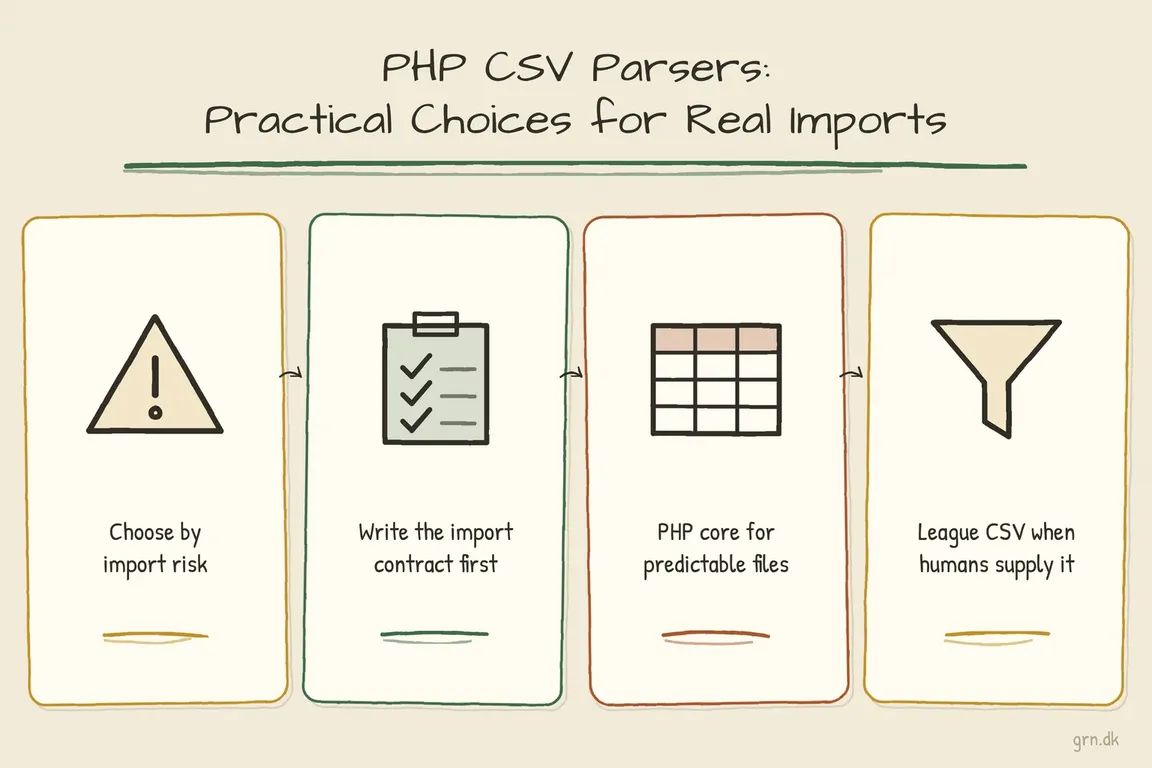
Choose according to import risk
| Import situation | Practical starting point | Main concern |
|---|---|---|
| Controlled export with a fixed schema | fgetcsv() |
Explicit CSV controls and row validation |
| Large recurring backend job | SplFileObject |
Streaming, batching, logging, and restartability |
| Supplier or client upload | league/csv |
Headers, BOMs, encodings, and actionable errors |
| Legacy utility or exploratory intake | ParseCsv | Delimiter detection and PHP-version testing |
Write the import contract before the parser
Document the delimiter, enclosure, character encoding, required and optional headings, accepted date and decimal formats, maximum file size, duplicate policy, and what should happen when one row fails. Decide whether the import is all-or-nothing or permits partial success.
This contract should also define business rules. Can a missing SKU be created automatically? Does an unknown customer block the file? Is a blank price genuinely empty or equivalent to zero? A CSV reader cannot answer these questions, but the importer must.
Use PHP core for predictable files
fgetcsv() remains a sound default when your team controls the export. It reads incrementally, avoids another dependency, and keeps memory use predictable. One detail now matters: since PHP 8.4, relying on the default escape argument is deprecated. PHP recommends passing an empty string explicitly to disable its proprietary escape mechanism and use doubled quotation marks inside enclosed fields.
<?php
$handle = fopen('/path/to/import.csv', 'r');

if ($handle === false) {
    throw new RuntimeException('The import file could not be opened.');
}

$expected = ['sku', 'name', 'price'];
$header = fgetcsv($handle, 0, ',', '"', '');

if ($header !== $expected) {
    throw new RuntimeException('The CSV headings do not match the template.');
}

while (($row = fgetcsv($handle, 0, ',', '"', '')) !== false) {
    if ($row === [null]) {
        continue;
    }

    if (count($row) !== count($header)) {
        // Record the row number and reject or quarantine the row.
        continue;
    }

    $record = array_combine($header, $row);
    // Normalize values, validate business rules, then stage the record.
}

fclose($handle);
SplFileObject provides a convenient iterator for recurring jobs. Configure it just as explicitly:
<?php
$file = new SplFileObject('/path/to/import.csv', 'r');
$file->setCsvControl(',', '"', '');
$file->setFlags(
    SplFileObject::READ_CSV
    | SplFileObject::READ_AHEAD
    | SplFileObject::SKIP_EMPTY
    | SplFileObject::DROP_NEW_LINE
);
The combination of SKIP_EMPTY and DROP_NEW_LINE handles blank records, while READ_AHEAD helps avoid an unwanted final iteration. The iterator is useful structure, but it does not supply header mapping, encoding conversion, or business validation by itself.
Use League CSV when humans supply the file
For an admin upload, agency handover, marketplace feed, or recurring supplier file, league/csv is the package I would normally evaluate first:
composer require league/csv:^9.0<?php
use League\Csv\Reader;
$csv = Reader::from('/path/to/import.csv', 'r');
$csv->setHeaderOffset(0);
foreach ($csv->getRecords() as $offset => $record) {
// $record is keyed by the heading row; validate before writing.
}League CSV skips an input BOM by default, can work with stream filters for encoding conversion, and rejects duplicate header names when records are accessed. Its reader also normalizes records to the header width: missing fields become null, while extra fields are truncated. That convenience is not validation. Check required values and column expectations before accepting the file.
Keep ParseCsv in the convenience-tool category
ParseCsv offers automatic delimiter detection, encoding conversion, offsets, limits, and straightforward manipulation. Those features can help with legacy code or exploratory intake where the file shape is not yet known.
composer require parsecsv/php-parsecsvFor a new, long-lived platform, assess it more cautiously. Its current README confirms compatibility only through PHP 8.3, so test the exact PHP version and representative files used in production. Automatic detection should propose settings or support triage; it should not silently redefine the contract for a financial, catalogue, or customer-data import.
Design the recovery path, not only the happy path
- Validate before changing live data. Parse into a staging area, then promote valid records or process small controlled batches.
- Return useful errors. Include the row, field, rejected value, expected format, and whether anything was committed.
- Make retries safe. Use stable business keys and an import identifier so a corrected upload does not create duplicates.
- Keep an audit trail. Retain the original file according to an agreed policy, plus its checksum, parser settings, user, timestamps, and import outcome.
- Test real failure cases. Cover quoted line breaks, semicolon delimiters, duplicate headings, UTF-8 and UTF-16 files, blank rows, missing fields, extra columns, and interrupted jobs.
A dependable CSV import is a small operational product: it has an owner, a documented contract, understandable feedback, and a recovery path. If your current workflow depends on manual spreadsheet cleanup or risky reruns, Greg can help turn it into an import process your team can support confidently.
Related on GrN.dk
- AI agents need a browser policy before they start clicking around
- Debugging PHP: A Practical Workflow for Faster Fixes
- OpenAI File Search: Internal Docs Need Governance Before Trust
Need help with this kind of work?
Plan a dependable CSV import with Greg Get in touch with Greg.