By Greg Nowak. Last updated 2026-07-25.
When mailR fails on an Ubuntu server, email is often not the real problem. The package depends on rJava, which must load a compatible Java Virtual Machine before mailR can contact an SMTP server.
The familiar error is:
libjvm.so: cannot open shared object file: No such file or directoryThe usual first fix remains:
sudo R CMD javareconfThat may restore a broken reporting job in seconds. For a production workflow, however, the useful question is not simply “Does it work in my SSH session?” It is “Will it still work tonight under cron, systemd, Shiny Server, or the account that runs the client report?”
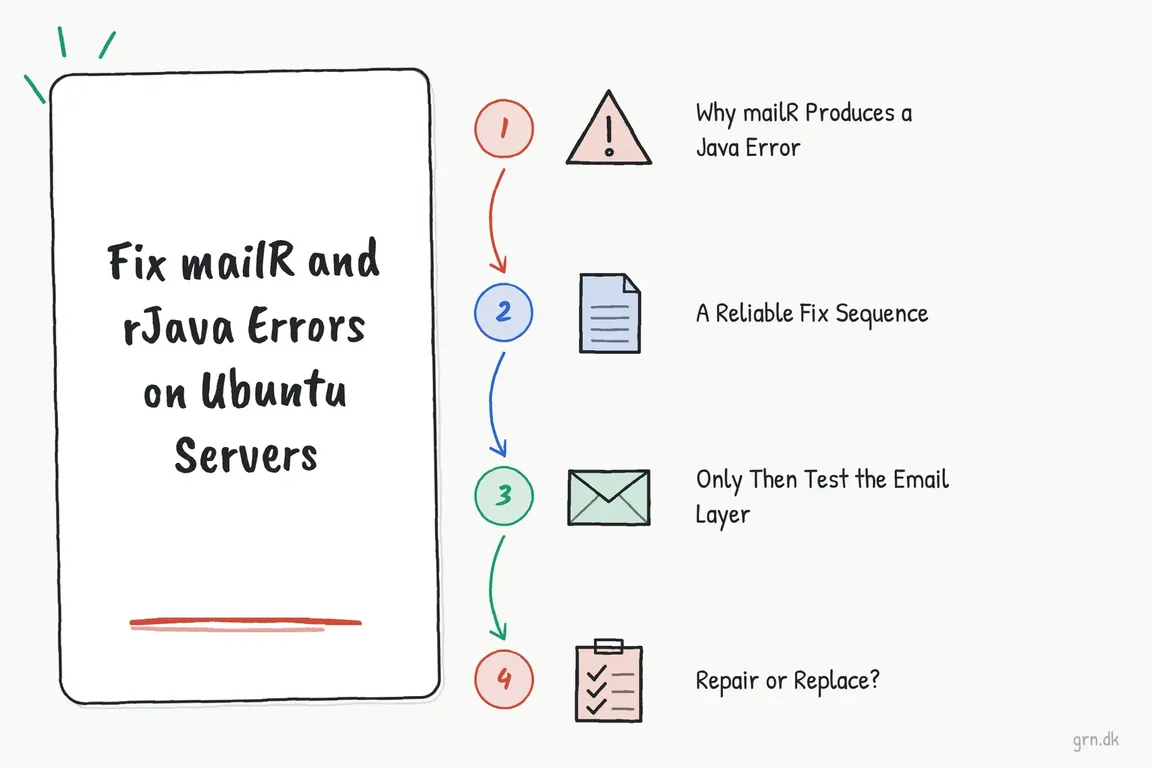
Why mailR Produces a Java Error
mailR provides an R interface to Apache Commons Email and imports rJava. This creates several separate failure points: the Ubuntu JDK, R’s Java configuration, the compiled rJava package, the production user’s environment, and finally the SMTP connection.
As of July 2026, CRAN lists mailR 0.8, published in December 2021, with Java as a system requirement. The package remains usable, but its age and Java dependency are worth considering when designing a new automation. Meanwhile, rJava is actively packaged on CRAN and requires a JDK and GNU make on Linux.
A Reliable Fix Sequence
Work through the layers in order. Changing several paths at once makes the immediate error harder to diagnose and the eventual server configuration harder to maintain.
- Confirm both Java tools are available.
javaproves that a runtime exists;javacconfirms that the development kit needed to build Java-integrated packages is installed.
java -version
javac -version
readlink -f "$(command -v java)"
If javac is missing, install Ubuntu’s distribution-selected JDK:
sudo apt update
sudo apt install default-jdk- Ask the correct R installation to detect Java again. For a system installation owned by root, run:
sudo R CMD javareconfR’s administration manual notes that javareconf must be run by the account that owns the R installation. If the server has several R installations, do not assume the first R in your interactive path is the one used by production. Check with which R and inspect the service definition.
If several JDKs are installed, select the intended one explicitly before reconfiguring. The path varies by Ubuntu release and processor architecture, so verify it under /usr/lib/jvm rather than copying a path from another server.
ls -la /usr/lib/jvm
sudo env JAVA_HOME=/usr/lib/jvm/java-21-openjdk-amd64 R CMD javareconf- Rebuild rJava when necessary. If it was installed before the correct JDK was available—or copied from another server—reinstall it using the account and R library that production actually uses:
R -q -e 'install.packages("rJava", repos="https://cloud.r-project.org")'- Test the bridge without mailR. This separates Java loading from SMTP configuration:
R -q -e 'library(rJava); .jinit()'
R -q -e 'cat(system.file("libs", package="rJava"), "\n")'
If this test fails, changing mail server credentials will achieve nothing. Resolve the R-to-Java layer first.
| Symptom | Likely layer | Best next action |
|---|---|---|
java or javac is missing |
Ubuntu packages | Install default-jdk |
libjvm.so cannot be opened |
R’s Java paths | Run R CMD javareconf as the R installation owner |
rJava will not install or load |
Compiled package | Verify the JDK, reconfigure R, then rebuild rJava |
| Works in SSH but fails on schedule | Service environment | Test as the production user and declare required settings in the service |
rJava loads but mail is not sent |
SMTP or network | Check host, port, TLS, authentication, and outbound access |
Test the Production Account, Not Just Yourself
Scheduled processes commonly receive a smaller environment than interactive shells. A JAVA_HOME export in one administrator’s profile will not necessarily reach cron or systemd.
Run the Java test as the service account, using the R binary invoked by the real job:
sudo -u <service-user> -H /usr/bin/R -q -e 'library(rJava); .jinit()'If the service needs an explicit variable, define it in the cron entry, systemd unit, container configuration, or deployment tooling. Avoid a global LD_LIBRARY_PATH workaround unless you understand what else it may affect. R supports R_JAVA_LD_LIBRARY_PATH for already-installed Java packages, but its manual says it must be set before R starts. Usually, a correct JDK selection followed by javareconf is easier to document.
Only Then Test the Email Layer
Once rJava loads, test mailR with a controlled recipient. Its documented debug = TRUE option can expose the SMTP conversation and help distinguish authentication, TLS, DNS, firewall, and recipient errors. Use debug output temporarily and handle the logs as operational data.
Keep credentials outside the R script, record the R and package versions used by the job, and make failed sends visible somewhere other than the email channel being tested. A reporting workflow should return a non-zero status, write a useful log, or alert through an independent monitoring system.
Repair or Replace?
If a stable script broke after a Java upgrade or server migration, repairing rJava is normally the least disruptive choice. For a new workflow, compare that repair burden with a mail package that does not require Java or a transactional email API. Consider authentication policy, attachments, audit requirements, delivery reporting, and who will maintain the automation next year.
If a mailR failure is holding up reports or client delivery, Greg can help diagnose the server, make the scheduled workflow reliable, and document the result.
Related on GrN.dk
- Sending Mail from a Linux Server with Postfix: A Reliable, Relay-First Setup
- AI automations need a spend dashboard before the first runaway bill
- Cockpit, Monit, ISPConfig, or Landscape: Which Fits Your Ubuntu Servers?
Need help with this kind of work?
Get help with your R server workflow Get in touch with Greg.