By Greg Nowak. Updated 26 September 2026.
Browser automation is useful when someone repeatedly signs into a web portal, follows predictable steps, and produces a file, screenshot, check, or record. Common examples include downloading supplier reports, checking campaign launches, reconciling orders, testing forms, and gathering evidence from authenticated systems.
The browser is rarely the hardest part. The real challenge is turning those clicks into a workflow that colleagues can trust, review, and repair. A script that works on its author’s laptop is only a prototype; a business automation also needs ownership, safeguards, useful failure evidence, and a clear definition of success.
Should this process use browser automation?
Document the current workflow in plain language before choosing a tool. Record what triggers it, which account it uses, the decisions a person makes, the expected output, and who handles exceptions. Walk through awkward cases such as expired sessions, missing reports, duplicate records, consent banners, partial downloads, and unexpected pop-ups.
Then check whether the system offers an API, webhook, scheduled export, managed integration, or approved database connection. These routes are usually more stable because they do not depend on an interface designed for people. Browser automation is appropriate when no suitable backend route exists, the task is frequent and consistent, and the value exceeds the ongoing maintenance cost.
Choose a narrow first project: one portal, one useful output, and one named reviewer. Avoid starting with a process that spans several organisations or requires frequent judgement. Every extra login, hand-off, and branching decision increases the number of ways a run can fail.
Playwright, Selenium, or R: which tool fits?
For a new JavaScript or TypeScript workflow, Playwright is usually the strongest starting point. It supports Chromium, Firefox, and WebKit. Its locators re-resolve elements and automatically wait for them to become actionable, while web-first assertions retry expected conditions. Traces can capture actions, DOM snapshots, and network activity, making a failed scheduled run much easier to investigate.
Selenium remains a sound choice when an organisation already has WebDriver tests, Selenium Grid infrastructure, established language expertise, or specific compatibility requirements. Selenium Manager is included with Selenium releases and normally handles drivers when none has been supplied. The project still describes Selenium Manager’s versioning as beta, so test upgrades in your own runtime rather than treating browser management as maintenance-free.
R teams have two distinct options. RSelenium connects R to Selenium Server or a remote WebDriver environment and may suit an existing Selenium estate. Its documentation and examples deserve careful validation against the browser and server versions you plan to operate.
For Chromium-focused work in R, chromote is often the cleaner starting point. It implements the Chrome DevTools Protocol, offers synchronous and asynchronous interfaces, and includes convenient navigation and screenshot methods. It can also select a version from Chrome for Testing, reducing surprises caused by an automatically updated local browser.
| Situation | Starting point | Why |
|---|---|---|
| New portal workflow or end-to-end check | Playwright | Modern locators, automatic waiting, assertions, and traces |
| Existing WebDriver suite or Selenium Grid | Selenium | Fits established infrastructure and team expertise |
| R process already using remote WebDriver | RSelenium | Minimises change, provided compatibility is verified |
| R workflow focused on Chromium or screenshots | chromote | Direct DevTools integration and versioned browser options |
| Vendor offers a suitable API or scheduled export | Use the supported interface | Usually more stable than controlling the visible UI |
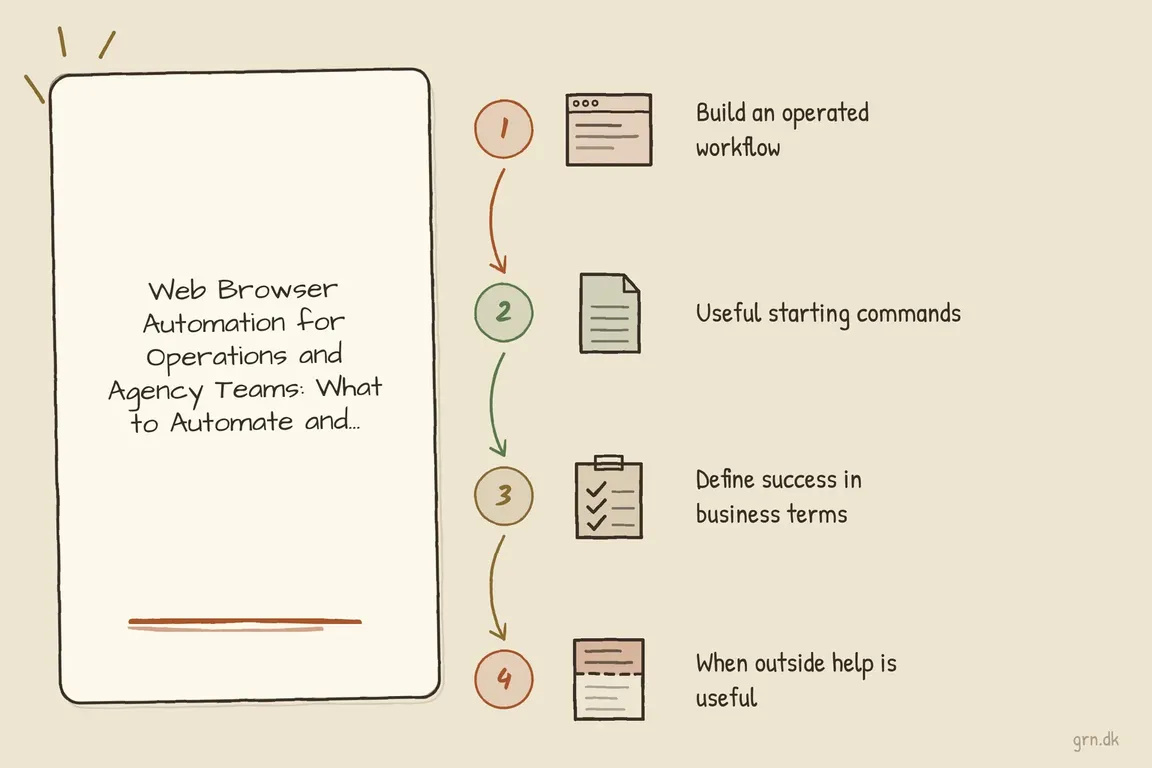
Build a workflow your team can operate
Use a dedicated integration or service account where the provider permits one. Keep passwords, tokens, cookies, and saved browser sessions out of source code; restrict access and document rotation. Do not design around bypassing CAPTCHA, multi-factor authentication, rate limits, access controls, or provider terms. If a sensitive action needs human confirmation, make that an explicit step.
Prefer accessible roles, labels, visible text, and stable test IDs over long CSS or XPath expressions copied from developer tools. Selectors tied to page structure tend to break during harmless redesigns. After every important action, verify a meaningful outcome: the correct account is open, the reporting period is right, a confirmation appeared, or the downloaded file exists and contains plausible data.
Each run should finish as completed, needs review, or failed. Log major steps without exposing credentials or personal data. When something fails, retain the page URL, timestamp, concise error, and—where appropriate—a screenshot or trace. An alert is useful only if a named person knows what to do with it.
Useful installation commands
These commands provide sensible starting points from the current project documentation:
# Create and run a Playwright Test project
npm init playwright@latest
npx playwright test

# Install browser binaries and OS dependencies in CI
npx playwright install --with-deps

# Install the released R packages
install.packages("RSelenium")
vignette("basics", package = "RSelenium")

install.packages("chromote")
Before scheduling a run, use realistic test accounts and data, deliberately force several failures, and confirm that somebody other than the author can pause, rerun, and diagnose it. Pin dependencies where reproducibility matters, then update them through a deliberate test-and-release process.
Measure business reliability, not just time saved
For an agency, the useful output might be a client-readable bundle of timestamped screenshots, validation results, and exceptions. For an operations team, it could be a correctly named report in the expected folder or a review ticket containing enough context to act.
Track manual time removed alongside failed runs, human interventions, false confirmations, and maintenance effort. A task that saves ten minutes but regularly demands developer attention is not mature automation. It may need a smaller scope, a supported integration, or a human checkpoint.
Know when to bring in outside help
Outside support becomes valuable when a workflow crosses systems, depends on authenticated sessions, handles customer data, or must run reliably without a developer watching it. The important work includes process design, security, exception handling, deployment, monitoring, and handover—not merely scripting clicks.
If you are evaluating a repetitive browser workflow, Greg can help determine whether it belongs in an API integration, Playwright, Selenium, or an R-based process, then shape a first version that your team can understand and operate.
Related on GrN.dk
- Agentic AI: What It Is, How It Works, and When to Use It
- AI automations need a spend dashboard before the first runaway bill
- NGINX 1.30 changed upstream connection reuse: what to check before you upgrade
Need help with this kind of work?
Discuss your browser automation workflow Get in touch with Greg.