By Greg Nowak. Updated 23 September 2026.
AI search reporting has moved beyond screenshots and repeated test prompts. Google now provides dedicated generative AI visibility reports in Search Console, while Bing Webmaster Tools shows when pages are cited across supported AI experiences.
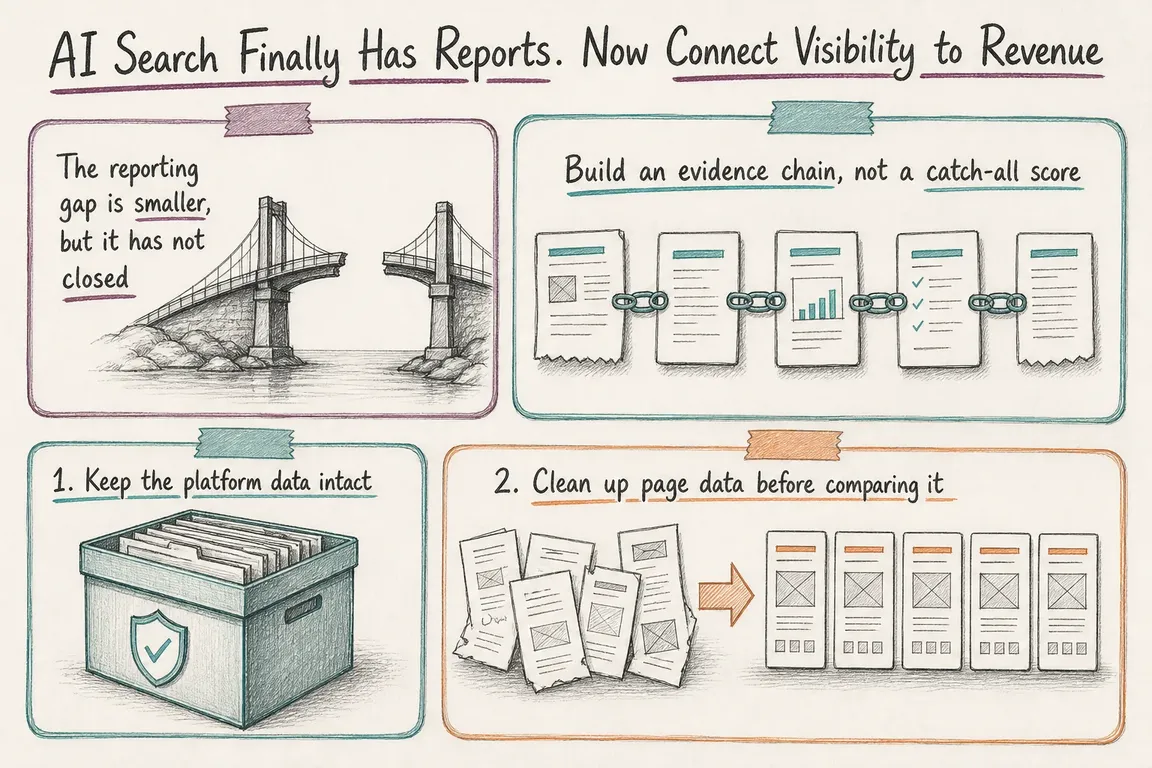
That is meaningful progress, but it does not solve attribution. An impression is not a visit, a citation is not a lead, and neither is revenue. The useful work is building an evidence chain that helps your team decide which pages to improve, which topics deserve investment, and whether relevant demand reaches the sales pipeline.
What Google and Bing can now tell you
Google’s Generative AI performance report covers impressions from AI Overviews and AI Mode. It identifies appearing pages and provides country, date, and device breakdowns. Google says these insights were rolled out to all websites worldwide on 31 August 2026, although sites with insufficient activity may still have little or no reportable data.
The report is useful for answering questions such as: Which product guides appear most often? Is visibility concentrated in one country? Did impressions change after a major content update? It does not reveal the user’s exact prompt, the generated answer, or the commercial value of an appearance.
Bing’s AI Performance report takes a different approach. It reports citations and cited pages across Microsoft Copilot, AI-generated Bing summaries, and selected partner integrations. Its grounding queries are grouped retrieval phrases, not transcripts of individual user prompts. Preview features also include topics, intent classifications, citation share, and period comparisons.
Bing explicitly warns that its aggregated, sampled data is intended for trend analysis. A citation does not represent a ranking, click, endorsement, or complete record of every time a page was used.
| Evidence | What it answers | What it cannot prove | Useful next action |
|---|---|---|---|
| Google AI impressions | Which pages appeared, where, and when? | That the appearance was noticed or produced a visit | Review visibility by page, market, and reporting period |
| Bing citations | Which pages and themes were used in supported AI answers? | Ranking, traffic, authority, or exact user prompts | Map commercially relevant grounding queries to cited pages |
| Analytics activity | What did identifiable visitors do on the website? | Every journey influenced by an off-site AI answer | Compare landing-page engagement and key events |
| CRM outcomes | Did enquiries become suitable leads, opportunities, or sales? | That AI visibility alone caused the outcome | Connect page groups to lead quality and pipeline stages |
Build the reporting chain in five practical steps
1. Start with a baseline you can audit
Export the Google and Bing reports on a consistent schedule. Retain the original platform, date range, page, market, device, query grouping, and any available intent or citation-share fields. Both products provide report downloads; Bing supports CSV and Excel exports.
Begin with a monthly process before commissioning a complicated dashboard. It reveals whether the available volume justifies automation and gives the team a clean specification for anything built later.
2. Create one dependable page map
Reporting becomes confusing when redirects, parameters, translated URLs, and trailing-slash variants are treated as different assets. Map exported URLs to a canonical page, content type, market, owner, and commercial role. A lightweight spreadsheet is enough for a smaller site; Python or a data transformation workflow becomes useful when the same cleanup must run repeatedly.
Google generally assigns report data to canonical URLs, but your analytics and CRM exports may not. Perform the normalization before joining datasets, not after drawing conclusions.
3. Separate visibility from attributable traffic
In analytics, review landing pages alongside session source and medium, engagement, and key events. Google Analytics defines source and medium as traffic-source dimensions used for attribution. They can describe a recorded visit, but they cannot reconstruct an AI-influenced journey when no identifiable referral reaches the site.
Keep four layers in the report: AI visibility, identifiable visits, on-site actions, and CRM outcomes. Do not invent a multiplier for untracked influence. “Unknown” is a valid result and considerably safer than a confident attribution percentage with no supporting evidence.
4. Carry meaningful conversions into the CRM
A form submission is only an intermediate event. Join it, where consent and data governance allow, to qualification status, opportunity stage, and revenue. Use stable page categories rather than expecting sales teams to interpret hundreds of URLs.
This exposes an important distinction: a page can be highly visible but commercially irrelevant, while a lower-volume comparison or implementation page may assist better opportunities. The right priority is not always the largest number.
5. Review changes without claiming causation
Record publication dates, substantial edits, technical fixes, and campaign activity. Compare equivalent periods and annotate platform incidents. If visibility rises after an update, treat that as a reason to investigate—not proof that the edit caused the increase. Demand, competitors, model changes, and reporting systems can all move at the same time.
Fix eligibility before producing more “AI content”
When a valuable page is absent, check the basics first. Google’s official guidance for AI features says a page must be indexed and eligible to appear with a snippet. It also recommends crawlable content, useful internal links, good page experience, visible text, and structured data that matches the page.
Google does not require a special AI schema or a new machine-readable “AI file.” Before rewriting, inspect indexing, canonicalization, robots rules, snippet controls, rendering, duplication, and internal discovery. Then assess whether the page answers a real customer need clearly and supports important claims with current evidence.
Make the report produce decisions
A useful monthly review should end with named actions: repair access to a valuable page, consolidate duplicates, update an outdated guide, improve the route to an enquiry, or stop investing in a topic that attracts the wrong demand. Give every action an owner and a date for reassessment.
Greg can help scope the measurement model, normalize exports, connect page-level evidence with analytics and CRM stages, and establish a review cadence that marketing, operations, and sales can actually use. The aim is not perfect attribution. It is a reporting system that clearly distinguishes what happened, what remains uncertain, and what the business should do next. Talk to Greg about putting that system in place.
Related on GrN.dk
- Google’s 2026 AI Search Guidance: SEO Still Matters, but Reporting Has Changed
- When Google can call the business, your local data stops being cosmetic
- Google’s AI Search Toggle Is a Publishing Decision, Not an SEO Setting
Need help with this kind of work?
Talk to Greg about AI search reporting Get in touch with Greg.