By Greg Nowak. Last updated 2026-08-05.
European data residency can look like a setting you switch on. For a live OpenAI API integration, it is an architectural change with consequences for routing, credentials, stored data, application behaviour and operating costs.
OpenAI applies residency at project level, and Europe must be selected when a new project is created. You cannot convert an existing project. Requests also need to use the European regional hostname, while the available endpoints, models, retention options and features may differ from the current setup.
So the job is not simply to move data. It is to keep the application working, put the intended privacy controls in place and produce evidence that technical, security and compliance stakeholders can rely on.
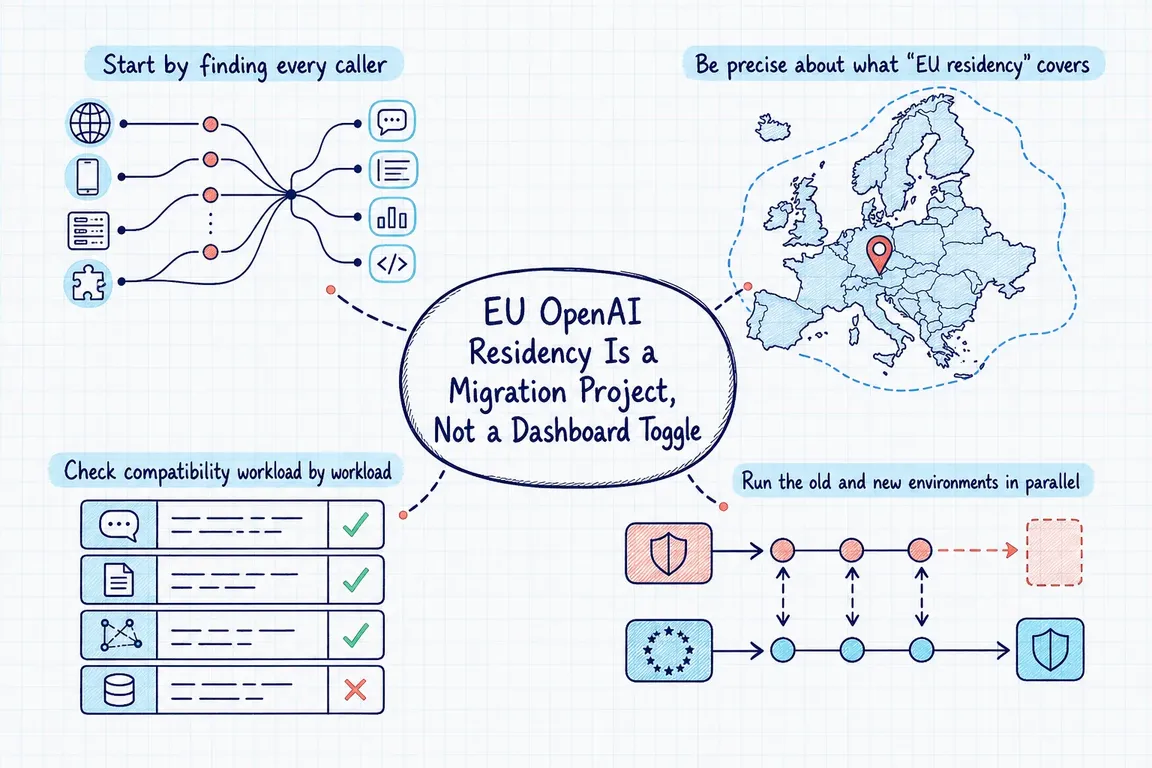
Start by finding every caller
OpenAI’s current documentation says residency is selected per project during creation. Its European residency announcement makes the practical constraint clear: an existing project cannot be updated after it has been created.
That matters because production use is rarely limited to the application everyone knows about. The same project may serve websites, internal tools, scheduled jobs, queue workers, serverless functions, integration platforms and developer utilities. Credentials and base URLs may be scattered across secret managers, deployment systems and application configuration.
Before creating the replacement project, build an inventory of those callers. Record the owner, environment, endpoint, model, authentication method, data category, expected volume and failure path for each one. Anything left unidentified may continue sending data through the old project after the migration is supposedly finished.
Be precise about what “EU residency” covers
Storage residency and regional processing are connected, but they are not interchangeable. OpenAI’s business-data overview says eligible API customers can select the US or Europe for data processing on supported endpoints. Its technical documentation also cautions that regional storage support does not automatically mean regional processing is supported.
Nor does the chosen region cover every type of information. OpenAI says system data, including account details, metadata, usage statistics, billing information and support requests, may be processed or stored outside the selected region. Customer infrastructure, end-user locations and third-party services can introduce further data flows beyond OpenAI’s regional boundary.
The project documentation needs to reflect that distinction. Saying “EU project enabled” is too broad to function as a useful control statement. Specify which customer content is stored in Europe, which processing happens there, what falls outside that scope and which organisational controls cover the remainder.
Check compatibility workload by workload
The current data-controls documentation lists Europe as supporting regional storage and processing through eu.api.openai.com. It also documents several limitations that can affect application behaviour:
- Chat Completions cannot use
store=truein non-US regions. - The Responses API cannot use
background=truein the EU region. - Realtime API tracing is not currently compliant with EU data residency.
- Model, endpoint, tool and regional-processing support must be checked against the current support matrix.
- Data sent to a remote MCP server is subject to that third party’s residency and retention policies.
Retention needs an equally detailed review. OpenAI treats abuse-monitoring logs separately from application state and publishes retention behaviour by endpoint. Some resources remain until they are deleted; others have shorter retention periods or retain no application state. Zero Data Retention and Modified Abuse Monitoring require approval. Non-US residency also requires approved abuse-monitoring controls and a Modified Retention amendment.
Pricing may change too. OpenAI currently applies a 10% uplift to residency endpoints for eligible models released on or after 5 March 2026. A meaningful cost comparison therefore needs the organisation’s real model mix and workload profile, not a generic token estimate.
| Migration gate | Evidence needed before cutover | Risk if missed |
|---|---|---|
| Caller inventory | A named owner and configuration location for every workload | Traffic continues through the old project |
| Compatibility | A checked matrix of endpoints, models, tools and parameters | Requests fail or application behaviour changes |
| Persisted state | An inventory of files, vector stores, batches and other resources | Retrieval data or dependent workflows go missing |
| Privacy controls | Approved retention settings and documented regional boundaries | Residency claims exceed the controls actually implemented |
| Operations | Monitoring, cost results, a rollback plan and a cutover owner | Problems are found late or cannot be reversed safely |
Run the old and new environments in parallel
The safer route is to provision the EU project alongside the existing one. This gives the team time to confirm eligibility and amendments, configure the European endpoint, issue replacement credentials and test the new environment before production traffic depends on it.
For each workload, compare its endpoint, model, parameters and tools with the European support matrix. Background processing, stored responses, Realtime tracing, file handling, vector stores and external services deserve particular attention. A feature may be technically available while carrying a different storage or processing profile.
Persisted state should be handled as a separate workstream. OpenAI documents application state for resources including files, vector stores, batches, conversations and fine-tuning jobs. Identify what the application still needs and what must be recreated through controlled ingestion. This is also a sensible point to remove obsolete material and reduce the personal data sent to the service.
Tests should cover representative workflows as well as failures and retries. Compare output quality, latency, rate behaviour and cost. Privacy checks should confirm that every intended caller uses the European hostname and its new credentials. Operational checks should make sure monitoring still catches failures without collecting unnecessary customer content.
Move traffic in controlled stages only after those checks pass. Keep a rollback path and monitor both projects during the transition. Old credentials should be revoked after residual traffic has been traced, not on an arbitrary date. The migration is complete when every old caller and retained resource has been accounted for.
Residency still needs API governance
The CNIL’s recommendation on sharing personal data through APIs treats security, data minimisation, access management and risk analysis as responsibilities across the full sharing chain. Applied here, that means reviewing who can obtain credentials, which fields are transmitted, what is logged, how secrets are rotated and how data-subject rights can be supported.
Server location is not the end of the regulatory analysis. The EDPB’s final guidance on Article 48 GDPR explains that requests from third-country authorities cannot automatically be recognised or enforced in Europe, including in processor and parent-company scenarios. European residency remains valuable, but it does not remove the need to assess wider transfer and access arrangements.
What the migration should leave behind
The finished project should produce more than a working endpoint. It should leave an accurate caller inventory, a compatibility record, documented data flows, approved retention controls, test evidence, cost findings, named operational owners and a clear decommissioning decision.
Greg can coordinate that work across application, infrastructure, privacy and vendor stakeholders. The remit can cover locating OpenAI dependencies, mapping incompatible behaviour, setting up the parallel EU project, supervising controlled ingestion, updating routing and secrets, and organising functional, privacy and cost acceptance before cutover.
The practical value lies in making the regional boundary real: correctly implemented in the technology, visible to the people operating it and supported by evidence when security or compliance teams ask how it works.
Related on GrN.dk
- AI agents need a browser policy before they start clicking around
- AI automations need a spend dashboard before the first runaway bill
- Cloudflare Workers can become shadow IT without an integration register
Need help with this kind of work?
Plan your EU OpenAI migration Get in touch with Greg.