By Greg Nowak. Updated 26 September 2026.
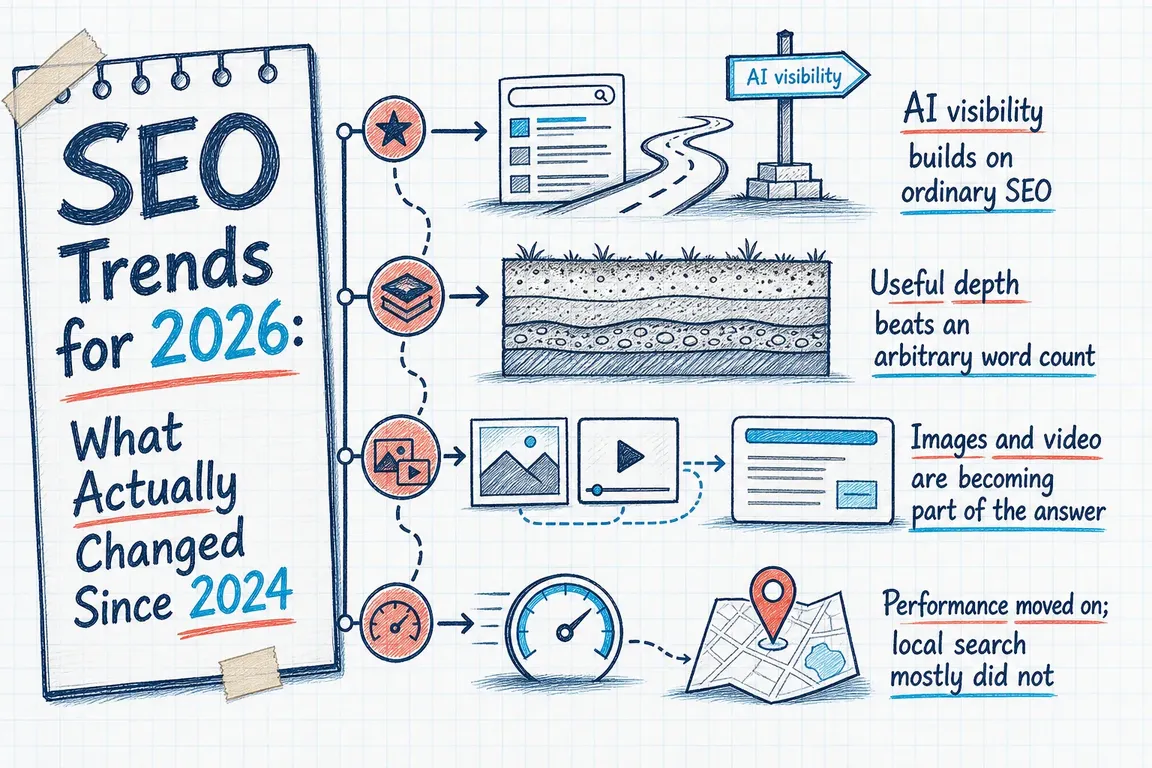
SEO in 2026 is neither dead nor unrecognisable. Search still depends on accessible pages, clear information and a credible reason to choose your business. The significant change is how that information is discovered: conventional results now sit alongside AI-generated answers, conversational follow-ups and visually assisted searches.
That expands the job without invalidating the fundamentals. Business owners do not need a fashionable new workstream for every search feature. They need to identify which changes affect customers, assign ownership and improve the underlying website systematically.
The short version: five priorities deserve attention
| Priority | What changed | Practical response |
|---|---|---|
| AI visibility | Generative answers are an established discovery layer | Publish specific, expert-led information that adds more than a generic summary |
| Measurement | Search Console now reports generative AI visibility separately | Establish a baseline before funding speculative optimisation |
| Page experience | INP replaced FID as the responsiveness Core Web Vital | Fix recurring template and component problems using field data |
| Local search | The fundamentals remain stable | Give somebody operational ownership of the Business Profile |
| Data collection | Consent remains a design requirement, not banner copy | Collect only information tied to a defined purpose and lawful basis |
AI search still starts with ordinary SEO
Google’s current guidance is unusually direct: its generative search features use the existing Search index and ranking systems. A page still needs to be crawlable, indexed and eligible to appear with a snippet. There is no separate technical shortcut that compensates for weak content or an inaccessible site.
The editorial standard has risen, however. A page that merely rearranges widely available information is easy to replace with a generated summary. Stronger pages contribute something identifiable: first-hand operating knowledge, a well-explained process, original analysis, precise product information or a useful comparison grounded in real constraints.
This is where E-E-A-T remains helpful as an editorial check rather than a score to chase. Readers should be able to see who is responsible for the page, why that person is qualified to discuss the subject and how important claims can be checked. Do not add an inflated biography or pad the article to reach an arbitrary word count. Add the evidence and detail a prospective customer needs to make a decision.
Google also explicitly cautions against treating AEO or GEO as a bag of special tricks. Tactics such as unnecessary content “chunking,” manufactured mentions or creating an llms.txt file solely for Google Search should not outrank the basic work: sound architecture, distinct pages, useful content and a good experience after the click.
Measure AI visibility before promising an AI-search strategy
A practical change in 2026 is that Search Console’s generative AI performance reporting has been rolled out worldwide. It can show which pages receive impressions in Google’s generative features, along with countries, devices and dates.
That does not provide a complete picture of every AI product, and an impression is not a sale. It does give teams a defensible starting point. Record the baseline, identify pages already earning visibility and compare those pages with strategically important pages that are absent. Then connect search data with enquiries, subscriptions or other meaningful actions on the site.
For agencies, this is also a reporting discipline: separate what can be observed from what is inferred. Clients need decisions supported by evidence, not confident claims built from screenshots and isolated prompt checks.
Core Web Vitals are operational metrics, not an audit trophy
The current Core Web Vitals are Largest Contentful Paint, Interaction to Next Paint and Cumulative Layout Shift. Google’s “good” thresholds remain LCP within 2.5 seconds, INP below 200 milliseconds and CLS below 0.1.
The useful development since 2024 is that INP is now established as the responsiveness measure. It captures how quickly a page provides visual feedback across user interactions, not merely the first one. Slow menus, filters, consent controls and form components can therefore expose system-wide problems.
Use real-user field data where possible. Group affected pages by template, component and third-party dependency. A shared fix to navigation JavaScript or image handling is usually more valuable than repeatedly polishing individual URLs for a presentation.
Local visibility still depends on somebody doing the upkeep
Google continues to describe local ranking through relevance, distance and how well known a business is. Complete details, correct hours, appropriate categories, current photographs and constructive review responses remain useful.
The recurring failure is operational: nobody owns the profile between marketing campaigns. Assign a named owner and create triggers for changes to hours, services, contact details and locations. An accurate profile helps customers immediately; an outdated one can waste a visit before website SEO has any chance to help.
Privacy belongs in the acquisition workflow
First-party information can improve sales and marketing, but “the customer entered it themselves” does not automatically make every use legitimate. Where consent is the lawful basis under EU data-protection rules, it must be freely given, informed, specific and expressed through a clear affirmative action. Withdrawing it should be as easy as giving it.
Review forms field by field. Record why each item is needed, what lawful basis applies, where it goes and how long it remains useful. This is a better design brief than collecting everything now in case somebody finds a use later.
A workable 90-day SEO plan
- Establish the baseline. Review organic landing pages, conversions, generative AI visibility, Core Web Vitals and Business Profile accuracy.
- Fix access and ownership. Resolve indexing barriers, duplicated pages and unclear responsibility before commissioning more content.
- Improve commercially important pages. Add missing expertise, evidence, comparisons, media and next steps where they help buyers decide.
- Repair shared performance faults. Prioritise templates, components and scripts affecting many visits.
- Review outcomes monthly. Track qualified actions as well as visibility, and document what changed so the team can learn from it.
The real challenge is coordination
Modern SEO crosses content, development, analytics, local operations and privacy. The hard part is rarely finding another recommendation; it is deciding what matters, who owns it and how success will be measured.
If that work is stuck between an agency, an internal team and a backlog, Greg can help turn the evidence into a scoped delivery plan. The goal is a manageable set of improvements with owners and priorities—not another trend document waiting in an inbox. See how a digital project manager can help.
Related on GrN.dk
- Google Review Link Generators: What Small Teams Actually Need
- Search Console Can See Social Posts—Your Reports Need a New Map
- AI Crawler Control for Business Websites: Protect Content Without Losing Search Visibility
Need help with this kind of work?
Plan your SEO priorities with Greg Get in touch with Greg.