- Client
- GrN.dk — demo shelf (demo.grn.dk); built as a working job application
- Sector
- Logistics / TMS configuration
- Period
- September 2026
TMS Configuration Cockpit (demo.grn.dk)
At a glance
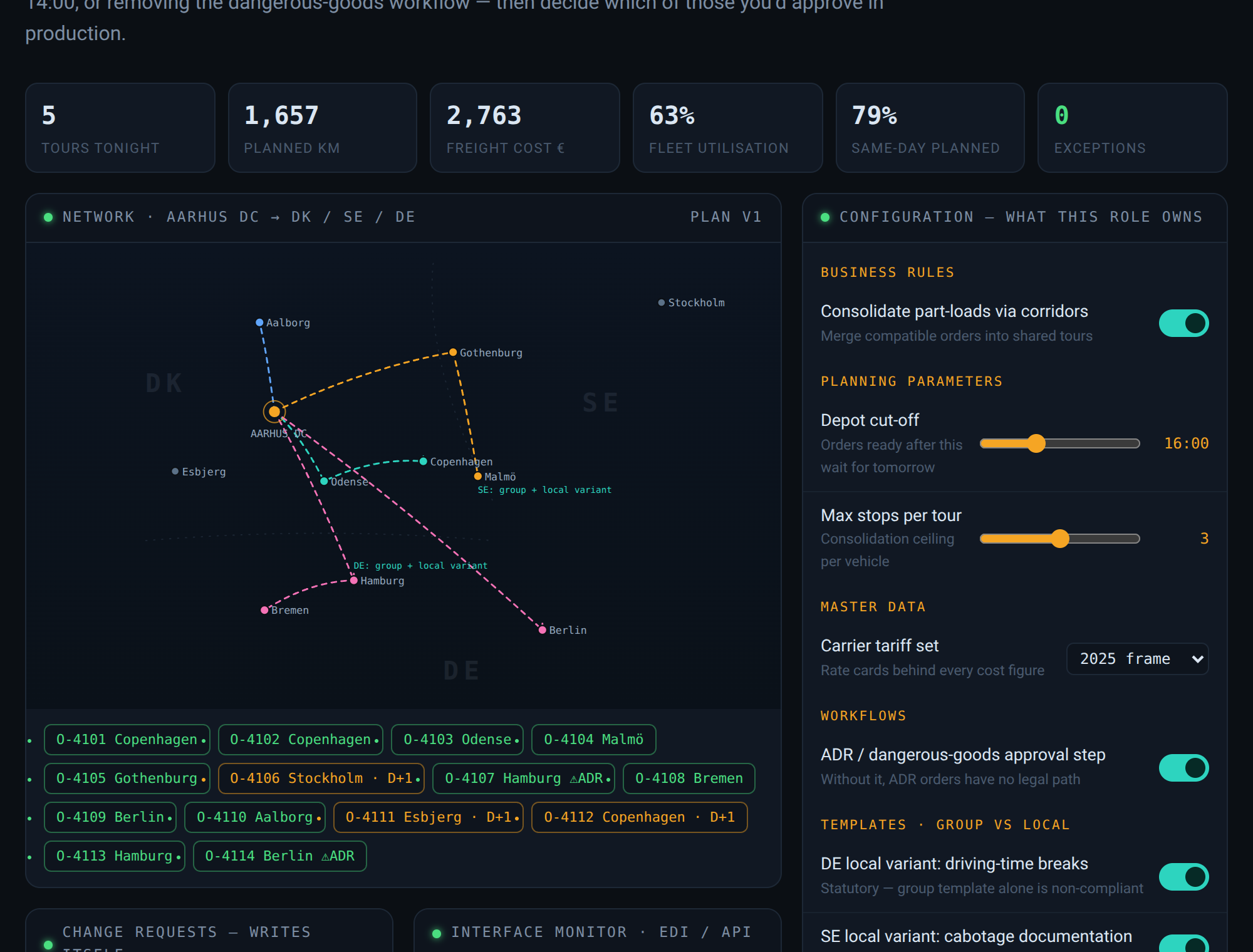
TMS Configuration Cockpit runs a small transport management system in the browser: one distribution centre in Aarhus, three countries, fourteen orders, and a configuration panel holding exactly what a TMS application and configuration manager owns — business rules, planning parameters, carrier tariffs, an ADR dangerous-goods workflow and group-versus-local country templates. Every lever you touch re-plans tonight’s tours live, moves the KPIs, shows up in the EDI interface monitor and writes itself up as a change request. It was built as a working answer to a job posting’s “why you?”.
The challenge
The posting asked for someone to own the configuration of a specific TMS (CarLo, by Soloplan) that the applicant had never used. A CV can claim transferable skills; a recruiter cannot check that claim in the minute a CV gets. The question the demo had to answer was whether the person understands what a configuration manager actually does — the consequences of a cut-off time, the difference between a group template and a statutory local variant, why an ADR step cannot be “simplified away” — well enough to build one and let the reader break it.
The solution
A static page with a planner written for it: fourteen orders out of an Aarhus DC into Denmark, Sweden and Germany, consolidated into tours under a max-stops ceiling and a depot cut-off, costed against a 2025 carrier tariff frame, with per-country local variants layered on the group template (driving-time breaks in Germany, cabotage documentation in Sweden). The right-hand panel exposes those as switches and sliders; flipping one re-runs the planner, redraws the SVG network map and the KPI row, logs the message flow in an EDI/API interface monitor (IFTMIN in, IFTSTA out, master-data sync) and appends a change request with a draft/tested/deployed status. A reset returns to the group-template baseline.
Below the cockpit, the posting’s own responsibilities are mapped to where the reader just met each of them, followed by an honest “do you know CarLo? — not yet” section and a concrete first-30-days plan.
The results
A job application that is itself a running system, on the public shelf, with nothing behind it — no backend, no login, no tracking. It says what the CV could not: that the applicant can reason about a planning configuration well enough to build one, and would rather be judged on that. Whatever comes of the role, the demo stands on its own as a small, honest TMS.
