By Greg Nowak. Updated 26 October 2026.
After a Kubuntu upgrade, blank icons or a missing panel can make a working computer feel unusable. For a business owner or agency team, the immediate concern is getting back to work without losing a carefully arranged desktop.
Start with the smallest repair that fits the symptom. Check the installed version, finish any interrupted package work, then investigate themes and widgets. Resetting the entire panel layout belongs at the end: it can remove useful customisation without fixing the underlying package problem.
Identify what broke before changing anything
Open Konsole and record:
plasmashell --version
lsb_release -ds
apt-cache policy plasma-workspace libqt5quick5 libqt6quick6
If the desktop is unusable, try Ctrl+Alt+F3 to reach a text console and sign in. Package commands work there; graphical restart commands should run inside your desktop session.
Note whether the problem appears before login, after login, or only in one application. Also check whether the panel is missing entirely or simply lacks its Task Manager widget.
| What you see | First check | Least disruptive next step |
|---|---|---|
| Blank icons across the desktop | Selected icon theme and package errors | Try Breeze; repair the relevant package if needed |
| Broken icons only before login | Active SDDM login theme | Investigate that theme separately |
| Panel works, but open applications are absent | Task Manager widget and its filters | Check its settings or add the widget again |
| Panel fails to load or remains corrupted | Shell restart, then user layout configuration | Back up and reset the layout while logged out |
Finish an interrupted upgrade first
If the upgrade stopped or reported errors, run these commands individually and read their output:
sudo dpkg --configure -a
sudo apt update
sudo apt-get --simulate --fix-broken install
The last command previews dependency repairs without applying them, as described in the Ubuntu APT manual. If the proposal is reasonable, apply it:
sudo apt-get --fix-broken installStop if APT proposes removing Plasma, the display manager or many unrelated packages. Repository errors, held packages and incompatible third-party sources need investigation. Repeating repair commands will not resolve every upgrade conflict.
Once dependencies are consistent, reinstall the workspace if its files appear damaged:
sudo apt install --reinstall plasma-workspaceThis restores that package and resolves its declared dependencies; it does not reinstall every dependency automatically. If the Kubuntu desktop metapackage was removed accidentally, sudo apt install kubuntu-desktop can restore its dependencies, but may also bring back applications you removed deliberately.
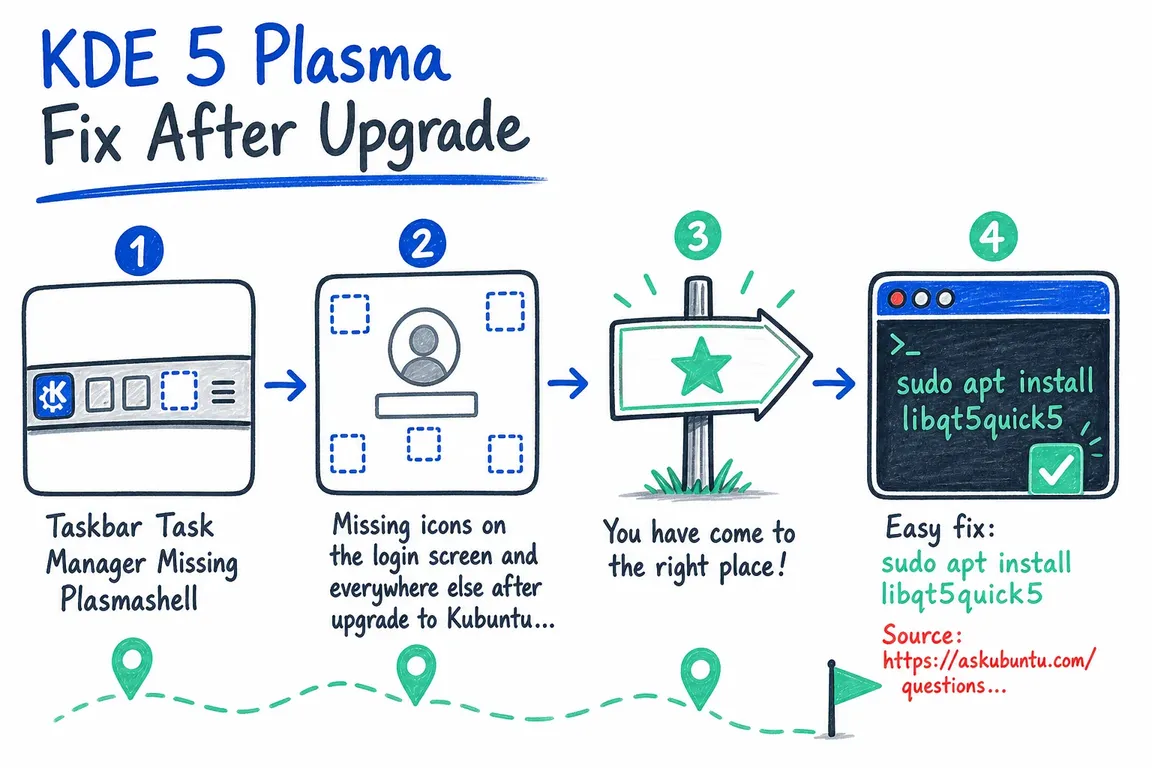
Is libqt5quick5 still the right fix?
Sometimes. Ubuntu identifies libqt5quick5 as the Qt 5 Quick library. On Plasma 5, installing it remains relevant when an error identifies a missing Qt 5 Quick library and APT shows a candidate:
sudo apt install libqt5quick5Missing icons alone do not prove this library is absent. If it is already installed, that command will usually change nothing.
Plasma 6 needs a different diagnosis. Ubuntu’s 26.04 workspace package depends on Qt 6 components, including libqt6quick6. Installing a Qt 5 library will not repair a missing Qt 6 component. Follow the actual error and your release’s package dependencies.
Check icon themes and the login screen separately
In System Settings, search for Icons, choose Breeze and apply it. If that restores the icons, investigate the previous theme before changing anything else. For panel appearance problems, also try the Breeze Plasma Style.
If Breeze appears incomplete, ask the package database which package owns its index:
dpkg -S /usr/share/icons/breeze/index.themeReinstall the package reported by that command. If it finds no owner, check your release’s package file lists rather than guessing a replacement name.
SDDM, the login screen, has separate theme settings. A desktop icon change will not necessarily fix it. If its active theme is Breeze, this targeted repair may help:
sudo apt install --reinstall sddm-theme-breezeFor another theme, investigate its own package instead. Save your work and reboot after login-screen repairs.
Restart Plasma and repair individual widgets
Before resetting anything, press Alt+Space inside the graphical session and run:
plasmashell --replaceThis is the shell restart method shown in KDE’s Plasma Style documentation. The panel may disappear briefly.
If only Task Manager is missing, enter Edit Mode and add Task Manager or Icons-only Task Manager. If it exists but shows no windows, check its desktop, activity and screen filters. For a completely absent panel, try adding a Default Panel before resetting the configuration.
Reset the layout only while Plasma is stopped
The file plasma-org.kde.plasma.desktop-appletsrc contains panel and widget configuration. KDE documents that widget settings are written when Plasma exits, so moving the file while Plasma is running can be undone at logout.
Save your work, log out of the graphical session, then switch to a text console and sign in as the affected user. Check:
pgrep -u "$(id -u)" -x plasmashellProceed only if it returns no process IDs. Then back up and move the configuration without sudo:
plasma_config="${XDG_CONFIG_HOME:-$HOME/.config}/plasma-org.kde.plasma.desktop-appletsrc"
plasma_stamp=$(date +%F-%H%M%S)
cp -a -- "$plasma_config" "$plasma_config.backup-$plasma_stamp" &&
  mv -- "$plasma_config" "$plasma_config.disabled-$plasma_stamp"
If copying fails, stop and inspect the error. Sign back into Plasma to create a fresh layout. Expect to rebuild panels and widgets; documents remain untouched. To restore the old layout, log out again and copy the timestamped backup over the original filename.
Make the recovery useful beyond this workstation
After repair, check application launching, window switching, external displays and persistence after another login. Record the versions, error messages and successful change before upgrading another team member’s machine.
If recovery is consuming staff time or delaying delivery, get in touch with Greg to discuss troubleshooting, coordination with your IT team and a practical maintenance plan.
Related on GrN.dk
- Check version of pip installed python package CSVkit
- glxgears Without VSync: What the FPS Can Tell You
- Keyboard Mapping in Kubuntu 20.04: Fix Missing Symbols and Broken Keys
Need help with this kind of work?
Discuss your Linux recovery plan with Greg Get in touch with Greg.