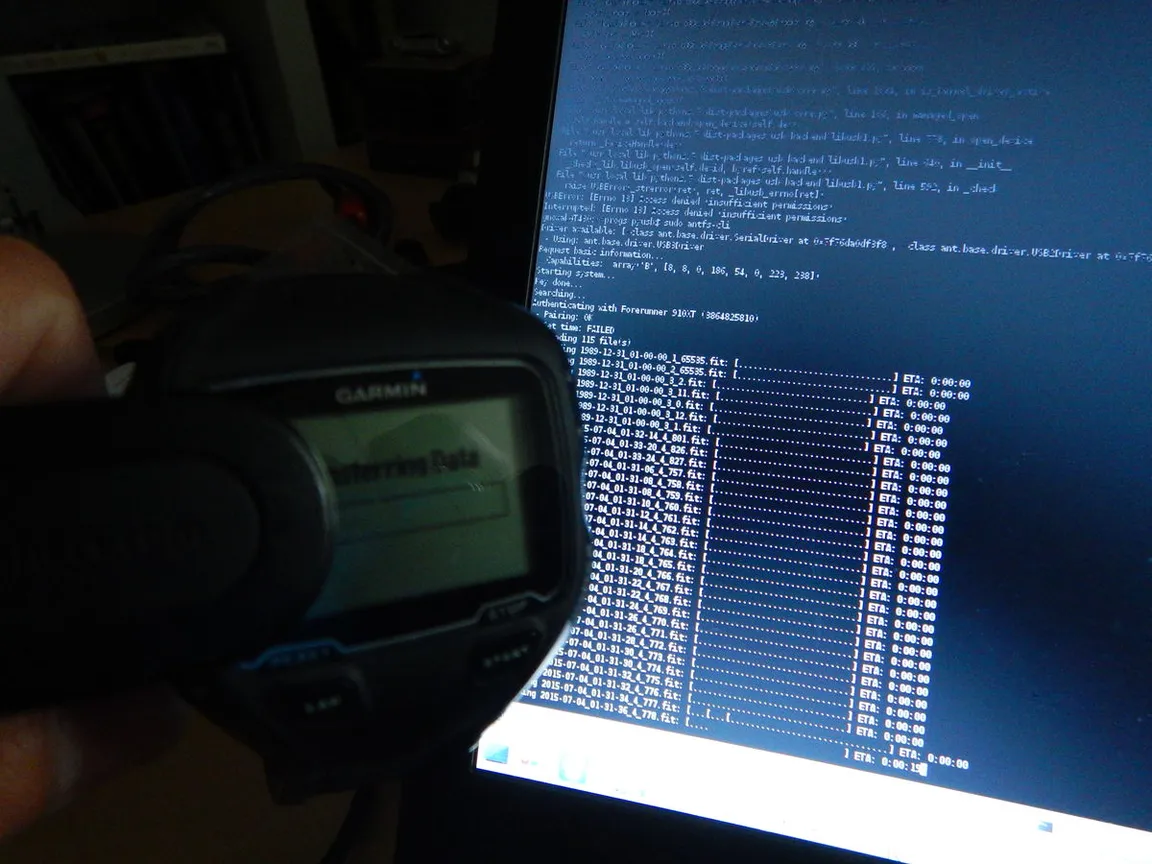
Holy molly. I thought Garmin would provide a fancy and "updatede" procedure for uploading and/or extracting data from the fancy Garmin 910XT... but no. You need to search for a while before you find the gold. First I thought you could find a garmin connect tool or plugin for Firefox, but that failed completely. Then I narrowed down my search to "forerunner 910xt linux" (without the quotation marks in google). I found some sites that suggested to download a lot of python stuff and get things directly from Git. I stumbled around and installed a bunch of things and ended up reading the README files from the Git installations.
I would suggest you do something like this:
sudo aptitude install python-pip
sudo pip install --pre pyusb
git clone git://github.com/Tigge/Garmin-Forerunner-610-Extractor.git
(Or use this git: https://github.com/Tigge/antfs-cli have not tried it)
Some people argue to run the Garmin Extractor (garmin.py) from within the Extractor folder with the following command: sudo env PYTHONPATH=/home/username/pyusb ./garmin.py
garmin.py does not exist in my git clone folder. The thing I did was to use the "sudo python setup.py install" which installs the command line interface (CLI) for ant in your bin directory: antfs-cli
Afterwards you just run the sudo antfs-cli from your command line, accept pairing on your device, and the extraction (download) starts. I recommend to read the README file, and maybe try out the --upload parameter - maybe it will allow direct upload to Garmin Connect? Who knows? :-) I know.. it will not. The upload feature seems to be used for uploading activites from your computer to the Garmin Device.
The downloaded files can be found in the ~/.config/antfs-cli/3864825810/activities folder.
Ressources
Tips for uploading to Strava: https://ironvet.wordpress.com/2014/05/28/how-to-automate-a-garmin-910xt…