- Client
- GrN.dk — demo shelf (demo.grn.dk)
- Sector
- 3D on the web / product configurators
- Period
- August 2026
At a glance
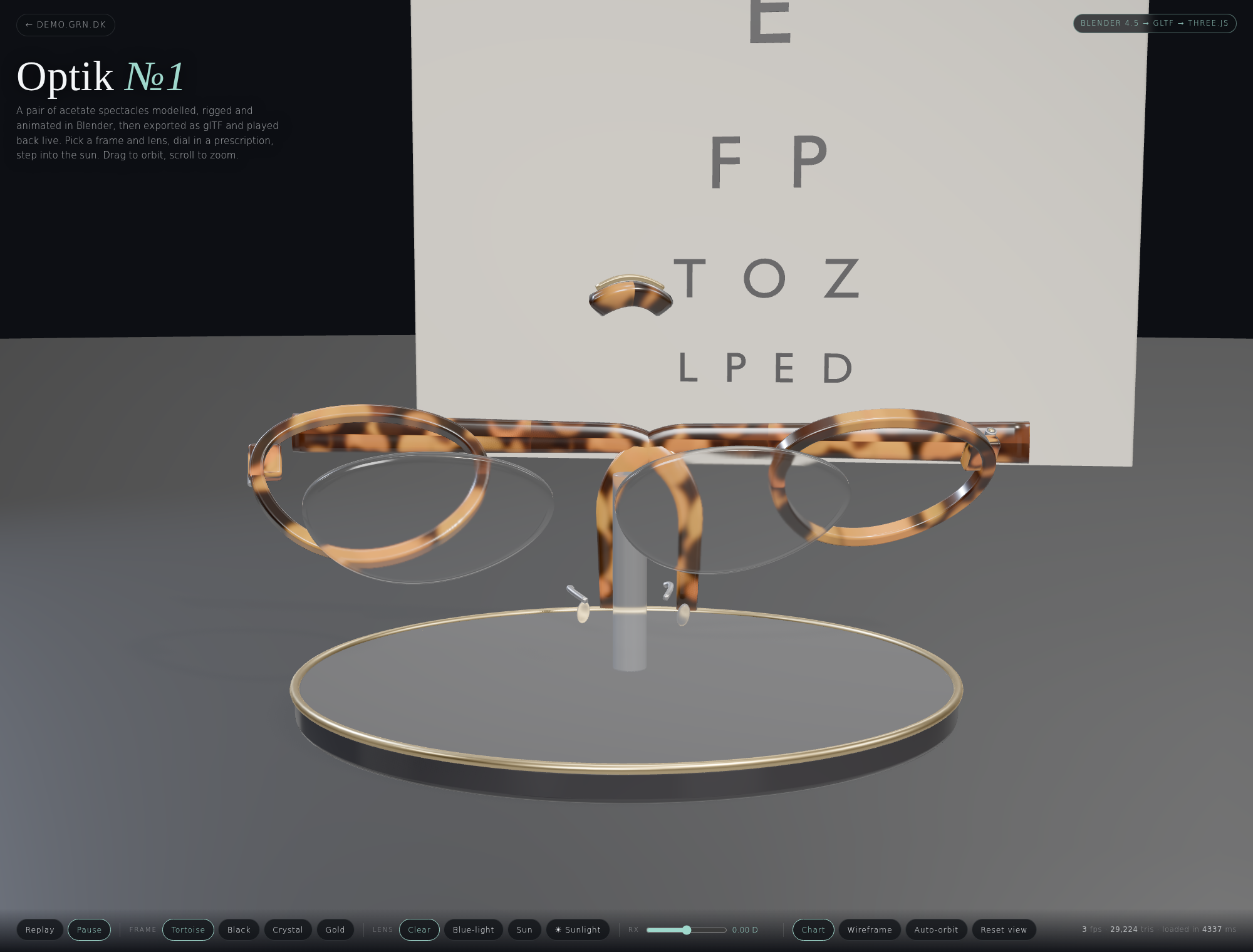
Optik №1 is a pair of acetate spectacles built end-to-end in Blender 4.5 — modelled, textured, rigged and animated — then exported as glTF and played back live with three.js. In the browser you pick a frame finish and a lens, dial in a prescription on lenses with real refraction, and step into sunlight to watch photochromic glass darken. A Cycles-rendered film and the source files ship alongside the live scene.
The challenge
Product configurators usually cheat: a colour swap is a texture swap, and “lens options” are tints painted onto flat geometry. Spectacles are an unforgiving subject for that trick — customers know what tortoiseshell acetate and a strong prescription actually look like, and a lens without refraction reads as a prop. The demo asks whether one asset pipeline can carry a product from a DCC tool to a browser scene without losing the material truth on the way.
The solution
Everything hard lives in Blender: the frame is modelled and textured there (tortoise, black, crystal and gold finishes), the hinges are rigged, and the presentation animation is keyed — then the whole thing exports as glTF, about 29,000 triangles, and three.js plays it back without re-authoring. The browser layer adds what only a live scene can: an orbit camera, wireframe and chart views for the technically curious, and an auto-orbit for a shop-window idle mode.
The lenses are the honest part: the prescription dial changes real refractive geometry, so the eye chart behind the glasses bends the way it would through actual lenses, and the sun toggle drives a photochromic transition rather than a crossfade.
The results
The piece runs as static files on the demo shelf, from a Blender scene to a configurable browser object with no engine download. Because the film, the live scene and the source files come from the same asset, it doubles as a pipeline argument: build once in Blender, present everywhere.
For a client it answers the configurator question the way the crystal hall answered the 3D question — not “could we”, but “here is one, wearing your product category”.
