By Greg Nowak. Updated September 27, 2026.
Google Search is moving beyond helping people find local businesses. It can also help them act: gathering prices and availability, linking to booking providers and, for supported categories, calling businesses on a customer’s behalf.
Google announced an expansion of these capabilities for selected US categories including home repair, beauty and pet care in May 2026. Its current Business Profile documentation also describes automated calls for appointments, restaurant wait times, operating hours, inventory, prices and service availability. Availability varies by market and category, but the operational lesson is already clear: the information around your listing now influences more than whether somebody clicks.
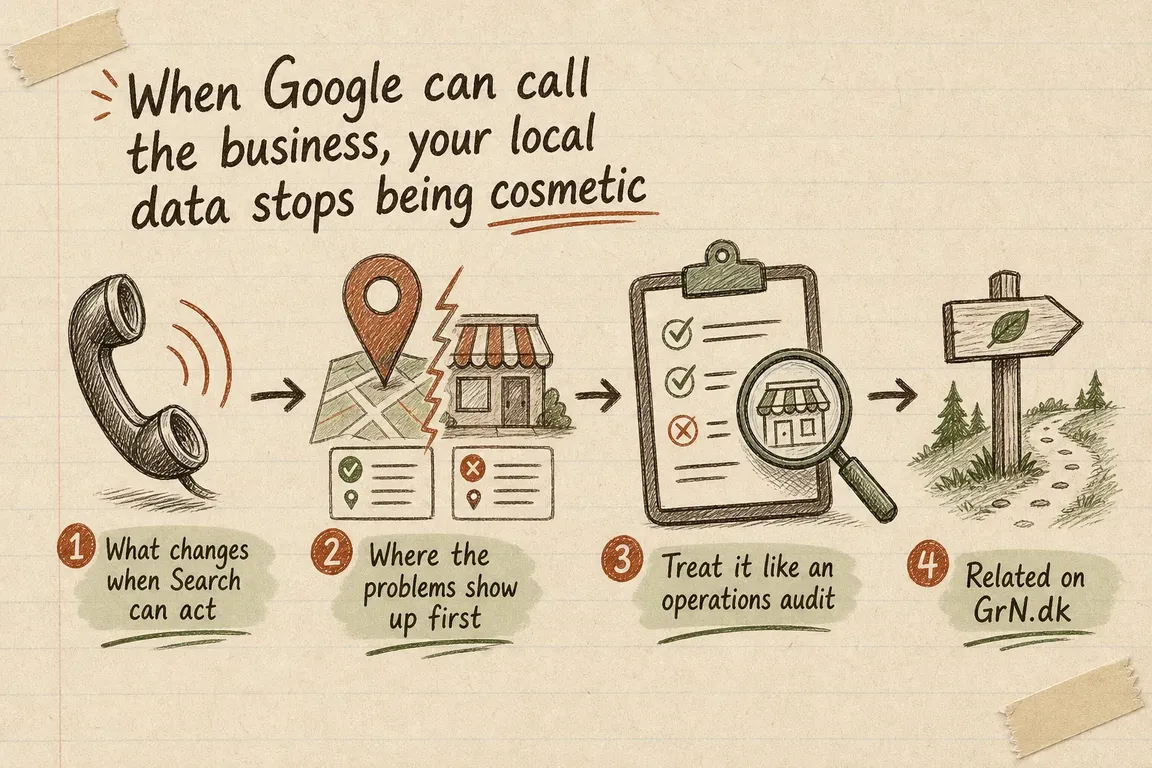
If your hours are wrong, your service area is vague or your phone tree cannot handle the request, a promising search can become a failed handoff. Local data is no longer cosmetic website maintenance. It belongs in the same conversation as lead routing, staffing and customer service.
The important distinction: visibility versus readiness
Google still describes local ranking mainly in terms of relevance, distance and prominence. Complete information, appropriate categories, reviews and links can help Google understand and present a business. There is no documented new ranking bonus for being ready to receive an automated call.
Readiness matters for a different reason. Once Google has surfaced the business, can the customer complete the next step? That is an operational question rather than an SEO trick. A listing can rank adequately and still waste demand through an unanswered number, an inaccurate holiday schedule or a location page that describes services the branch does not provide.
| Handoff point | Failure to look for | Practical test | Likely owner |
|---|---|---|---|
| Hours | Regular, seasonal or holiday hours do not match staffing. | Compare the profile with rotas and upcoming closures. | Location manager |
| Address and service area | Customers are sent outside the real coverage area or to a non-customer-facing address. | Check storefront, hybrid and hidden-address settings. | Operations |
| Phone routing | The line is unanswered, loops through a menu or reaches the wrong team. | Call during and outside opening hours from a new number. | Sales or customer service |
| Services and categories | The profile promises something the location cannot quote or deliver. | Compare profile fields with the actual service catalogue. | Commercial lead |
| Landing page | The page is generic, contradictory or missing the next action. | Follow the profile link on mobile and attempt an enquiry. | Marketing or agency |
Run the audit from the customer backwards
Start with the requested outcome. Pick three common enquiries, such as requesting a repair estimate, checking whether a treatment is available or arranging an appointment. For each one, follow the path from Search to a useful answer. Do not stop when the phone rings or the form submits; confirm where the request arrives and who is expected to respond.
Test every public number. Google’s guidelines say the number should connect to the individual location, remain under the business’s direct control and, where possible, be local rather than a central call-centre line. A central number is not automatically unusable, but it needs a short, reliable route to someone who can answer location-specific questions. Test transfers, voicemail, caller-ID handling and any call-tracking numbers as part of the same journey.
Reconcile location rules with reality. A service-area business that does not receive customers at its base should remove its address from the public profile. Google currently permits up to 20 named service areas and advises that the overall boundary generally remain within roughly two hours’ driving time of the base. Those settings should reflect dispatch capacity, not an aspirational sales territory.
Check services, categories and pages together. Use the fewest categories needed to describe the core business accurately. Then compare them with the services listed on the profile and the destination page. If one location offers emergency work but another does not, a generic national page leaves both Google and the customer to guess. A useful local page should identify the location or coverage area, explain the available service and offer the appropriate next step.
Review exceptional hours before they become urgent. Regular hours are not enough. Add holidays, temporary closures and genuine seasonal changes while there is still time for staff and systems to agree. For multi-location businesses, give branch managers a simple process for reporting exceptions instead of expecting the marketing team to discover them.
Decide deliberately whether to accept automated calls
Google lets verified businesses manage automated calls and texts in their Business Profile’s advanced settings. Controls cover customer bookings and enquiries, requests intended to keep profile information current, and permission for Google to post supplied updates. Businesses can opt out, although manual verification calls may still occur.
That choice should involve operations, not just whoever holds the Google login. Accepting the calls makes sense only if frontline staff understand what they are, can answer consistently and know which information they may share. Google says legitimate automated calls identify themselves, may be recorded or monitored, and do not request payment, card details or account passwords. Include that distinction in staff guidance so scam awareness does not turn into rejecting every legitimate enquiry.
Opting out can be reasonable while routing or training is being repaired. It does not fix inaccurate hours, unsuitable categories or a poor landing page, all of which still affect ordinary customers.
Give local data an owner and a review rhythm
The durable fix is governance. Assign one accountable owner for each location, record who may edit shared fields and schedule checks around predictable change: public holidays, staffing changes, new services, relocations and campaign launches. Agencies should document approvals and escalation paths rather than quietly becoming the permanent source of truth for operational information.
Track a small set of useful outcomes: answered calls, correctly routed enquiries, response time and bookings or qualified leads by location. Profile views alone cannot tell you whether the handoff worked.
Need a second pair of eyes?
Greg can review your Business Profiles, local pages, service-area setup and lead-routing journey as one operating system. If several teams or locations are involved, a focused audit can identify ownership gaps and failed handoffs before you invest in more traffic.
Related on GrN.dk
- Google Review Link Generators: What Small Teams Actually Need
- Google’s 2026 AI Search Guidance: SEO Still Matters, but Reporting Has Changed
- JavaScript-Heavy Service Pages Still Lose Leads: What to Audit in 2026
Need help with this kind of work?
Talk to Greg about a local search audit Get in touch with Greg.