- Client
- GrN.dk — demo shelf (demo.grn.dk)
- Sector
- ERP / open-source business systems
- Period
- September 2026
At a glance
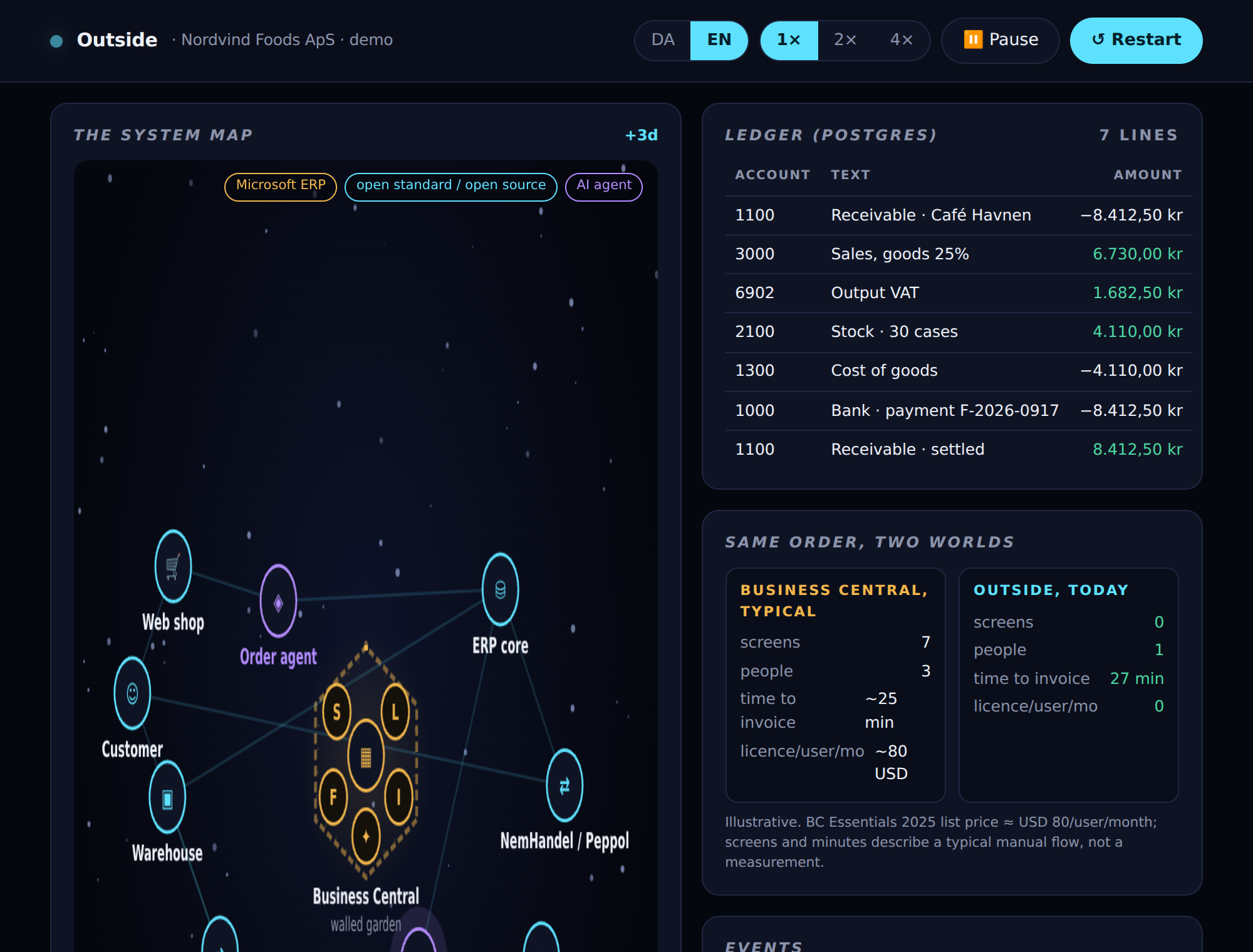
Udenfor (“Outside”) follows one order through one day at Nordvind Foods, a fictional Aarhus wholesaler with 14 staff and a web shop — on an open stack instead of Business Central. It plays in three acts: the camera zooms out of the Microsoft walled garden onto a live system map where an order agent, an open-source ERP core on Postgres, the warehouse scanner, GLS, NemHandel/Peppol e-invoicing, a PSD2 bank feed and the tax export light up in turn while the ledger posts itself; then you ask the books a question in plain Danish and watch the SQL and the answer appear; then you change a business rule in one sentence and see it tested and deployed in seconds, next to the 26-day partner change-request timeline it replaces.
The challenge
The brief was two lines: a “mindblowing visual demo that shows there is a world outside Microsoft ERP”, aimed at a Nordic Microsoft partner. The obvious trap is a feature comparison, which a Dynamics consultant has seen a hundred times and can argue with. The harder ask was to show a working day rather than a slide — an order that actually moves, a ledger that actually posts, a rule that actually changes — with no backend, in Danish and English, in a browser tab.
It also had to stay fair. Business Central is not the villain; the fence around it is. So the demo runs the same order in both worlds side by side (screens, people, minutes to invoice, licence per user), marks the price figures as illustrative, and draws the Microsoft modules as what they are: a good system with a wall around it.
The solution
A single HTML file with a canvas system map and no framework. Act 1 draws the walled garden as a hexagon of Business Central modules, pulls the camera back onto the open map and flies the order from node to node as a comet — web shop, order agent, ERP core, warehouse, carrier, e-invoice, bank, finance agent, SAF-T export — while the Postgres ledger fills in on the right and an event feed narrates each hop. Act 2 is a chat over the same books: three preset questions in plain Danish, the SQL shown before the answer, bars drawn from the result. Act 3 types out a rule (“2% discount if paid within 8 days, not for public-sector customers”) as YAML, replays it against 90 days of data and deploys version 15 with a rollback button, while a timeline alongside walks the same change through a partner: day 0 request, day 4 estimate, day 26 in production.
Everything is mocked in the browser. A facts strip at the bottom names what is real — the Danish bookkeeping act and SAF-T, Peppol, ERPNext and Odoo Community as open ERP cores, MCP/REST agents, PSD2 — and what an open stack means for a Microsoft partner.
The results
Live on the demo shelf the same day as the card, in Danish and English (?lang=en), with each act deep-linkable (?act=0|1|2) so a mail can point straight at the rule change. Verified end to end with headless Chrome on the server, including the phone width where the outer nodes of the map first clipped and had to be scaled to fit.
The pitch it makes is deliberately not “leave Microsoft” but “we build on both sides of the wall”: the team that writes a Business Central extension can also put an agent, an open ledger and Danish e-invoicing next to it — and this is what that day looks like.
