- Client
- GrN.dk — demo shelf (demo.grn.dk)
- Sector
- Accounting automation / UK practices
- Period
- September 2026
At a glance
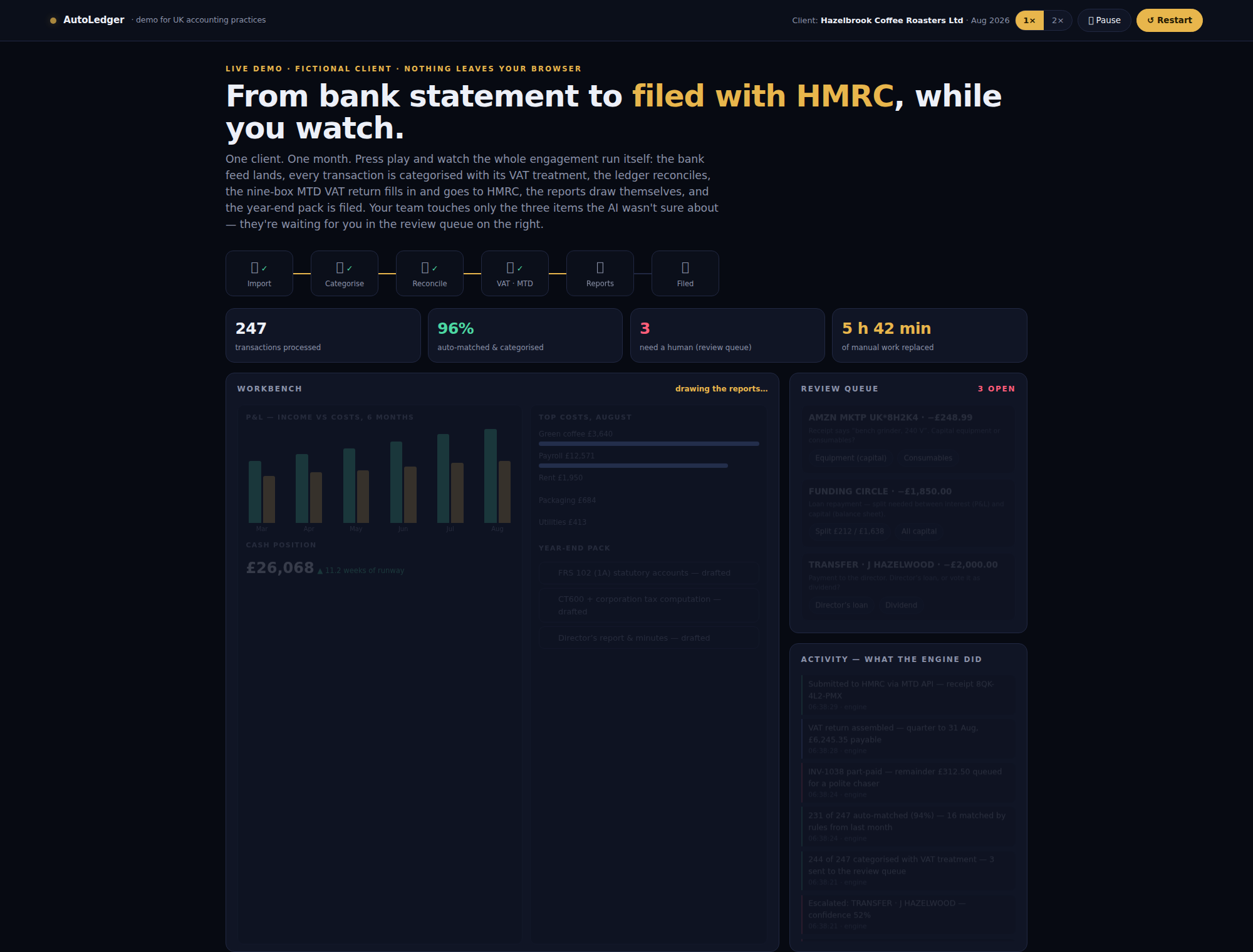
AutoLedger is a guided walkthrough for UK accounting practices: one fictional client (Hazelbrook Coffee Roasters Ltd), one month, and a play button. The bank feed lands, every transaction is categorised with its VAT treatment, the ledger reconciles, the nine-box MTD VAT return fills itself in and goes to HMRC, and the reports draw themselves — while an activity log narrates what the engine is doing and why. Nothing leaves the browser; the client, the bank and the filing are all simulated.
The challenge
Accounting automation is sold in abstractions — “AI categorisation”, “MTD-ready” — that a practice partner cannot evaluate without sitting through a vendor demo. The interesting questions are concrete: what exactly gets matched automatically, what happens to the transactions the machine is not sure about, and where does the human sit in the loop? A walkthrough has to answer those honestly, at the pace of a coffee break, without asking anyone to upload real client data.
The solution
A scripted month that runs like a film but is built like software. 247 bank transactions stream in and 96% are auto-matched and categorised, each with a per-line VAT treatment; the rest escalate to a review queue on the right, where each item shows the engine’s confidence and the actual question it wants a human to answer (equipment or consumables? director’s loan or dividend?). The MTD VAT return assembles box by box, is “filed to HMRC” with a receipt, and a year-end pack — FRS 102 accounts, CT600 computation, director’s report — drafts itself underneath.
The whole piece is a static page: play/pause, 1× and 2× speed, restart, and an activity feed that doubles as an audit trail of every decision the engine took.
The results
The finale is a scoreboard: 9 h 24 min of manual bookkeeping for the month replayed as 26 minutes of review — the three escalated items and a sanity check, with everything else already done. The number lands because the viewer has just watched every step it summarises.
As a sales artefact for practices it does what a feature list cannot: it shows where the human stays in the loop, which is precisely the question practitioners ask first.
